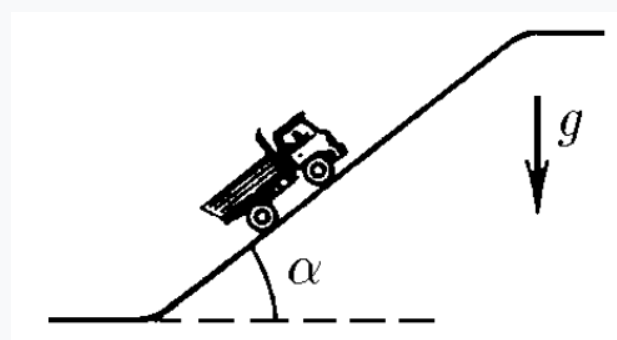
2.3.12. A car with a running engine drives onto an icy hill, the surface of which forms an angle $\alpha$ with the horizontal. What height of the hill can the car overcome if its initial velocity when entering it is $v$, and the coefficient of friction of the wheels on the ice is $\mu < \tan\alpha$?
For problem $2.3.12$
Solution
While going up the hill, the car slows down. To reach the maximum possible height, the engine must pull the car forward with the maximum possible traction force. On an icy slope, this maximum traction force is limited by the maximum static friction force (which transitions into sliding friction): $$F_{\text{fr}} = \mu N$$
Let's write Newton's second law in projections onto the coordinate axes ($OY$ perpendicular to the slope, $OX$ parallel to the slope downwards): $$OY: N - mg \cos\alpha = 0 \implies N = mg \cos\alpha$$ $$OX: mg \sin\alpha - F_{\text{fr}} = ma_x$$
Substitute the friction force $F_{\text{fr}} = \mu mg \cos\alpha$ into the $OX$ equation to find the acceleration (which is directed down the slope, slowing the car): $$ma_x = mg \sin\alpha - \mu mg \cos\alpha \implies a_x = g(\sin\alpha - \mu \cos\alpha)$$
Using the kinematic equation for a displacement $S$ with initial velocity $v$ and final velocity $v' = 0$: $$S = \frac{v^2}{2a_x} = \frac{v^2}{2g(\sin\alpha - \mu \cos\alpha)}$$
The vertical height $h$ the car reaches is related to the displacement $S$ by $h = S \sin\alpha$: $$h = \frac{v^2 \sin\alpha}{2g(\sin\alpha - \mu \cos\alpha)}$$
Divide the numerator and the denominator by $\sin\alpha$: $$h = \frac{v^2}{2g(1 - \mu \cot\alpha)}$$