Правка разделов «Statement», «Solution», «Answer»

en/2.1.58.md
+4 −10
| @@ -1,15 +1,13 @@ | |||
| ### Statement | |||
| − | $2.1.58.$ [Insert the problem statement] | ||
| − | |||
| − | ### Solution | ||
| − | |||
| − | ### Statement | ||
| − | |||
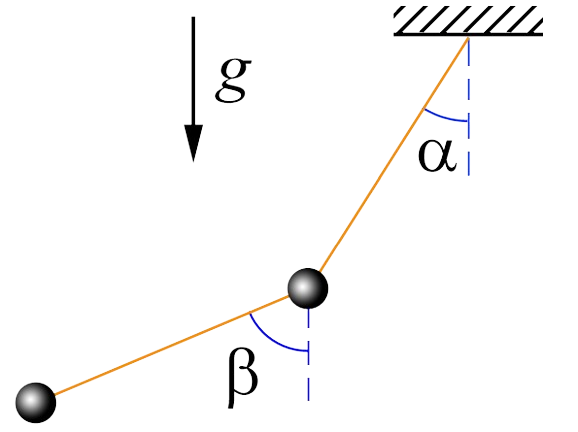
| $2.1.58.$ A heavy ball suspended on a thread of length $l$ has a second heavy ball suspended from it on a thread of the same length. When the balls rotate about a vertical axis passing through the top suspension point, both threads lie in the same plane and make constant angles $\alpha$ and $\beta$ with the vertical. Find the angular velocity of rotation of the balls. | |||
| + |  | ||
| + | |||
| ### Solution | |||
| + |  | ||
| + | |||
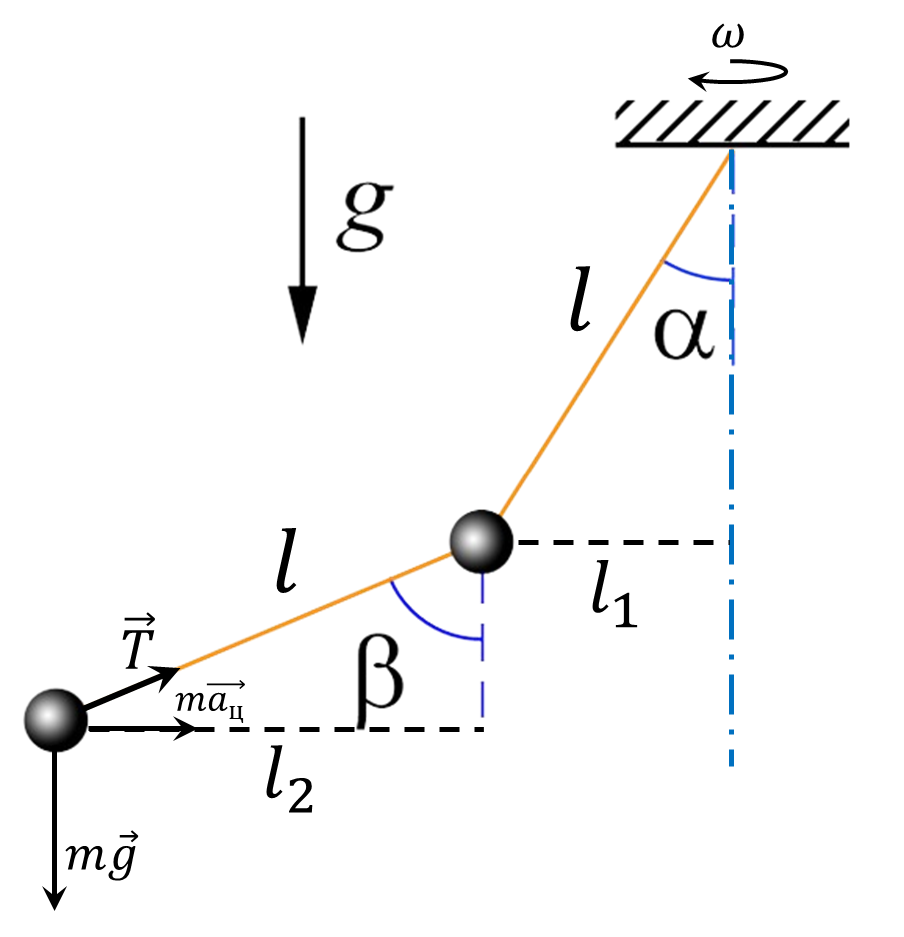
| Projecting the tension force $T$ for the lower ball, we write Newton's second law on the vertical and horizontal axes: | |||
| $$T \sin\beta = m a_{\text{cp}}$$ | |||
| $$mg - T \cos\beta = 0$$ | |||
| From this: | |||
| $$mg \tan\beta = m a_{\text{cp}} \quad (1)$$ | |||
| Let's find the centripetal acceleration through the angular velocity of rotation $\omega$: | |||
| $$a_{\text{cp}} = \omega^2 r = \omega^2(l_1 + l_2)$$ | |||
| $$a_{\text{cp}} = \omega^2 l(\sin\alpha + \sin\beta)$$ | |||
| Substitute this into (1): | |||
| $$g \tan\beta = \omega^2 l(\sin\alpha + \sin\beta)$$ | |||
| From which we find $\omega$: | |||
| $$\omega = \sqrt{\frac{g \tan\beta}{l(\sin\beta + \sin\alpha)}}$$ | |||
| @@ -29,7 +27,3 @@Solution | |||
| #### Answer | |||
| $$\omega = \sqrt{\frac{g \tan\beta}{l(\sin\beta + \sin\alpha)}}$$ | |||
| − | |||
| − | #### Answer | ||
| − | |||
| − | [Insert a concise answer or boxed result] | ||
| @@ -1,15 +1,13 @@ | |||
| ### Statement | ### Statement | ||
| $2.1.58.$ [Insert the problem statement] | |||
| ### Solution | |||
| ### Statement | |||
| $2.1.58.$ A heavy ball suspended on a thread of length $l$ has a second heavy ball suspended from it on a thread of the same length. When the balls rotate about a vertical axis passing through the top suspension point, both threads lie in the same plane and make constant angles $\alpha$ and $\beta$ with the vertical. Find the angular velocity of rotation of the balls. | $2.1.58.$ A heavy ball suspended on a thread of length $l$ has a second heavy ball suspended from it on a thread of the same length. When the balls rotate about a vertical axis passing through the top suspension point, both threads lie in the same plane and make constant angles $\alpha$ and $\beta$ with the vertical. Find the angular velocity of rotation of the balls. | ||
|  | |||
| ### Solution | ### Solution | ||
|  | |||
| Projecting the tension force $T$ for the lower ball, we write Newton's second law on the vertical and horizontal axes: | Projecting the tension force $T$ for the lower ball, we write Newton's second law on the vertical and horizontal axes: | ||
| $$T \sin\beta = m a_{\text{cp}}$$ | $$T \sin\beta = m a_{\text{cp}}$$ | ||
| $$mg - T \cos\beta = 0$$ | $$mg - T \cos\beta = 0$$ | ||
| From this: | From this: | ||
| $$mg \tan\beta = m a_{\text{cp}} \quad (1)$$ | $$mg \tan\beta = m a_{\text{cp}} \quad (1)$$ | ||
| Let's find the centripetal acceleration through the angular velocity of rotation $\omega$: | Let's find the centripetal acceleration through the angular velocity of rotation $\omega$: | ||
| $$a_{\text{cp}} = \omega^2 r = \omega^2(l_1 + l_2)$$ | $$a_{\text{cp}} = \omega^2 r = \omega^2(l_1 + l_2)$$ | ||
| $$a_{\text{cp}} = \omega^2 l(\sin\alpha + \sin\beta)$$ | $$a_{\text{cp}} = \omega^2 l(\sin\alpha + \sin\beta)$$ | ||
| Substitute this into (1): | Substitute this into (1): | ||
| $$g \tan\beta = \omega^2 l(\sin\alpha + \sin\beta)$$ | $$g \tan\beta = \omega^2 l(\sin\alpha + \sin\beta)$$ | ||
| From which we find $\omega$: | From which we find $\omega$: | ||
| $$\omega = \sqrt{\frac{g \tan\beta}{l(\sin\beta + \sin\alpha)}}$$ | $$\omega = \sqrt{\frac{g \tan\beta}{l(\sin\beta + \sin\alpha)}}$$ | ||
| @@ -29,7 +27,3 @@Solution | |||
| #### Answer | #### Answer | ||
| $$\omega = \sqrt{\frac{g \tan\beta}{l(\sin\beta + \sin\alpha)}}$$ | $$\omega = \sqrt{\frac{g \tan\beta}{l(\sin\beta + \sin\alpha)}}$$ | ||
| #### Answer | |||
| [Insert a concise answer or boxed result] | |||