Правка разделов «Statement», «Answer»

en/2.1.62.md
+2 −10
| @@ -1,13 +1,9 @@ | |||
| ### Statement | |||
| − | $2.1.62.$ [Insert the problem statement] | ||
| − | |||
| − | ### Solution | ||
| − | |||
| − | ### Statement | ||
| − | |||
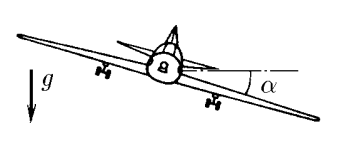
| $2.1.62^\ast$. An airplane makes a turn, moving in a horizontal circle of radius $R$ with a constant speed $v$. What angle does the plane of the wings make with the horizontal? | |||
| + |  | ||
| + | |||
| ### Solution | |||
| When an airplane executes a coordinated turn in a horizontal circle, the aerodynamic lift force $F_{\text{lift}}$, which acts perpendicular to the plane of the wings, must provide both the vertical force to balance gravity and the horizontal centripetal force to maintain circular motion. | |||
| Let $\alpha$ be the angle the wings make with the horizontal. This means the lift force is tilted by an angle $\alpha$ from the vertical. | |||
| We can write Newton's second law for the vertical and horizontal (radial) axes: | |||
| Vertical axis (equilibrium): | |||
| $$F_{\text{lift}} \cos\alpha = mg \quad (1)$$ | |||
| Horizontal axis (centripetal acceleration): | |||
| $$F_{\text{lift}} \sin\alpha = m a_c = m \frac{v^2}{R} \quad (2)$$ | |||
| Divide equation (2) by equation (1): | |||
| $$\frac{F_{\text{lift}} \sin\alpha}{F_{\text{lift}} \cos\alpha} = \frac{m v^2 / R}{mg}$$ | |||
| $$\tan\alpha = \frac{v^2}{gR}$$ | |||
| From this, we find the required angle $\alpha$: | |||
| $$\alpha = \arctan\left( \frac{v^2}{gR} \right)$$ | |||
| @@ -29,7 +25,3 @@Solution | |||
| #### Answer | |||
| $$\alpha = \arctan\left( \frac{v^2}{gR} \right)$$ | |||
| − | |||
| − | #### Answer | ||
| − | |||
| − | [Insert a concise answer or boxed result] | ||
| @@ -1,13 +1,9 @@ | |||
| ### Statement | ### Statement | ||
| $2.1.62.$ [Insert the problem statement] | |||
| ### Solution | |||
| ### Statement | |||
| $2.1.62^\ast$. An airplane makes a turn, moving in a horizontal circle of radius $R$ with a constant speed $v$. What angle does the plane of the wings make with the horizontal? | $2.1.62^\ast$. An airplane makes a turn, moving in a horizontal circle of radius $R$ with a constant speed $v$. What angle does the plane of the wings make with the horizontal? | ||
|  | |||
| ### Solution | ### Solution | ||
| When an airplane executes a coordinated turn in a horizontal circle, the aerodynamic lift force $F_{\text{lift}}$, which acts perpendicular to the plane of the wings, must provide both the vertical force to balance gravity and the horizontal centripetal force to maintain circular motion. | When an airplane executes a coordinated turn in a horizontal circle, the aerodynamic lift force $F_{\text{lift}}$, which acts perpendicular to the plane of the wings, must provide both the vertical force to balance gravity and the horizontal centripetal force to maintain circular motion. | ||
| Let $\alpha$ be the angle the wings make with the horizontal. This means the lift force is tilted by an angle $\alpha$ from the vertical. | Let $\alpha$ be the angle the wings make with the horizontal. This means the lift force is tilted by an angle $\alpha$ from the vertical. | ||
| We can write Newton's second law for the vertical and horizontal (radial) axes: | We can write Newton's second law for the vertical and horizontal (radial) axes: | ||
| Vertical axis (equilibrium): | Vertical axis (equilibrium): | ||
| $$F_{\text{lift}} \cos\alpha = mg \quad (1)$$ | $$F_{\text{lift}} \cos\alpha = mg \quad (1)$$ | ||
| Horizontal axis (centripetal acceleration): | Horizontal axis (centripetal acceleration): | ||
| $$F_{\text{lift}} \sin\alpha = m a_c = m \frac{v^2}{R} \quad (2)$$ | $$F_{\text{lift}} \sin\alpha = m a_c = m \frac{v^2}{R} \quad (2)$$ | ||
| Divide equation (2) by equation (1): | Divide equation (2) by equation (1): | ||
| $$\frac{F_{\text{lift}} \sin\alpha}{F_{\text{lift}} \cos\alpha} = \frac{m v^2 / R}{mg}$$ | $$\frac{F_{\text{lift}} \sin\alpha}{F_{\text{lift}} \cos\alpha} = \frac{m v^2 / R}{mg}$$ | ||
| $$\tan\alpha = \frac{v^2}{gR}$$ | $$\tan\alpha = \frac{v^2}{gR}$$ | ||
| From this, we find the required angle $\alpha$: | From this, we find the required angle $\alpha$: | ||
| $$\alpha = \arctan\left( \frac{v^2}{gR} \right)$$ | $$\alpha = \arctan\left( \frac{v^2}{gR} \right)$$ | ||
| @@ -29,7 +25,3 @@Solution | |||
| #### Answer | #### Answer | ||
| $$\alpha = \arctan\left( \frac{v^2}{gR} \right)$$ | $$\alpha = \arctan\left( \frac{v^2}{gR} \right)$$ | ||
| #### Answer | |||
| [Insert a concise answer or boxed result] | |||