Statement
2.1.65∗. A speed skater on an ice track tries to negotiate a turn as close to the inner edge as possible. A cyclist on a velodrome, conversely, takes a turn as far from the inner edge as possible. How can this difference in cornering tactics be explained? The profile of the velodrome becomes steeper with distance from its inner edge.

Solution
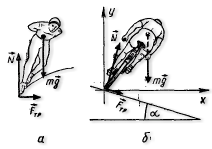
Let's first consider the speed skater. The centripetal acceleration of the skater is provided by the static friction force against the ice:
Since the skater does not move in the vertical direction, the normal reaction force
According to Newton's second law for circular motion, the maximum speed is determined by:
When making a turn, the skater covers a distance proportional to the radius,
The larger the radius
For the cyclist on the velodrome, the mechanics change due to the banked track. The angle of inclination increases as one moves further from the inner edge. On a steeply banked track, the horizontal component of the normal reaction force provides a massive centripetal force, allowing for much higher speeds (