Правка разделов «Statement», «Solution», «Answer»

en/6.1.2.md
+17 −6
| @@ -1,13 +1,24 @@ | |||
| ### Statement | |||
| − | $6.1.2.$ | ||
| + | $6.1.2.$ The interaction force between two identical charges at a distance of $1\text{ m}$ is $1\text{ N}$. Determine these charges in SI and CGS systems. | ||
| ### Solution | |||
| − | 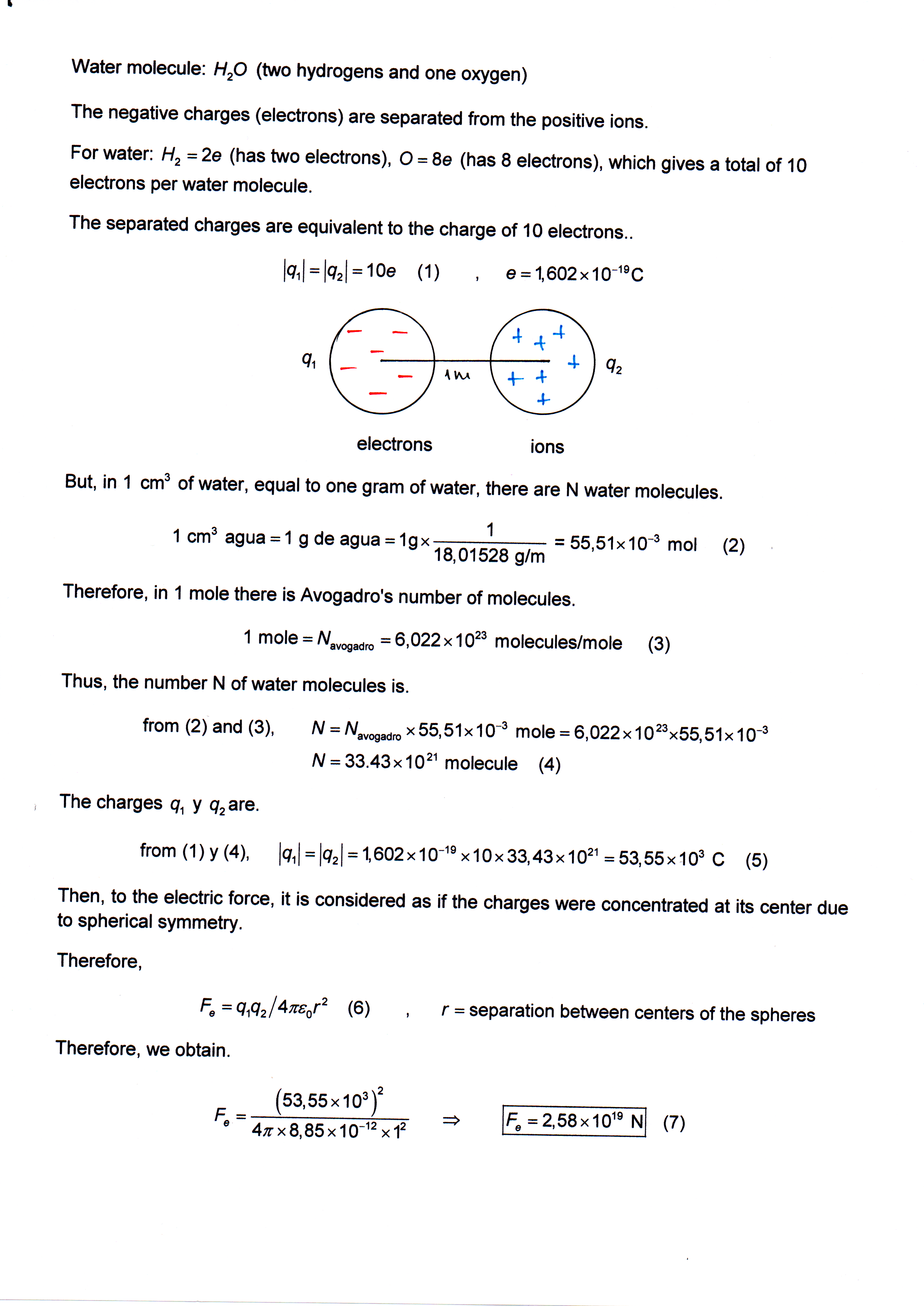 | ||
| + | <b>1. In the SI system:</b> | ||
| + | From Coulomb's law: | ||
| + | $$F = \frac{1}{4\pi\varepsilon_0} \cdot \frac{q^2}{r^2}$$ | ||
| + | Expressing the charge $q$: | ||
| + | $$q = \sqrt{4\pi\varepsilon_0 r^2 F}$$ | ||
| + | Substitute the numerical values ($F = 1\text{ N}$, $r = 1\text{ m}$, $\frac{1}{4\pi\varepsilon_0} = 9 \cdot 10^9\text{ N}\cdot\text{m}^2/\text{C}^2$): | ||
| + | $$q = \sqrt{\frac{1 \cdot 1^2}{9 \cdot 10^9}} = \frac{1}{3 \cdot 10^4 \cdot \sqrt{10}} \approx 1.05 \cdot 10^{-5}\text{ C}$$ | ||
| − | #### Answer | ||
| + | <b>2. In the CGS system (electrostatic):</b> | ||
| + | In the CGS system, the coefficient is $1$, and Coulomb's law is written as: | ||
| + | $$F = \frac{q^2}{r^2}$$ | ||
| + | Expressing the charge $q_{\text{cgs}}$: | ||
| + | $$q_{\text{cgs}} = r\sqrt{F}$$ | ||
| + | Keep in mind that in CGS, force is measured in dynes ($1\text{ N} = 10^5\text{ dyn}$), and distance is measured in centimeters ($1\text{ m} = 100\text{ cm}$). | ||
| + | $$q_{\text{cgs}} = 100\text{ cm} \cdot \sqrt{10^5\text{ dyn}} = 100 \cdot 316.2 = 3.16 \cdot 10^4\text{ statC (esu)}$$ | ||
| − | $$ | ||
| − | |||
| − | $$ | ||
| + | #### Answer | ||
| + | $1.05 \cdot 10^{-5}\text{ C}$; $3.16 \cdot 10^4\text{ statC}$ | ||
| @@ -1,13 +1,24 @@ | |||
| ### Statement | ### Statement | ||
| $6.1.2.$ |
$6.1.2.$ The interaction force between two identical charges at a distance of $1\text{ m}$ is $1\text{ N}$. Determine these charges in SI and CGS systems. | ||
| ### Solution | ### Solution | ||
|  | <b>1. In the SI system:</b> | ||
| From Coulomb's law: | |||
| $$F = \frac{1}{4\pi\varepsilon_0} \cdot \frac{q^2}{r^2}$$ | |||
| Expressing the charge $q$: | |||
| $$q = \sqrt{4\pi\varepsilon_0 r^2 F}$$ | |||
| Substitute the numerical values ($F = 1\text{ N}$, $r = 1\text{ m}$, $\frac{1}{4\pi\varepsilon_0} = 9 \cdot 10^9\text{ N}\cdot\text{m}^2/\text{C}^2$): | |||
| $$q = \sqrt{\frac{1 \cdot 1^2}{9 \cdot 10^9}} = \frac{1}{3 \cdot 10^4 \cdot \sqrt{10}} \approx 1.05 \cdot 10^{-5}\text{ C}$$ | |||
| #### Answer | <b>2. In the CGS system (electrostatic):</b> | ||
| In the CGS system, the coefficient is $1$, and Coulomb's law is written as: | |||
| $$F = \frac{q^2}{r^2}$$ | |||
| Expressing the charge $q_{\text{cgs}}$: | |||
| $$q_{\text{cgs}} = r\sqrt{F}$$ | |||
| Keep in mind that in CGS, force is measured in dynes ($1\text{ N} = 10^5\text{ dyn}$), and distance is measured in centimeters ($1\text{ m} = 100\text{ cm}$). | |||
| $$q_{\text{cgs}} = 100\text{ cm} \cdot \sqrt{10^5\text{ dyn}} = 100 \cdot 316.2 = 3.16 \cdot 10^4\text{ statC (esu)}$$ | |||
| $$ | #### Answer | ||
| $1.05 \cdot 10^{-5}\text{ C}$; $3.16 \cdot 10^4\text{ statC}$ | |||
| $$ | |||