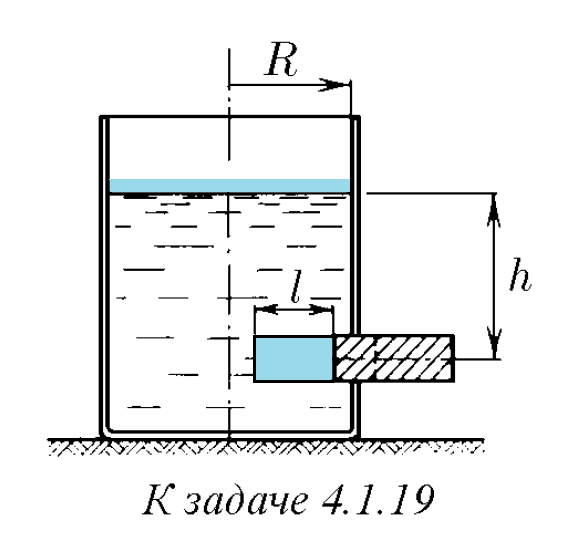
4.1.19∗. In a cylindrical vessel of radius $R$, partially filled with liquid of density $\rho$, there is a hole in the side wall plugged by a cork. What work must be done to push the cork to length $l$? The cork is a cylinder of radius $r$. The center of the hole is at depth $h$. The vessel is high enough so that the liquid does not pour out of it. Do not consider friction.
Solution
For problem $4.1.19$
The work done in pushing the cork is equal to the change in gravitional potential energy of the system. This is equal to the gravitational potential energy of the additional water at the surface with the same volume as the water replaced by the cork, which is at the zero-potential level. The volume $\pi r^2l$ of replaced water becomes a water disk of thickness $(\pi r^2l)/(\pi R^2)=r^2l/R^2$ at the surface, and its center of mass is at the height $h+r^2l/(2R^2)$ above the zero-potential level. Thus, its gravitational potential energy is