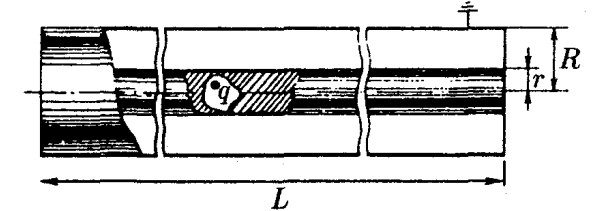
6.3.17∗. Inside the cavity of a long uncharged conductor, the radius of which is $r$, there is a charge $q$. The conductor is surrounded by a cylindrical screen of radius $R$. Conductor length $L \gg R$. How does the electric field strength outside the cavity in the middle part of the system depend on the distance to the axis of this system?
For problem $6.3.17$
Solution
Let's consider the middle part of the system. Since the length of the conductors is significantly greater than their radii ($L \gg R$), we can neglect the edge effects at the ends of the cylinders. In the middle region, the system possesses axial (cylindrical) symmetry.
1. Inside the metal: The electric field strength inside the uncharged conductor itself (within the bulk of the wall) is zero. The charge $q$ induces a charge of $-q$ on the walls of the cavity. According to the law of conservation of charge, a charge of $+q$ appears on the outer surface of the conductor (at radius $r$).
2. Field in the gap ($r < \rho < R$): The charge $+q$ is distributed uniformly over the outer surface of the conductor of radius $r$ along the length $L$. The linear charge density is $\lambda = \frac{q}{L}$. We apply Gauss's Law to a coaxial cylindrical surface of radius $\rho$ (where $r < \rho < R$) and length $l$: $$E \cdot 2\pi\rho l = \frac{\lambda l}{\varepsilon_0} = \frac{(q/L) l}{\varepsilon_0}$$ From this, the electric field strength in the gap between the conductor and the screen is: $$E(\rho) = \frac{q}{2\pi\varepsilon_0 L \rho}$$
3. Field outside the screen ($\rho > R$): Looking closely at the diagram provided in the problem, the outer cylindrical screen of radius $R$ has a grounding symbol. A grounded screen has zero potential and completely shields the electric field by inducing a charge of $-q$ on its inner surface. Therefore, there is completely no field outside the system: $$E(\rho) = 0$$
Answer
$E(\rho) = \frac{q}{2\pi\varepsilon_0 L \rho}$ for $r < \rho < R$; $E(\rho) = 0$ for $\rho > R$ (since the screen is grounded).