Statement
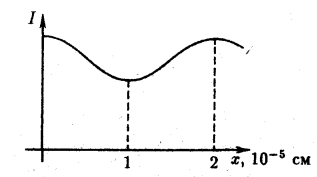
12.1.16. When two parallel translucent mirror plates are extended, the intensity of electromagnetic radiation transmitted through these plates periodically changes depending on the distance between them. Explain this phenomenon and use the figure to determine the wavelength of the incident radiation. The radiation propagates perpendicular to the plates.
Solution
Physical phenomenon:
We are observing multiple-beam interference (as in a Fabry-Perot interferometer). The incident plane wave partially passes through the first plate, reaches the second, where it again partially passes and partially reflects back. The reflected wave returns to the first plate, reflects from it, and goes to the second one again. At the exit of the system, multiple waves emerge having traveled different optical paths.
The path difference between the directly transmitted wave and the wave that underwent two internal reflections is
When the distance
Determining the wavelength from the graph:
Condition for a transmission minimum:
Condition for the adjacent transmission maximum:
Consequently, when transitioning from an intensity minimum to the adjacent maximum, the optical path difference
Let's carefully examine the graph provided in the problem.
On the x-axis, the distance between these points is:
Since this is the distance from a minimum to the adjacent maximum, we equate it to
(which corresponds to
Answer
The phenomenon is explained by the interference of rays multiply reflected between the plates.