Statement
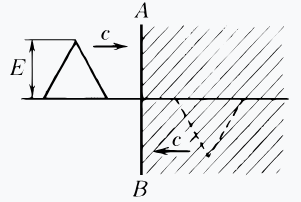
12.1.19. For a sufficiently large number of conduction electrons per unit volume of metal, the component of the electric field strength of the wave parallel to the metal surface is weakened to almost zero. Therefore, the solution of the problem of the interaction of an electromagnetic wave with a metal is reduced to finding two such traveling waves near its surface, the superposition of which gives a zero component of the electric field strength along the surface. Such electromagnetic waves are two waves that fall perpendicularly to a metal surface: one actually moves in space outside the metal, and another fictitious "inverted" wave moves towards the first one inside the metal (in the figure, this area along with the fictitious wave is located to the right of the
Using the described technique, find the electric field strength and magnetic field induction near the metal plane at the moment when the top of the incident wave reaches the
Solution
Reflection from a perfect metal is modeled using a fictitious wave that, inside the metal, propagates toward the surface. Outside the metal, there exists the real incident wave; inside, the fictitious wave moves in the opposite direction. By superposing both, the tangential electric field vanishes at the surface (plane
Choice of geometry and waves:
Metal surface: plane
Incident wave (traveling toward
Reflected wave (real, traveling toward
The sign reversal of
Electromagnetic field outside the metal (
Superposing the incident and reflected waves creates a standing wave:
Instant when the crest of the incident wave reaches the surface:
The crest (positive maximum of
Taking
Near the metal plane itself (