Новое решение

en/2.7.26.md
+23 −0
| @@ -0,0 +1,23 @@ | |||
| + | ### Statement | ||
| + | |||
| + | $2.7.26.$ [Insert the problem statement] | ||
| + | |||
| + | ### Solution | ||
| + | |||
| + |  | ||
| + | |||
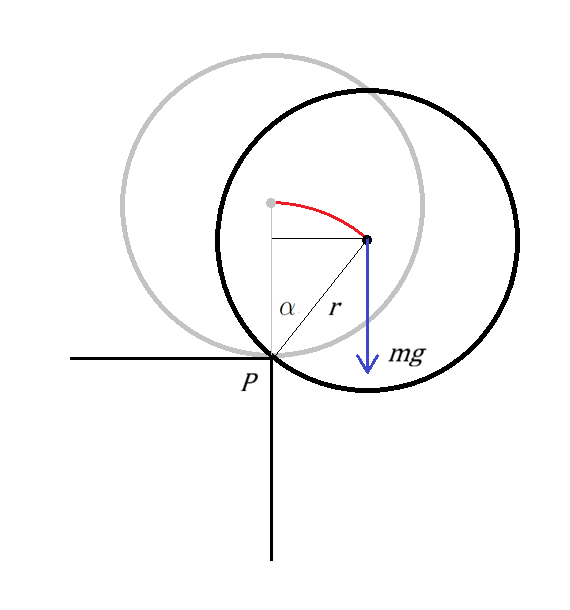
| + | The center of the ring will rotate about point $P$ at the edge of the table until it leaves the table. Suppose the moment of inertia of the ring about its center is $I$. Then the moment of inertia of the ring about $P$ is $I+mr^2$, where $m$ and $r$ are the mass and the radius of the ring, respectively. Assume that the ring leaves the table after its center has rotated through an angle $\alpha$. Then, its height drops by $r-r\cos\alpha$, and gravitational potential energy becomes rotational kinetic energy; that is, | ||
| + | |||
| + | \[mgr(1-\cos\alpha)=\frac{1}{2}(I+mr^2)\omega^2\qquad\Rightarrow\qquad\omega^2=\frac{2mgr(1-\cos\alpha)}{I+mr^2}.\] | ||
| + | |||
| + | When the ring is about to lose contact with the table, the centripetal force that keeps the center of the ring rotating about $P$ is a component of gravity. At this point, | ||
| + | |||
| + | \[mg\cos\alpha=m\omega^2r\qquad\Rightarrow\qquad\cos\alpha=\frac{2mr^2(1-\cos\alpha)}{I+mr^2}.\] | ||
| + | |||
| + | Using $I=mr^2$ for the ring, we have $\cos\alpha=1/2$, and so $\alpha=60^\circ.$ For a ball with the same mass and radius, $I<mr^2$, and hence | ||
| + | |||
| + | \[\cos\alpha>1-\cos\alpha\qquad\Rightarrow\qquad\cos\alpha>\frac{1}{2}\qquad\Rightarrow\qquad\alpha<60^\circ.\] | ||
| + | |||
| + | #### Answer | ||
| + | |||
| + | [Insert a concise answer or boxed result] | ||
| @@ -0,0 +1,23 @@ | |||
| ### Statement | |||
| $2.7.26.$ [Insert the problem statement] | |||
| ### Solution | |||
|  | |||
| The center of the ring will rotate about point $P$ at the edge of the table until it leaves the table. Suppose the moment of inertia of the ring about its center is $I$. Then the moment of inertia of the ring about $P$ is $I+mr^2$, where $m$ and $r$ are the mass and the radius of the ring, respectively. Assume that the ring leaves the table after its center has rotated through an angle $\alpha$. Then, its height drops by $r-r\cos\alpha$, and gravitational potential energy becomes rotational kinetic energy; that is, | |||
| \[mgr(1-\cos\alpha)=\frac{1}{2}(I+mr^2)\omega^2\qquad\Rightarrow\qquad\omega^2=\frac{2mgr(1-\cos\alpha)}{I+mr^2}.\] | |||
| When the ring is about to lose contact with the table, the centripetal force that keeps the center of the ring rotating about $P$ is a component of gravity. At this point, | |||
| \[mg\cos\alpha=m\omega^2r\qquad\Rightarrow\qquad\cos\alpha=\frac{2mr^2(1-\cos\alpha)}{I+mr^2}.\] | |||
| Using $I=mr^2$ for the ring, we have $\cos\alpha=1/2$, and so $\alpha=60^\circ.$ For a ball with the same mass and radius, $I<mr^2$, and hence | |||
| \[\cos\alpha>1-\cos\alpha\qquad\Rightarrow\qquad\cos\alpha>\frac{1}{2}\qquad\Rightarrow\qquad\alpha<60^\circ.\] | |||
| #### Answer | |||
| [Insert a concise answer or boxed result] | |||