6.3.33. How will the force of interaction of a charged metal sphere of radius $R$ with a point charge $q$, which is located at a distance $L$ from its center, change if the sphere's charge is increased by $Q$?
Solution
For problem $6.3.33$
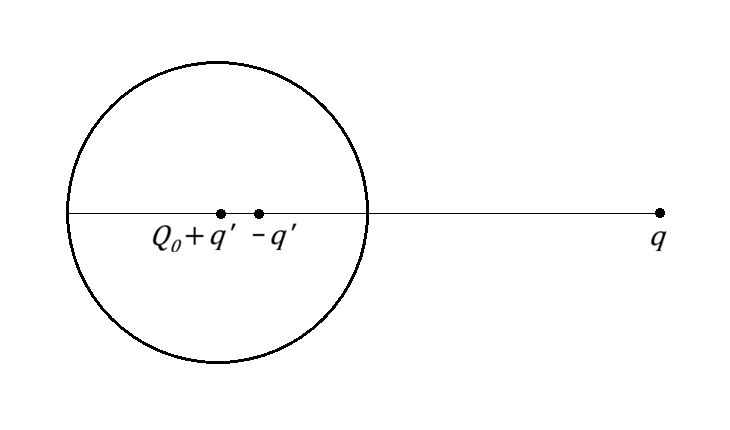
Suppose that the sphere has charge $Q_0$ originally. As a result of the charge $q$, the charge on the sphere is not uniformly distributed. However, the sphere is an equipotential surface, and the electric field outside the sphere can be simulated by placing two charges that will produce the equipotential surface where the sphere used to be as follows. A charge $-q'=-qR/L$ independepnt of $Q_0$ is placed at an appropriate position (see Problem 6.3.32) so that, together with the charge $q$, a zero-potential surface is created where the sphere used to be. Also, a charge $Q_0+q'$ is placed where the center of the sphere used to be to to produce the equipotential surface. The total force on the charge $q$ is the sum of the forces from the charges $-q'$ and $Q_0+q'$.
If the charge on the sphere is increased by $Q$, then the charge that must be placed where the center of the sphere used to be (to simulate the electric field outside the sphere) becomes $Q_0+Q+q'$. As a result, the total force on the charge $q$ is increased by $kQq/L^2$.