Новое решение

en/11.1.20.md
+29 −0
| @@ -0,0 +1,29 @@ | |||
| + | ### Statement | ||
| + | |||
| + | $11.1.20.$ [Insert the problem statement] | ||
| + | |||
| + | ### Solution | ||
| + | |||
| + |  | ||
| + | |||
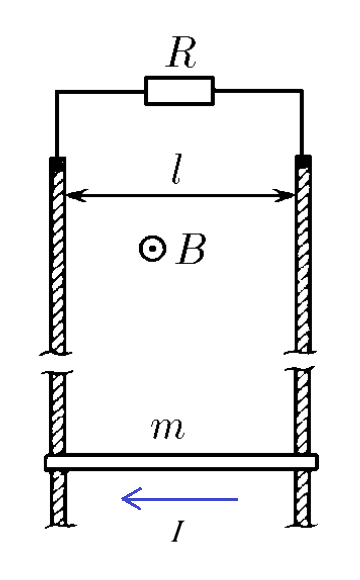
| + | In addition to gravity, the conductor experiences upward magnetic force $F=IlB$, where $I$ is the current through the conductor. The current flows in the circuit, because there is an induced EMF $\mathcal{E}=Blv$, where $v$ is the downward speed of the conductor, as a result of increasing area of the circuit loop and hence magnetic flux. | ||
| + | |||
| + | In the case when the circuit is closed with the resistor, $I=\mathcal{E}/R=Blv/R$, and the equation of motion of the conductor becomes | ||
| + | |||
| + | \[m\dot v=mg-B^2l^2v/R.\] | ||
| + | |||
| + | Subject to the initial condition $v=0$ at $t=0$, we have the solution | ||
| + | |||
| + | \[v=\frac{mgR}{B^2l^2}(1-e^{-B^2l^2t/(mR)}).\] | ||
| + | |||
| + | In the case when the circuit is closed with the capacitor, $I=C(d\mathcal{E}/dt)=CBl\dot v$, and the equation of motion of the conductor becomes | ||
| + | |||
| + | \[m\dot v=mg-CB^l^2\dot v\qquad\Rightarrow\qquad(m+CB^2l^2)\dot v=mg.\] | ||
| + | |||
| + | Subject to the initial condition $v=0$ at $t=0$, we have the solution | ||
| + | |||
| + | \[v=\frac{mgt}{m+CB^2l^2}.\] | ||
| + | |||
| + | #### Answer | ||
| + | |||
| + | [Insert a concise answer or boxed result] | ||
| @@ -0,0 +1,29 @@ | |||
| ### Statement | |||
| $11.1.20.$ [Insert the problem statement] | |||
| ### Solution | |||
|  | |||
| In addition to gravity, the conductor experiences upward magnetic force $F=IlB$, where $I$ is the current through the conductor. The current flows in the circuit, because there is an induced EMF $\mathcal{E}=Blv$, where $v$ is the downward speed of the conductor, as a result of increasing area of the circuit loop and hence magnetic flux. | |||
| In the case when the circuit is closed with the resistor, $I=\mathcal{E}/R=Blv/R$, and the equation of motion of the conductor becomes | |||
| \[m\dot v=mg-B^2l^2v/R.\] | |||
| Subject to the initial condition $v=0$ at $t=0$, we have the solution | |||
| \[v=\frac{mgR}{B^2l^2}(1-e^{-B^2l^2t/(mR)}).\] | |||
| In the case when the circuit is closed with the capacitor, $I=C(d\mathcal{E}/dt)=CBl\dot v$, and the equation of motion of the conductor becomes | |||
| \[m\dot v=mg-CB^l^2\dot v\qquad\Rightarrow\qquad(m+CB^2l^2)\dot v=mg.\] | |||
| Subject to the initial condition $v=0$ at $t=0$, we have the solution | |||
| \[v=\frac{mgt}{m+CB^2l^2}.\] | |||
| #### Answer | |||
| [Insert a concise answer or boxed result] | |||