Правка разделов «Statement», «Solution», «Answer»

en/4.2.16.md
+3 −3
| @@ -1,15 +1,15 @@ | |||
| ### Statement | |||
| − | $4.2.16.$ [Insert the problem statement] | ||
| + | $4.2.16.$ Prove that the force with which the halves of the floating bathysphere are pressed to each other does not depend on the inclination of the plane of contact of the hemispheres of the bathysphere if it is completely submerged in water. | ||
| ### Solution | |||
| − | 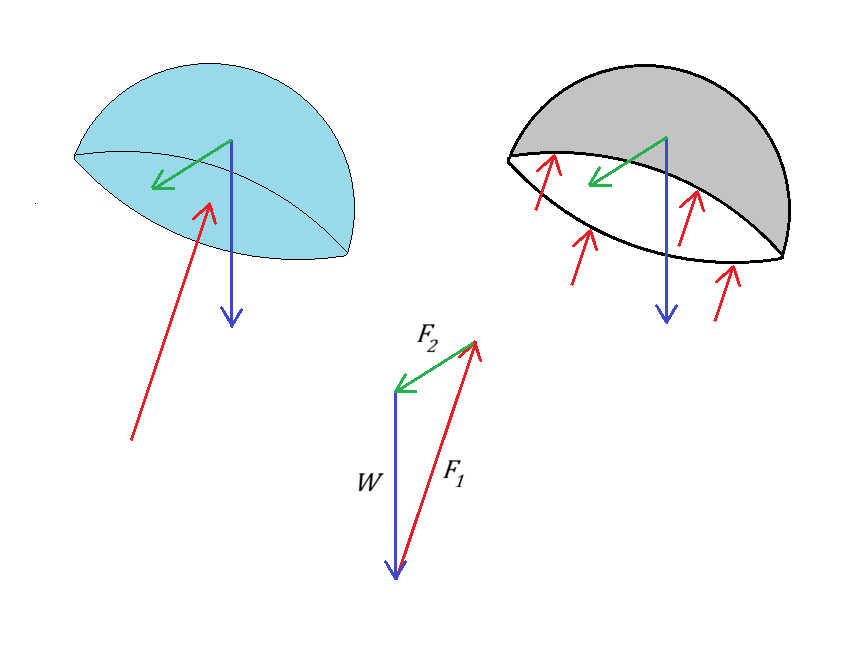 | ||
| The bathysphere remains stationary if its weight is the same as the weight of the water that it replaces. Suppose the hemisphere of water replaced by one half of the bathysphere has weight $W$ (shown in blue). The pressure force on its flat circular surface is $F_1=P\cdot\pi R^2$ (shown in red), where $P$ is the pressure at the depth of the center of the flat circular surface and $R$ is the radius of the bathysphere. The pressure force $F_2$ (shown in green) on its curved hemispherical surface is such that the total force $\vec W+\vec F_1+\vec F_2$ is zero. | |||
| Now consider the force balance of the half of the bathysphere that replaces the water. It still has weight $W$ and experiences the same pressure force $F_2$ on its curved hemispherical surface. Consequently, the force from the other half of the bathysphere must add up to $F_1$, which depends on the depth of the bathysphere and not on the inclination of the plane of contact of both hemispheres. | |||
| #### Answer | |||
| − | [Insert a concise answer or boxed result] | ||
| + | See the solution. | ||
| @@ -1,15 +1,15 @@ | |||
| ### Statement | ### Statement | ||
| $4.2.16.$ [Insert the problem statement] | $4.2.16.$ Prove that the force with which the halves of the floating bathysphere are pressed to each other does not depend on the inclination of the plane of contact of the hemispheres of the bathysphere if it is completely submerged in water. | ||
| ### Solution | ### Solution | ||
|  | ||
| The bathysphere remains stationary if its weight is the same as the weight of the water that it replaces. Suppose the hemisphere of water replaced by one half of the bathysphere has weight $W$ (shown in blue). The pressure force on its flat circular surface is $F_1=P\cdot\pi R^2$ (shown in red), where $P$ is the pressure at the depth of the center of the flat circular surface and $R$ is the radius of the bathysphere. The pressure force $F_2$ (shown in green) on its curved hemispherical surface is such that the total force $\vec W+\vec F_1+\vec F_2$ is zero. | The bathysphere remains stationary if its weight is the same as the weight of the water that it replaces. Suppose the hemisphere of water replaced by one half of the bathysphere has weight $W$ (shown in blue). The pressure force on its flat circular surface is $F_1=P\cdot\pi R^2$ (shown in red), where $P$ is the pressure at the depth of the center of the flat circular surface and $R$ is the radius of the bathysphere. The pressure force $F_2$ (shown in green) on its curved hemispherical surface is such that the total force $\vec W+\vec F_1+\vec F_2$ is zero. | ||
| Now consider the force balance of the half of the bathysphere that replaces the water. It still has weight $W$ and experiences the same pressure force $F_2$ on its curved hemispherical surface. Consequently, the force from the other half of the bathysphere must add up to $F_1$, which depends on the depth of the bathysphere and not on the inclination of the plane of contact of both hemispheres. | Now consider the force balance of the half of the bathysphere that replaces the water. It still has weight $W$ and experiences the same pressure force $F_2$ on its curved hemispherical surface. Consequently, the force from the other half of the bathysphere must add up to $F_1$, which depends on the depth of the bathysphere and not on the inclination of the plane of contact of both hemispheres. | ||
| #### Answer | #### Answer | ||
| [Insert a concise answer or boxed result] | See the solution. | ||