Новое решение

en/5.5.18.md
+23 −0
| @@ -0,0 +1,23 @@ | |||
| + | ### Statement | ||
| + | |||
| + | $5.5.18.$ [Insert the problem statement] | ||
| + | |||
| + | ### Solution | ||
| + | |||
| + |  | ||
| + | |||
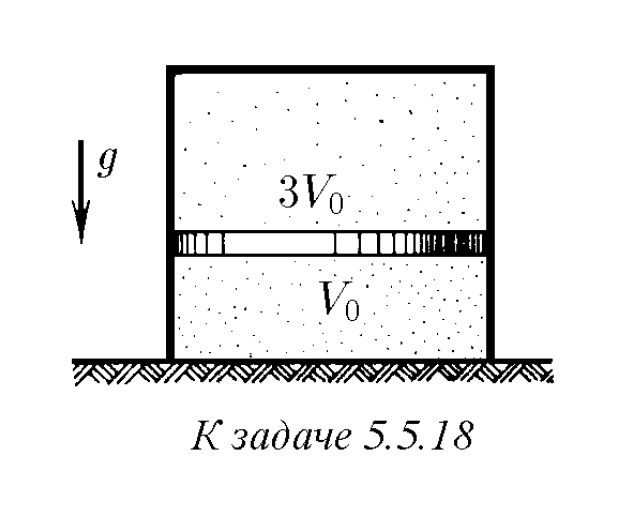
| + | Suppose the pressure of the gas in the upper part is $P_0$ before the temperature change. Then, the pressure of the gas in the lower part is $3P_0$ as its volume is one third of the volume of the gas in upper part, while the mass and the temperature of the gas in both parts are the same. The equilibrium of the piston means that | ||
| + | |||
| + | \[mg+P_0A=3P_0A\qquad\Rightarrow\qquad mg=2P_0A,\] | ||
| + | |||
| + | where $m$ is the mass of the piston and $A$ is the area of the cross section of the vessel. Let the volume of the gas in the upper part be $3V_0-x$ when the temperature is doubled. Then, its pressure becomes $2P_0\cdot3V_0/(3V_0-x)$. Similarly, the volume and the pressure of the gas in the lower part become $V_0+x$ and $2P_0\cdot V_0/(V_0+x)$, respectivly. Considering the equilibrium of the piston, we have | ||
| + | |||
| + | \[2P_0A+\frac{2P_0A\cdot3V_0}{3V_0-x}=\frac{2P_0A\cdot V_0}{V_0+x},\] | ||
| + | |||
| + | which simplifies to the quadratic equation $x^2-8V_0x+3V_0^2=0$. As $x=(4-\sqrt{13})V_0$, the ratio of the volumes of the gas in the upper and lower parts is | ||
| + | |||
| + | \[\frac{3V_0-x}{V_0+x}=\frac{(\sqrt{13}-1)V_0}{(5-\sqrt{13})V_0}=\frac{2+\sqrt{13}}{3}.\] | ||
| + | |||
| + | #### Answer | ||
| + | |||
| + | [Insert a concise answer or boxed result] | ||
| @@ -0,0 +1,23 @@ | |||
| ### Statement | |||
| $5.5.18.$ [Insert the problem statement] | |||
| ### Solution | |||
|  | |||
| Suppose the pressure of the gas in the upper part is $P_0$ before the temperature change. Then, the pressure of the gas in the lower part is $3P_0$ as its volume is one third of the volume of the gas in upper part, while the mass and the temperature of the gas in both parts are the same. The equilibrium of the piston means that | |||
| \[mg+P_0A=3P_0A\qquad\Rightarrow\qquad mg=2P_0A,\] | |||
| where $m$ is the mass of the piston and $A$ is the area of the cross section of the vessel. Let the volume of the gas in the upper part be $3V_0-x$ when the temperature is doubled. Then, its pressure becomes $2P_0\cdot3V_0/(3V_0-x)$. Similarly, the volume and the pressure of the gas in the lower part become $V_0+x$ and $2P_0\cdot V_0/(V_0+x)$, respectivly. Considering the equilibrium of the piston, we have | |||
| \[2P_0A+\frac{2P_0A\cdot3V_0}{3V_0-x}=\frac{2P_0A\cdot V_0}{V_0+x},\] | |||
| which simplifies to the quadratic equation $x^2-8V_0x+3V_0^2=0$. As $x=(4-\sqrt{13})V_0$, the ratio of the volumes of the gas in the upper and lower parts is | |||
| \[\frac{3V_0-x}{V_0+x}=\frac{(\sqrt{13}-1)V_0}{(5-\sqrt{13})V_0}=\frac{2+\sqrt{13}}{3}.\] | |||
| #### Answer | |||
| [Insert a concise answer or boxed result] | |||