Новое решение

en/11.1.13.md
+13 −0
| @@ -0,0 +1,13 @@ | |||
| + | ### Statement | ||
| + | |||
| + | $11.1.13.$ [Insert the problem statement] | ||
| + | |||
| + | ### Solution | ||
| + | |||
| + |  | ||
| + | |||
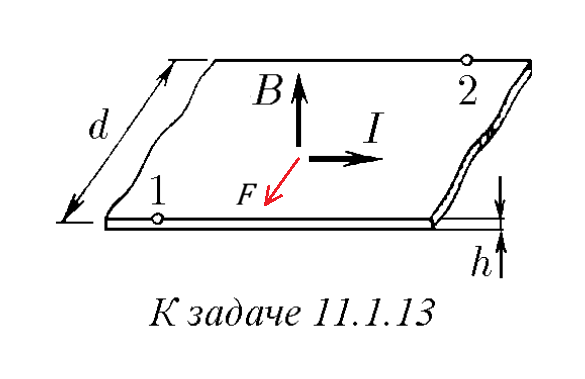
| + | Consider a section of the tape of length $l$. The magnetic force on the charge in the tape is $F=IlB$. In this section of the tape, the total charge is $Q=\rho dlh$. Consequently, the force per unit charge $F/Q=IB/(\rho dh)$ is equivalent to an electric field $E$. Thus, the potential difference between the near edge and the far edge of the tape is $V=Ed=IB/(\rho h)$. | ||
| + | |||
| + | #### Answer | ||
| + | |||
| + | [Insert a concise answer or boxed result] | ||
| @@ -0,0 +1,13 @@ | |||
| ### Statement | |||
| $11.1.13.$ [Insert the problem statement] | |||
| ### Solution | |||
|  | |||
| Consider a section of the tape of length $l$. The magnetic force on the charge in the tape is $F=IlB$. In this section of the tape, the total charge is $Q=\rho dlh$. Consequently, the force per unit charge $F/Q=IB/(\rho dh)$ is equivalent to an electric field $E$. Thus, the potential difference between the near edge and the far edge of the tape is $V=Ed=IB/(\rho h)$. | |||
| #### Answer | |||
| [Insert a concise answer or boxed result] | |||