Правка разделов «Problem», «Solution», «Answer»

en/7.2.7.md
+148 −4
| @@ -1,11 +1,155 @@ | |||
| − | ### | ||
| + | ### Problem | ||
| − | $7.2.7.$ [Insert the problem statement] | ||
| + | $7.2.7.$ A parallel beam of protons, accelerated by a potential difference $V_{0}$, flies along the axis of two small coaxial circular holes in the plates of a capacitor. At what distance from the second plate will this beam focus if the potential of the second plate is $V$? The first plate is grounded. The distance between the plates is $d$. | ||
| + | 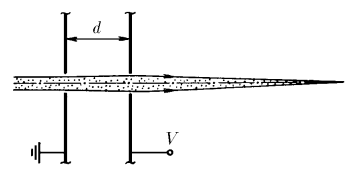 | ||
| + | |||
| ### Solution | |||
| − | Studio Cyborg Squad presents | ||
| + | Before reading the solution to this problem, I recommend familiarizing yourself with the solution to problem $7.2.6.$, as I will use its result in this solution. | ||
| + | In the solution, I assume the paraxial approximation: the protons propagate at very small angles to the symmetry axis of the system. | ||
| + | |||
| + | A hole in a capacitor plate, separating regions with different field strengths $E_{1}$ and $E_{2}$, acts as an electrostatic lens. The focal length of such a lens was found in problem $7.2.6.$: | ||
| + | |||
| + | $$f=\frac{4U}{E_{2}-E_{1}}$$ | ||
| + | |||
| + | where $U$ is the potential equivalent to the kinetic energy of the proton as it approaches the hole; $E_{1}$ is the field strength before the hole; $E_{2}$ is the field strength after the hole. | ||
| + | |||
| + | We have two holes, which means two lenses. Outside the capacitor, there is no field; inside the capacitor, $E=\frac{V}{d}$. The kinetic energy of the protons approaching the first hole is determined by the accelerating potential difference $V_{0}$. Then the focal length of the first lens (hole) is: | ||
| + | |||
| + | $$f_{1}=\frac{4V_{0}}{\frac{V}{d}-0}=\frac{4dV_{0}}{V} \tag{1}$$ | ||
| + | |||
| + | Since $f_{1}\gt 0$, this is a converging lens, meaning it "presses" the proton beam toward the axis, reducing the beam radius. | ||
| + | |||
| + | For the second lens (hole), the kinetic energy of the protons will be determined by the potential difference $V_{0}+V$, since the protons are accelerated by the field inside the capacitor. Then the focal length of the second lens (hole) is: | ||
| + | |||
| + | $$f_{2}=\frac{4(V_{0}+V)}{0-\frac{V}{d}}=-\frac{4d(V_{0}+V)}{V} \tag{2}$$ | ||
| + | |||
| + | Since $f_{2}\lt 0$, this is a diverging lens, meaning it increases the radius of the proton beam. | ||
| + | |||
| + | Since we have a converging lens first, focusing of the beam is possible in two different regions of the system. The first is inside the capacitor, i.e., at a distance $L\lt d$ from the first plate. The second is outside the capacitor. I will note right away that the beam will definitely focus, because the optical power of the first lens is greater than that of the second: | ||
| + | |||
| + | $$\left| \frac{1}{f_{1}} \right|\gt \left| \frac{1}{f_{2}} \right|$$ | ||
| + | |||
| + | Let us consider the first \textbf{case: focusing inside the capacitor}. | ||
| + | |||
| + | Let $r_{0}$ be the initial radius of the beam. A proton, passing through the region of the non-uniform field near the hole, receives a radial momentum. Let us denote the acquired radial velocity of the proton as $\upsilon_{r0}$. Since the width of the hole is very small, there is no change in the proton's velocity along the symmetry axis while passing through the hole. This velocity is equal to: | ||
| + | |||
| + | $$\upsilon_{x0}=\sqrt{\frac{2eV_{0}}{m}} \tag{3}$$ | ||
| + | |||
| + | On the one hand, the tangent of the beam's deflection angle is: | ||
| + | |||
| + | $$\tan\alpha=\frac{\upsilon_{r0}}{\upsilon_{x0}}$$ | ||
| + | |||
| + | And on the other hand, by definition: | ||
| + | |||
| + | $$\tan\alpha=\frac{r_{0}}{f_{1}}$$ | ||
| + | |||
| + | Then: | ||
| + | |||
| + | $$\upsilon_{r0}=\upsilon_{x0}\cdot\frac{r_{0}}{f_{1}} \tag{4}$$ | ||
| + | |||
| + | Inside the capacitor, the field acts only along the symmetry axis, so the radial velocity is conserved: $\upsilon_{r}=\upsilon_{r0}=const$. | ||
| + | |||
| + | The dependence of the beam radius on time will be: | ||
| + | |||
| + | $$r(t)=r_{0}-\upsilon_{r0}t=r_{0}\left( 1-\frac{\upsilon_{x0}}{f_{1}}t \right)$$ | ||
| + | |||
| + | The time $\tau$ when the beam radius becomes equal to 0: | ||
| + | |||
| + | $$r(\tau)=0=r_{0}\left( 1-\frac{\upsilon_{x0}}{f_{1}}\tau \right)\Longrightarrow \tau=\frac{f_{1}}{\upsilon_{x0}}$$ | ||
| + | |||
| + | Substituting the values from (1) and (3): | ||
| + | |||
| + | $$\tau=\frac{4dV_{0}}{V}\sqrt{\frac{m}{2eV_{0}}} \tag{5}$$ | ||
| + | |||
| + | Along the symmetry axis, the electric field acts on the protons with a force: | ||
| + | |||
| + | $$F=eE=\frac{eV}{d}$$ | ||
| + | |||
| + | Under the action of this force, the protons acquire an acceleration: | ||
| + | |||
| + | $$a=\frac{F}{m}=\frac{eV}{md} \tag{6}$$ | ||
| + | |||
| + | The coordinate $x(t)$ during uniformly accelerated motion: | ||
| + | |||
| + | $$x(t)=\upsilon_{x0}t+\frac{at^{2}}{2}$$ | ||
| + | |||
| + | The protons will focus at a distance $L=x(\tau)$: | ||
| + | |||
| + | $$L=\upsilon_{x0}\tau+\frac{a\tau^{2}}{2}$$ | ||
| + | |||
| + | Substituting formulas (3), (5), and (6) here: | ||
| + | |||
| + | $$L=\sqrt{\frac{2eV_{0}}{m}}\frac{4dV_{0}}{V}\sqrt{\frac{m}{2eV_{0}}}+\frac{1}{2}\frac{eV}{md}\left( \frac{4dV_{0}}{V}\sqrt{\frac{m}{2eV_{0}}} \right)^{2}=\frac{8dV_{0}}{V}$$ | ||
| + | |||
| + | Since $L\lt d$, it must be that $V\gt 8V_{0}$. | ||
| + | |||
| + | At $V=8V_{0}$, the beam will focus exactly at the second hole: $L=d$. | ||
| + | |||
| + | Now let us consider the second case: \textbf{focusing outside the plates (taking both holes into account)}. | ||
| + | |||
| + | According to the law of conservation of energy, the work of the field goes into increasing the kinetic energy of the protons, so the proton velocity along the symmetry axis when they reach the second hole will be: | ||
| + | |||
| + | $$\upsilon_{xd}=\sqrt{\frac{2e(V_{0}+V)}{m}} \tag{7}$$ | ||
| + | |||
| + | The flight time of the protons from the first plate to the second: | ||
| + | |||
| + | $$t_{f}=\frac{\upsilon_{xd}-\upsilon_{x0}}{a}$$ | ||
| + | |||
| + | Substituting (3), (6), and (7) here: | ||
| + | |||
| + | $$t_{f}=\frac{md}{eV}\left( \sqrt{\frac{2e(V_{0}+V)}{m}}-\sqrt{\frac{2eV_{0}}{m}} \right) \tag{8}$$ | ||
| + | |||
| + | The radius of the proton beam before passing through the second hole: | ||
| + | |||
| + | $$r_{d}=r_{0}-\upsilon_{r0}t_{f}=r_{0}\left( 1-\frac{\upsilon_{x0}}{f_{1}}t_{f} \right)$$ | ||
| + | |||
| + | Substituting (1), (3), and (8) here: | ||
| + | |||
| + | $$r_{d}=r_{0}\left[ 1-\frac{V}{4dV_{0}}\sqrt{\frac{2eV_{0}}{m}}\frac{md}{eV}\left( \sqrt{\frac{2e(V_{0}+V)}{m}}-\sqrt{\frac{2eV_{0}}{m}} \right) \right]$$ | ||
| + | |||
| + | Performing the algebraic transformations, we get: | ||
| + | |||
| + | $$r_{d}=\frac{r_{0}}{2}\left( 3-\sqrt{1+\frac{V}{V_{0}}} \right) \tag{9}$$ | ||
| + | |||
| + | Passing through the second hole, the protons acquire additional velocity in the radial direction. By analogy with formula (4): | ||
| + | |||
| + | $$\upsilon_{r2}=\upsilon_{xd}\frac{r_{d}}{f_{2}}$$ | ||
| + | |||
| + | Substituting (7), (2), and (9) here: | ||
| + | |||
| + | $$\upsilon_{r2}=\sqrt{\frac{2e(V_{0}+V)}{m}}\frac{V}{4d(V_{0}+V)}\frac{r_{0}}{2}\left( \sqrt{1+\frac{V}{V_{0}}} -3\right)$$ | ||
| + | |||
| + | The resulting radial velocity after passing the second lens: | ||
| + | |||
| + | $$\upsilon_{r}=\upsilon_{r0}+\upsilon_{r2}=\upsilon_{x0}\frac{r_{0}}{f_{1}}+\upsilon_{r2}$$ | ||
| + | |||
| + | After substituting the previously found values, we obtain: | ||
| + | |||
| + | $$\upsilon_{r}=\sqrt{\frac{2e}{m}}\frac{r_{0}}{4d}\left[ \frac{V}{\sqrt{V_{0}}}+\frac{V}{2\sqrt{V_{0}+V}}\left( \sqrt{1+\frac{V}{V_{0}}}-3 \right) \right]$$ | ||
| + | |||
| + | After passing through the second hole, the protons move by inertia. By analogy with formula (4): | ||
| + | |||
| + | $$\frac{\upsilon_{r}}{\upsilon_{xd}}=\frac{r_{d}}{L}\Longrightarrow L=r_{d}\frac{\upsilon_{xd}}{\upsilon_{r}}$$ | ||
| + | |||
| + | After substituting all formulas and performing algebraic transformations, we obtain: | ||
| + | |||
| + | $$L=\frac{4}{3}d\left( 1+\frac{V_{0}}{V} \right)\left( 2\frac{V_{0}}{V}+2\sqrt{\frac{V_{0}}{V}\left( \frac{V_{0}}{V}+1 \right)}-1 \right)$$ | ||
| + | |||
| #### Answer | |||
| − | |||
| + | $$L=\frac{4}{3}d\left( 1+\frac{V_{0}}{V} \right)\left( 2\frac{V_{0}}{V}+2\sqrt{\frac{V_{0}}{V}\left( \frac{V_{0}}{V}+1 \right)}-1 \right)$$ | ||
| + | |||
| + | for $$V\lt 8V_{0}$$ | ||
| + | |||
| + | and at a distance $$L=\frac{8dV_{0}}{V}$$ | ||
| + | |||
| + | from the first plate for $$V\gt 8V_{0}$$ | ||
| + | |||
| + | For $V=8V_{0}$ | ||
| + | |||
| + | $$L=d$$ | ||
| + | |||
| + | from the first plate. | ||
| @@ -1,11 +1,155 @@ | |||
| ### |
### Problem | ||
| $7.2.7.$ [Insert the problem statement] | $7.2.7.$ A parallel beam of protons, accelerated by a potential difference $V_{0}$, flies along the axis of two small coaxial circular holes in the plates of a capacitor. At what distance from the second plate will this beam focus if the potential of the second plate is $V$? The first plate is grounded. The distance between the plates is $d$. | ||
|  | |||
| ### Solution | ### Solution | ||
| Studio Cyborg Squad presents | Before reading the solution to this problem, I recommend familiarizing yourself with the solution to problem $7.2.6.$, as I will use its result in this solution. | ||
| In the solution, I assume the paraxial approximation: the protons propagate at very small angles to the symmetry axis of the system. | |||
| A hole in a capacitor plate, separating regions with different field strengths $E_{1}$ and $E_{2}$, acts as an electrostatic lens. The focal length of such a lens was found in problem $7.2.6.$: | |||
| $$f=\frac{4U}{E_{2}-E_{1}}$$ | |||
| where $U$ is the potential equivalent to the kinetic energy of the proton as it approaches the hole; $E_{1}$ is the field strength before the hole; $E_{2}$ is the field strength after the hole. | |||
| We have two holes, which means two lenses. Outside the capacitor, there is no field; inside the capacitor, $E=\frac{V}{d}$. The kinetic energy of the protons approaching the first hole is determined by the accelerating potential difference $V_{0}$. Then the focal length of the first lens (hole) is: | |||
| $$f_{1}=\frac{4V_{0}}{\frac{V}{d}-0}=\frac{4dV_{0}}{V} \tag{1}$$ | |||
| Since $f_{1}\gt 0$, this is a converging lens, meaning it "presses" the proton beam toward the axis, reducing the beam radius. | |||
| For the second lens (hole), the kinetic energy of the protons will be determined by the potential difference $V_{0}+V$, since the protons are accelerated by the field inside the capacitor. Then the focal length of the second lens (hole) is: | |||
| $$f_{2}=\frac{4(V_{0}+V)}{0-\frac{V}{d}}=-\frac{4d(V_{0}+V)}{V} \tag{2}$$ | |||
| Since $f_{2}\lt 0$, this is a diverging lens, meaning it increases the radius of the proton beam. | |||
| Since we have a converging lens first, focusing of the beam is possible in two different regions of the system. The first is inside the capacitor, i.e., at a distance $L\lt d$ from the first plate. The second is outside the capacitor. I will note right away that the beam will definitely focus, because the optical power of the first lens is greater than that of the second: | |||
| $$\left| \frac{1}{f_{1}} \right|\gt \left| \frac{1}{f_{2}} \right|$$ | |||
| Let us consider the first \textbf{case: focusing inside the capacitor}. | |||
| Let $r_{0}$ be the initial radius of the beam. A proton, passing through the region of the non-uniform field near the hole, receives a radial momentum. Let us denote the acquired radial velocity of the proton as $\upsilon_{r0}$. Since the width of the hole is very small, there is no change in the proton's velocity along the symmetry axis while passing through the hole. This velocity is equal to: | |||
| $$\upsilon_{x0}=\sqrt{\frac{2eV_{0}}{m}} \tag{3}$$ | |||
| On the one hand, the tangent of the beam's deflection angle is: | |||
| $$\tan\alpha=\frac{\upsilon_{r0}}{\upsilon_{x0}}$$ | |||
| And on the other hand, by definition: | |||
| $$\tan\alpha=\frac{r_{0}}{f_{1}}$$ | |||
| Then: | |||
| $$\upsilon_{r0}=\upsilon_{x0}\cdot\frac{r_{0}}{f_{1}} \tag{4}$$ | |||
| Inside the capacitor, the field acts only along the symmetry axis, so the radial velocity is conserved: $\upsilon_{r}=\upsilon_{r0}=const$. | |||
| The dependence of the beam radius on time will be: | |||
| $$r(t)=r_{0}-\upsilon_{r0}t=r_{0}\left( 1-\frac{\upsilon_{x0}}{f_{1}}t \right)$$ | |||
| The time $\tau$ when the beam radius becomes equal to 0: | |||
| $$r(\tau)=0=r_{0}\left( 1-\frac{\upsilon_{x0}}{f_{1}}\tau \right)\Longrightarrow \tau=\frac{f_{1}}{\upsilon_{x0}}$$ | |||
| Substituting the values from (1) and (3): | |||
| $$\tau=\frac{4dV_{0}}{V}\sqrt{\frac{m}{2eV_{0}}} \tag{5}$$ | |||
| Along the symmetry axis, the electric field acts on the protons with a force: | |||
| $$F=eE=\frac{eV}{d}$$ | |||
| Under the action of this force, the protons acquire an acceleration: | |||
| $$a=\frac{F}{m}=\frac{eV}{md} \tag{6}$$ | |||
| The coordinate $x(t)$ during uniformly accelerated motion: | |||
| $$x(t)=\upsilon_{x0}t+\frac{at^{2}}{2}$$ | |||
| The protons will focus at a distance $L=x(\tau)$: | |||
| $$L=\upsilon_{x0}\tau+\frac{a\tau^{2}}{2}$$ | |||
| Substituting formulas (3), (5), and (6) here: | |||
| $$L=\sqrt{\frac{2eV_{0}}{m}}\frac{4dV_{0}}{V}\sqrt{\frac{m}{2eV_{0}}}+\frac{1}{2}\frac{eV}{md}\left( \frac{4dV_{0}}{V}\sqrt{\frac{m}{2eV_{0}}} \right)^{2}=\frac{8dV_{0}}{V}$$ | |||
| Since $L\lt d$, it must be that $V\gt 8V_{0}$. | |||
| At $V=8V_{0}$, the beam will focus exactly at the second hole: $L=d$. | |||
| Now let us consider the second case: \textbf{focusing outside the plates (taking both holes into account)}. | |||
| According to the law of conservation of energy, the work of the field goes into increasing the kinetic energy of the protons, so the proton velocity along the symmetry axis when they reach the second hole will be: | |||
| $$\upsilon_{xd}=\sqrt{\frac{2e(V_{0}+V)}{m}} \tag{7}$$ | |||
| The flight time of the protons from the first plate to the second: | |||
| $$t_{f}=\frac{\upsilon_{xd}-\upsilon_{x0}}{a}$$ | |||
| Substituting (3), (6), and (7) here: | |||
| $$t_{f}=\frac{md}{eV}\left( \sqrt{\frac{2e(V_{0}+V)}{m}}-\sqrt{\frac{2eV_{0}}{m}} \right) \tag{8}$$ | |||
| The radius of the proton beam before passing through the second hole: | |||
| $$r_{d}=r_{0}-\upsilon_{r0}t_{f}=r_{0}\left( 1-\frac{\upsilon_{x0}}{f_{1}}t_{f} \right)$$ | |||
| Substituting (1), (3), and (8) here: | |||
| $$r_{d}=r_{0}\left[ 1-\frac{V}{4dV_{0}}\sqrt{\frac{2eV_{0}}{m}}\frac{md}{eV}\left( \sqrt{\frac{2e(V_{0}+V)}{m}}-\sqrt{\frac{2eV_{0}}{m}} \right) \right]$$ | |||
| Performing the algebraic transformations, we get: | |||
| $$r_{d}=\frac{r_{0}}{2}\left( 3-\sqrt{1+\frac{V}{V_{0}}} \right) \tag{9}$$ | |||
| Passing through the second hole, the protons acquire additional velocity in the radial direction. By analogy with formula (4): | |||
| $$\upsilon_{r2}=\upsilon_{xd}\frac{r_{d}}{f_{2}}$$ | |||
| Substituting (7), (2), and (9) here: | |||
| $$\upsilon_{r2}=\sqrt{\frac{2e(V_{0}+V)}{m}}\frac{V}{4d(V_{0}+V)}\frac{r_{0}}{2}\left( \sqrt{1+\frac{V}{V_{0}}} -3\right)$$ | |||
| The resulting radial velocity after passing the second lens: | |||
| $$\upsilon_{r}=\upsilon_{r0}+\upsilon_{r2}=\upsilon_{x0}\frac{r_{0}}{f_{1}}+\upsilon_{r2}$$ | |||
| After substituting the previously found values, we obtain: | |||
| $$\upsilon_{r}=\sqrt{\frac{2e}{m}}\frac{r_{0}}{4d}\left[ \frac{V}{\sqrt{V_{0}}}+\frac{V}{2\sqrt{V_{0}+V}}\left( \sqrt{1+\frac{V}{V_{0}}}-3 \right) \right]$$ | |||
| After passing through the second hole, the protons move by inertia. By analogy with formula (4): | |||
| $$\frac{\upsilon_{r}}{\upsilon_{xd}}=\frac{r_{d}}{L}\Longrightarrow L=r_{d}\frac{\upsilon_{xd}}{\upsilon_{r}}$$ | |||
| After substituting all formulas and performing algebraic transformations, we obtain: | |||
| $$L=\frac{4}{3}d\left( 1+\frac{V_{0}}{V} \right)\left( 2\frac{V_{0}}{V}+2\sqrt{\frac{V_{0}}{V}\left( \frac{V_{0}}{V}+1 \right)}-1 \right)$$ | |||
| #### Answer | #### Answer | ||
| $$L=\frac{4}{3}d\left( 1+\frac{V_{0}}{V} \right)\left( 2\frac{V_{0}}{V}+2\sqrt{\frac{V_{0}}{V}\left( \frac{V_{0}}{V}+1 \right)}-1 \right)$$ | |||
| for $$V\lt 8V_{0}$$ | |||
| and at a distance $$L=\frac{8dV_{0}}{V}$$ | |||
| from the first plate for $$V\gt 8V_{0}$$ | |||
| For $V=8V_{0}$ | |||
| $$L=d$$ | |||
| from the first plate. | |||