Правка разделов «Statement», «Solution», «Answer»

en/8.4.5.md
+6 −4
| @@ -1,10 +1,10 @@ | |||
| ### Statement | |||
| − | $8.4.5.$ [Insert the problem statement] | ||
| + | $8.4.5.$ Find the amount of heat released at each resistance after closing the switch. One capacitor was initially charged to a voltage of $V$, and the second was not charged. | ||
| ### Solution | |||
| − | 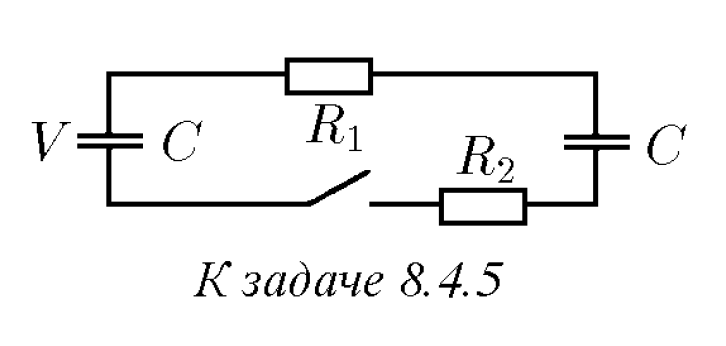 | ||
| Initially, there are charge $q=CV$ and energy $CV^2/2$ stored on the left capacitor. When the circuit is closed, the same current flows through both resistors and the ratio of the heat generated in each of them is | |||
| \[\frac{Q_1}{Q_2}=\frac{R_1}{R_2}.\] | |||
| When the circuit reaches steady state and there is no current, there are charge $q/2$ and energy $(q/2)^2/(2C)=CV^2/8$ stored on each capacitor. Thus, the total heat generated is | |||
| \[Q_1+Q_2=\frac{1}{2}CV^2-2\cdot\frac{1}{8}CV^2=\frac{1}{4}CV^2.\] | |||
| @@ -16,8 +16,10 @@Solution | |||
| Solving both displayed equations for $Q_1$ and $Q_2$, we have | |||
| − | \[Q_1=\frac{1}{4}CV^2\cdot\frac{R_1}{R_1+R_2}\qquad\mbox\qquad Q_2=\frac{1}{4}CV^2\cdot\frac{R_2}{R_1+R_2}.\] | ||
| + | \[Q_1=\frac{1}{4}CV^2\cdot\frac{R_1}{R_1+R_2}\qquad\mbox{and}\qquad Q_2=\frac{1}{4}CV^2\cdot\frac{R_2}{R_1+R_2}.\] | ||
| #### Answer | |||
| − | [Insert a concise answer or boxed result] | ||
| + | $Q_1=\frac{1}{4}CV^2\cdot\frac{R_1}{R_1+R_2}$ | ||
| + | |||
| + | $Q_2=\frac{1}{4}CV^2\cdot\frac{R_2}{R_1+R_2}$ | ||
| @@ -1,10 +1,10 @@ | |||
| ### Statement | ### Statement | ||
| $8.4.5.$ [Insert the problem statement] | $8.4.5.$ Find the amount of heat released at each resistance after closing the switch. One capacitor was initially charged to a voltage of $V$, and the second was not charged. | ||
| ### Solution | ### Solution | ||
|  | ||
| Initially, there are charge $q=CV$ and energy $CV^2/2$ stored on the left capacitor. When the circuit is closed, the same current flows through both resistors and the ratio of the heat generated in each of them is | Initially, there are charge $q=CV$ and energy $CV^2/2$ stored on the left capacitor. When the circuit is closed, the same current flows through both resistors and the ratio of the heat generated in each of them is | ||
| \[\frac{Q_1}{Q_2}=\frac{R_1}{R_2}.\] | \[\frac{Q_1}{Q_2}=\frac{R_1}{R_2}.\] | ||
| When the circuit reaches steady state and there is no current, there are charge $q/2$ and energy $(q/2)^2/(2C)=CV^2/8$ stored on each capacitor. Thus, the total heat generated is | When the circuit reaches steady state and there is no current, there are charge $q/2$ and energy $(q/2)^2/(2C)=CV^2/8$ stored on each capacitor. Thus, the total heat generated is | ||
| \[Q_1+Q_2=\frac{1}{2}CV^2-2\cdot\frac{1}{8}CV^2=\frac{1}{4}CV^2.\] | \[Q_1+Q_2=\frac{1}{2}CV^2-2\cdot\frac{1}{8}CV^2=\frac{1}{4}CV^2.\] | ||
| @@ -16,8 +16,10 @@Solution | |||
| Solving both displayed equations for $Q_1$ and $Q_2$, we have | Solving both displayed equations for $Q_1$ and $Q_2$, we have | ||
| \[Q_1=\frac{1}{4}CV^2\cdot\frac{R_1}{R_1+R_2}\qquad\mbox\qquad Q_2=\frac{1}{4}CV^2\cdot\frac{R_2}{R_1+R_2}.\] | \[Q_1=\frac{1}{4}CV^2\cdot\frac{R_1}{R_1+R_2}\qquad\mbox{and}\qquad Q_2=\frac{1}{4}CV^2\cdot\frac{R_2}{R_1+R_2}.\] | ||
| #### Answer | #### Answer | ||
| [Insert a concise answer or boxed result] | $Q_1=\frac{1}{4}CV^2\cdot\frac{R_1}{R_1+R_2}$ | ||
| $Q_2=\frac{1}{4}CV^2\cdot\frac{R_2}{R_1+R_2}$ | |||