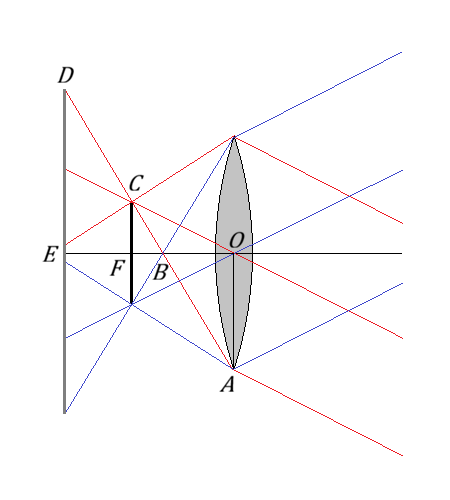
13.3.10. When photographing the Moon, a blurry image was obtained in the form of a disk of radius $r_1$. A sharp image of the Moon would have a radius of $r_2$. Determine how much distance you need to move the photographic plate so that the image on it turns out sharp. The focal length of the lens is $f$, the diameter is $D$, with $r_1>D/2>r_2$. The image area is considered to be the area where light hits the photographic plate.
Solution
For problem $13.3.10$
There is an error in the inequality in the original problem, which makes it nonsensical. The inequality in the problem stated above is correct. Since the moon is far away, the sharp image (shown as a thick black line segment) is formed almost on the focal plane, so $OB+BF=OF=f$. From the similarity of $\triangle OAB$ and $\triangle FCB$, we have $OB/BF=OA/FC=(D/2)/r_2$. Solving for $BF$, we have $BF=fr_2/(r_2+D/2)$.
Suppose the blurry image (shown as a thick gray line segment) is formed on the plane through point $E$. From the similarity of $\triangle FCB$ and $\triangle EDB$, we have $BE/BF=ED/FC=r_1/r_2$, and so $BE=fr_1/(r_2+D/2)$. If the photographic plate used to be where the blurry image is, we need to move it toward the lens through the distance $EF=BE-BF=f(r_1-r_2)/(r_2+D/2)$ to obtain a sharp image.