| @@ -1,22 +1,38 @@ |
| ### Statement |
| ### Statement |
| |
| |
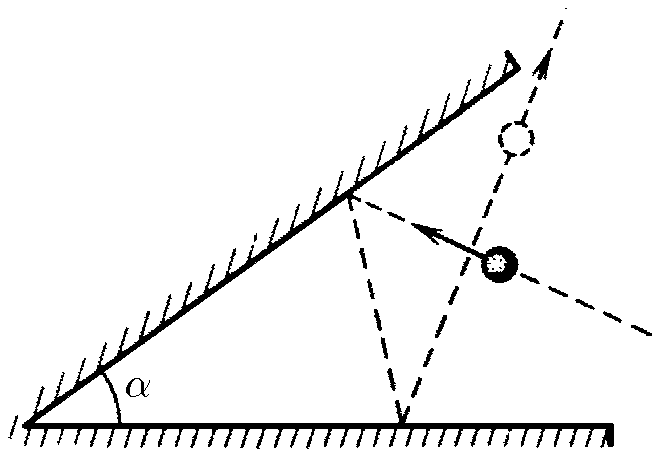
| $1.1.19.$ By what angle will the direction of velocity of the ball change after two elastic impacts on the walls, the angle between which is equal to $\alpha$? How will the ball fly if the angle $\alpha = \pi /2$? The motion occurs in a plane perpendicular to the walls. In an elastic collision with a smooth stationary wall, the angle of incidence of the ball is equal to the angle of reflection. |
| $1.1.19.$ By what angle will the direction of velocity of the ball change after two elastic impacts on the walls, the angle between which is equal to $\alpha$? How will the ball fly if the angle $\alpha = \pi /2$? The motion occurs in a plane perpendicular to the walls. In an elastic collision with a smooth stationary wall, the angle of incidence of the ball is equal to the angle of reflection. |
| |
| |
|  |
|  |
| |
| |
| ### Solution |
| ### Solution |
| |
| |
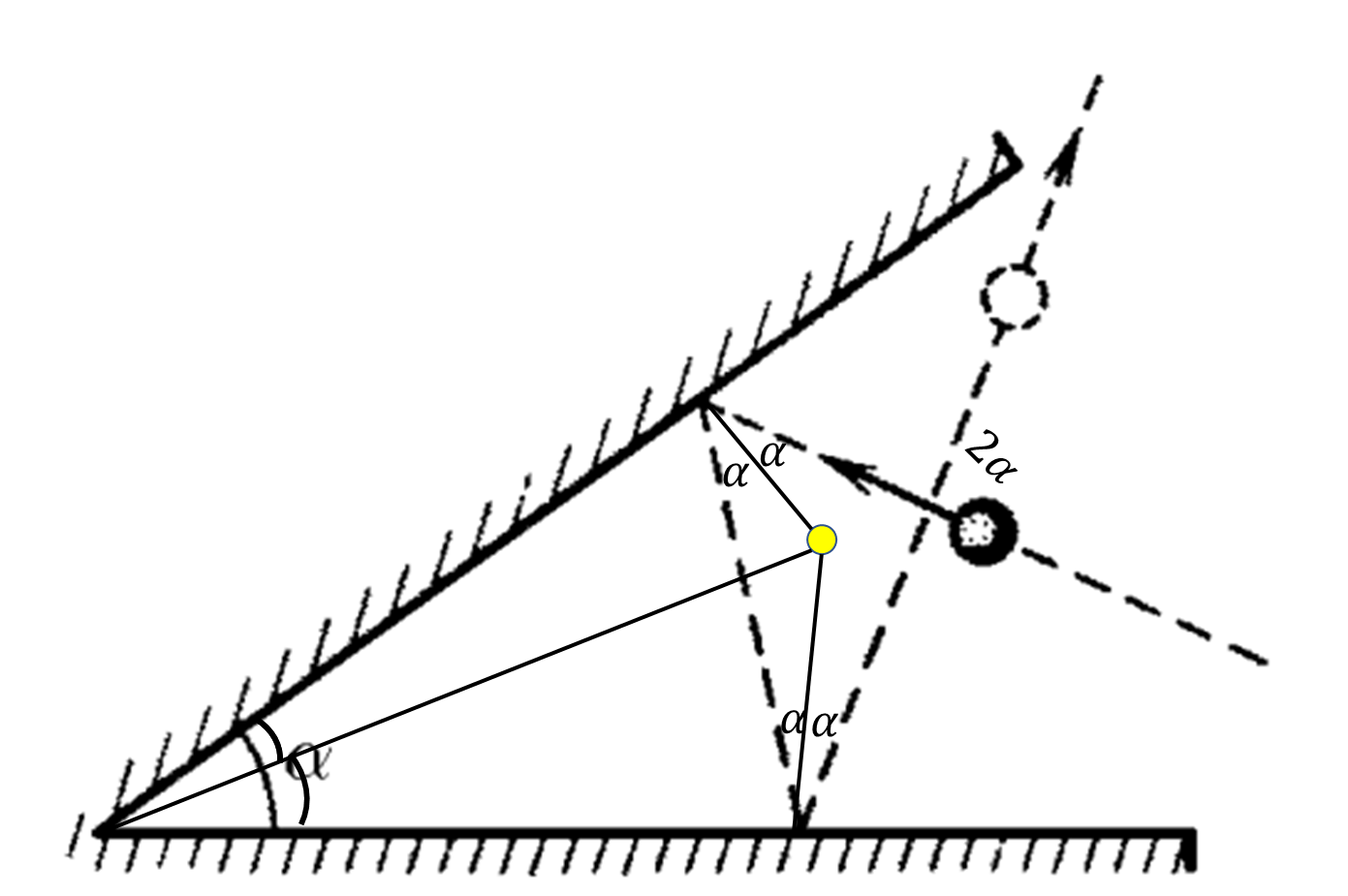
| When falling elastically on a horizontal plane, the angle of incidence is equal to the angle of reflection. |
|  |
| |
| |
|  |
| <b>1. Angle between the normals</b><br> |
| |
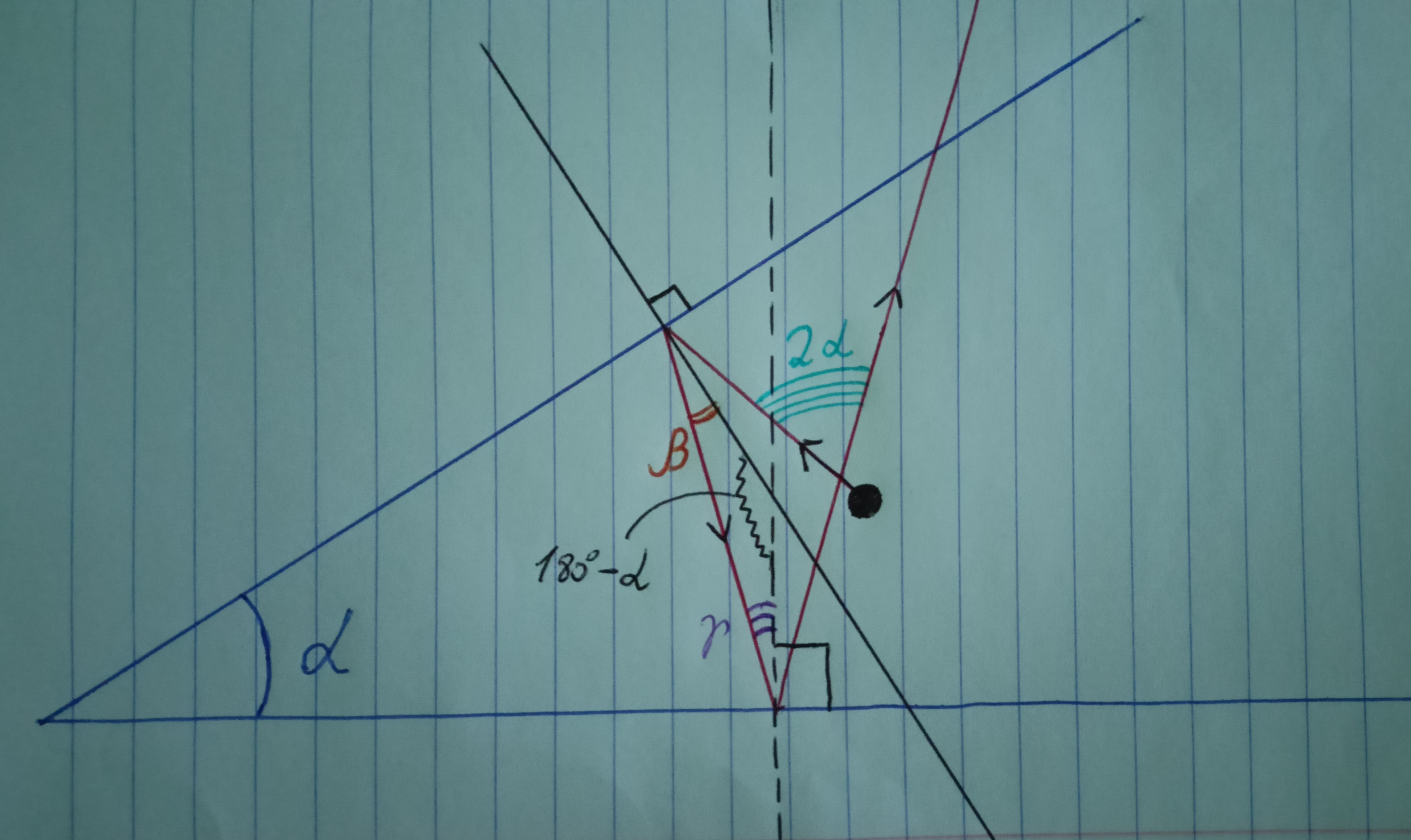
| Consider the quadrilateral formed by the wedge's vertex (with angle $\alpha$), the two points of the ball's impact on the walls, and the intersection point of the perpendiculars (normals) drawn to them. Since the perpendiculars form 90° angles with the walls, the sum of the remaining two angles of this quadrilateral is 180°. Therefore, the angle between the normals at their intersection is $180^\circ - \alpha$. |
| |
| |
| Thus, the direction of velocity of the ball after two elastic impacts will change by the angle $\beta = 2\alpha$ |
| <b>2. Relationship between the angles of incidence and the wedge angle</b><br> |
| |
| Let us examine the triangle formed by the ball's trajectory (the red line) between the two collisions and the two normals. |
| |
| The internal angles of this triangle adjacent to the normals are the angles of incidence $\beta$ and $\gamma$. The third angle is the previously found intersection angle of the normals, $180^\circ - \alpha$. |
| |
| Since the sum of the angles in any triangle is 180°, we can write the equation: |
| |
| $$ \beta + \gamma + (180^\circ - \alpha) = 180^\circ $$ |
| |
| This directly leads to the key equality: |
| |
| $$ \beta + \gamma = \alpha $$ |
| |
| |
| When $\alpha =\pi /2$, $\beta = \pi$, i.e., the ball will fly in the opposite direction.. |
| <b>3. Change in velocity direction</b><br> |
| |
| With each elastic reflection, the velocity vector rotates by an angle of $180^\circ - 2\theta$, where $\theta$ is the angle of incidence relative to the normal. |
| |
| Since the ball undergoes two consecutive impacts, the total rotation angle of the velocity vector $\Delta$ will be: |
| |
| $$ \Delta = (180^\circ - 2\beta) + (180^\circ - 2\gamma) = 360^\circ - 2(\beta + \gamma) $$ |
| |
| Substituting our equality $\beta + \gamma = \alpha$ into this, we get: |
| |
| $$ \Delta = 360^\circ - 2\alpha $$ |
| |
| Geometrically, the rotation of a vector by an angle of $360^\circ - 2\alpha$ means that the final angle between the initial and final directions is exactly $2\alpha$ (marked with a triple blue arc on the drawing). |
| |
| |
| |
| <i>For $\alpha = \pi/2$:</i><br> |
| |
| The direction will change by $2 \cdot (\pi/2) = \pi$, meaning the ball will move in the strictly opposite direction. |
| |
| |
| #### Answer |
| #### Answer |
| |
| By an angle of $2\alpha$. In the direction opposite to the initial one. |
| |
| |
| $\beta = 2\alpha$. In the direction opposite to the initial |
| |
| |
| |
| |
| |
| |
| |
