Решение на момент правки #20867 от , автор Valter. Это не текущая версия.

Statement

2.7.45. Two identical dumbbells fly toward each other with speeds and as shown in the figure. The distance between the balls of a dumbbell is . How will the dumbbells move after the elastic collision?
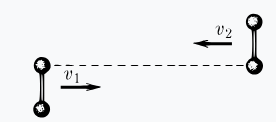
For problem $2.7.45$
For problem

Solution

Let the -axis point to the right. The upper ball of the left dumbbell and the lower ball of the right dumbbell lie on the same horizontal line, so the first collision occurs between them, and it is a central one.


First collision.
The impulse of the collision is horizontal, i.e. perpendicular to the rods, and a massless rod cannot transmit to the second ball a force perpendicular to itself. Therefore the second ball of each dumbbell does not take part in the collision. Two identical balls collide and exchange velocities: the upper ball of the left dumbbell acquires velocity (to the left), and the lower ball of the right dumbbell acquires velocity (to the right).

As a result, both dumbbells have identical end velocities: the upper ball moves to the left with speed , and the lower ball moves to the right with speed .

The velocity of the center of mass of both dumbbells (directed to the right):

The velocity of each ball relative to the center of mass is , so both dumbbells rotate counterclockwise with the same angular velocity:

Second collision.
The centers of mass of the dumbbells move with the same velocity, and the dumbbells rotate synchronously. Therefore the center of the right dumbbell is always higher than the center of the left one by , and balls of different dumbbells can coincide only when the dumbbells are vertical, i.e. after a rotation by , The nearest such moment is a rotation by , at which each dumbbell is flipped over. Then the lower ball of the left dumbbell ends up on top and meets the upper ball of the right dumbbell, which has ended up at the bottom. The time until the second collision:

During a rotation by the velocity of the center of mass does not change, while the rotational part of the velocity changes sign. Therefore, just before the second collision:

  • the lower ball of the left dumbbell (now on top): , i.e. it moves to the left with speed ;
  • the upper ball of the right dumbbell (now at the bottom): , i.e. it moves to the right with speed .

The balls move toward each other and again exchange velocities: the ball of the left dumbbell gets , and the ball of the right dumbbell gets .

The other balls of the dumbbells do not take part in the collision. The left one (now at the bottom) has velocity , and the right one (now on top) has velocity .

Thus both balls of the left dumbbell have velocity (to the right), and both balls of the right dumbbell have velocity (to the left). The rotation of both dumbbells stops.

Check: the total momentum before the collisions, , equals the total momentum after the collisions, .

Answer

After the time the second collision occurs, after which the rotation stops. The dumbbells then move purely translationally: the left one with speed to the right, the right one with speed to the left. It is as if the dumbbells passed through each other.

Note: The official answer in the problem book contains a typo. The time is given as , which corresponds to a rotation by only a quarter turn (), but for the balls to meet again a rotation by exactly half a turn () is required.