5.8.6∗. Solve problems 5.8.5 if the initial tangent of the angle of incidence is $\frac{1}{m}$, where $m$ is an integer.
Solution
For problem $5.8.6$
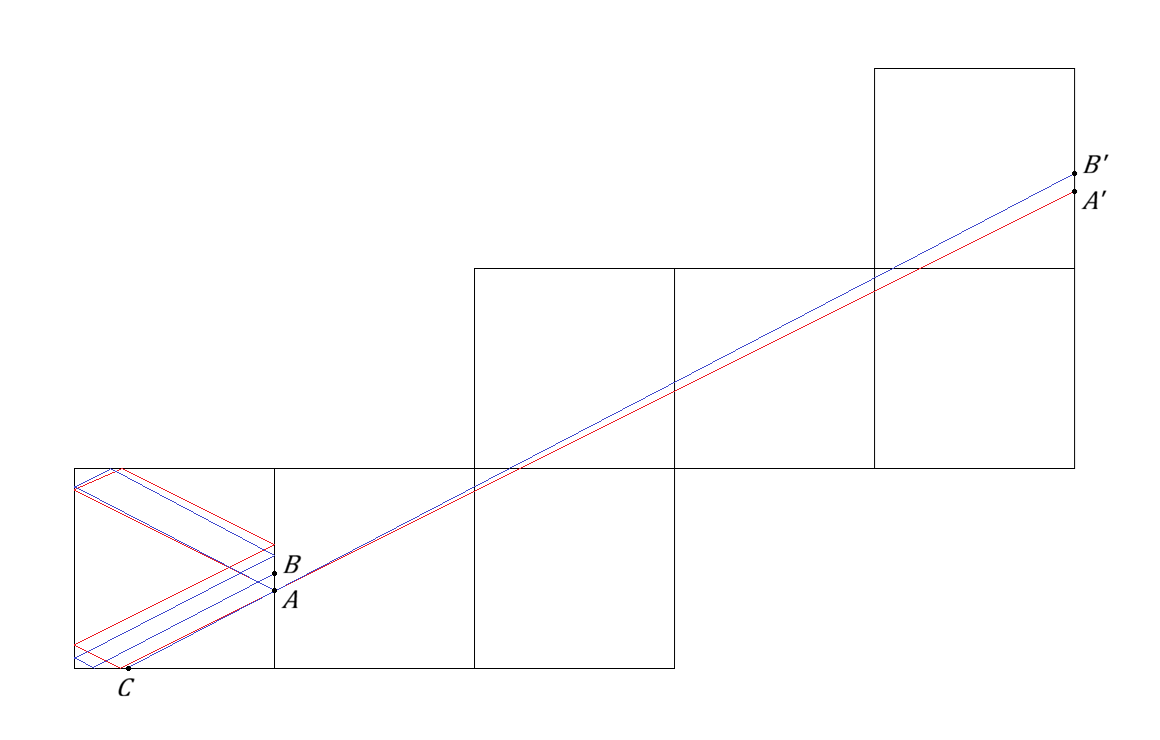
The closed trajectory of an atom when the incident angle is $\theta=\arctan(1/m)$ is shown in red for $m=2$. (The plane of the trajectory is a square parallel to a face of the cube.) The trajectory in the square from $A$ returning to $A$ can be unfolded into a line segment from $A$ to $A'$ by the symmetry of reflection, where the horizontal distance is $2ma$ and the vertical distance is $2a$.
The trajectory of an atom when the incident angle is increased by $\Delta\ll1$ on the plane of the square is shown in blue. The trajectory from $A$ to $B$ in the square can be unfolded into a line segment from $A$ to $B'$, where the horizontal distance is also $2ma$ and the vertical distance is $2ma\tan(\theta+\Delta)$. Consequently, the drifting of the impact site from $A$ to $B$ is equal to $A'B'=2ma\tan(\theta+\Delta)-2a$. The trajectory will be closed when $a$ and $AB$ are commensurable, i.e.
and we have $A'B'\approx2ma(\sec\theta)^2\Delta$. Since the travel time of the atom from $A$ to $B'$ (or from $A$ to $B$ in the square) is $2ma\sec(\theta+\Delta)/v$, the drifting speed of the impact site is
Typically, however, the trajectory will not be closed, because rational numbers are less abundant than irrational numbers. (Technically speaking, rational numbers are countable, while irrational numbers are not.) When the trajectory is not closed, it will fill the plane of the square, and the distance between adjacent parallel sections of the trajectory is practically zero. Consequently, the probability of finding the atom in a square of area $S$ is $S/a^2$. Similarly, if the incident angle is increased by $\Delta$ perpendicular to the plane of the square and the trajectory fills the cube, then the probability of finding the atom in a cube of volume $V$ is $V/a^3$.
(Note that line segment $AC$ serves only to show the small change $\Delta$ in the incident angle but is not part of the blue trajectory.)