Новое решение

en/14.4.24.md
+27 −0
| @@ -0,0 +1,27 @@ | |||
| + | ### Statement | ||
| + | |||
| + | $14.4.24.$ Complete the task 14.4.23 if the area occupied by the magnetic field is moving perpendicular to its boundary with the velocity $\beta_1 c$. | ||
| + | |||
| + | ### Solution | ||
| + | |||
| + |  | ||
| + | |||
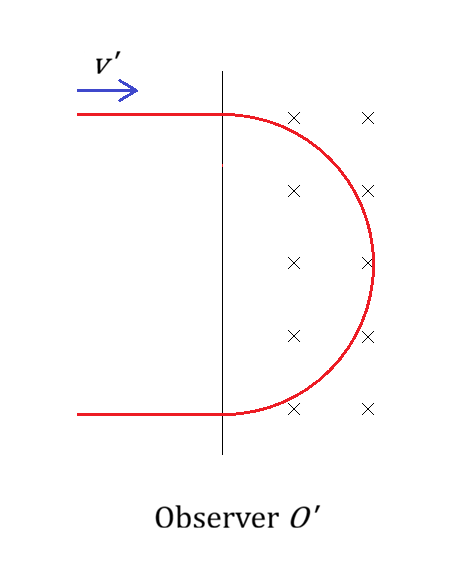
| + | Suppose Observer $O$ sees an electron moving to the right with the speed $v=\beta c$ and the region producing the magnetic field moving to the left with the speed $v_1=\beta_1 c$. Then, Observer $O'$ moving with the region sees the electron entering the region with the speed | ||
| + | |||
| + | \[v'=\frac{v+v_1}{1+vv_1/c^2}=\frac{(\beta+\beta_1)c}{1+\beta\beta_1}.\] | ||
| + | |||
| + | Let | ||
| + | |||
| + | \[\gamma'=\frac{1}{\sqrt{1-(v'/c)^2}}=\frac{1+\beta\beta_1}{\sqrt{(1+\beta\beta_1)^2-(\beta+\beta_1)^2}}=\frac{1+\beta\beta_1}{\sqrt{(1-\beta^2)(1-\beta_1^2)}}.\] | ||
| + | |||
| + | From Problem 14.4.23, Observer $O'$ witnesses the electron moving along a semicircular arc in the region for the duration of | ||
| + | |||
| + | \[T'=\frac{\pi m_e\gamma'}{eB}=\frac{\pi m_e(1+\beta\beta_1)}{eB\cdot\sqrt{(1-\beta^2)(1-\beta_1^2)}},\] | ||
| + | |||
| + | where $B$ is the magnetic field produced in the region. As a result of time dilation, Observer $O$ records the duration as | ||
| + | |||
| + | \[T=\frac{T'}{\sqrt{1-\beta_1^2}}=\frac{\pi m_e(1+\beta\beta_1)}{eB(1-\beta_1^2)\sqrt{1-\beta^2}}.\] | ||
| + | |||
| + | #### Answer | ||
| + | |||
| + | $\frac{\pi m_e(1+\beta\beta_1)}{eB(1-\beta_1^2)\sqrt{1-\beta^2}}$ | ||
| @@ -0,0 +1,27 @@ | |||
| ### Statement | |||
| $14.4.24.$ Complete the task 14.4.23 if the area occupied by the magnetic field is moving perpendicular to its boundary with the velocity $\beta_1 c$. | |||
| ### Solution | |||
|  | |||
| Suppose Observer $O$ sees an electron moving to the right with the speed $v=\beta c$ and the region producing the magnetic field moving to the left with the speed $v_1=\beta_1 c$. Then, Observer $O'$ moving with the region sees the electron entering the region with the speed | |||
| \[v'=\frac{v+v_1}{1+vv_1/c^2}=\frac{(\beta+\beta_1)c}{1+\beta\beta_1}.\] | |||
| Let | |||
| \[\gamma'=\frac{1}{\sqrt{1-(v'/c)^2}}=\frac{1+\beta\beta_1}{\sqrt{(1+\beta\beta_1)^2-(\beta+\beta_1)^2}}=\frac{1+\beta\beta_1}{\sqrt{(1-\beta^2)(1-\beta_1^2)}}.\] | |||
| From Problem 14.4.23, Observer $O'$ witnesses the electron moving along a semicircular arc in the region for the duration of | |||
| \[T'=\frac{\pi m_e\gamma'}{eB}=\frac{\pi m_e(1+\beta\beta_1)}{eB\cdot\sqrt{(1-\beta^2)(1-\beta_1^2)}},\] | |||
| where $B$ is the magnetic field produced in the region. As a result of time dilation, Observer $O$ records the duration as | |||
| \[T=\frac{T'}{\sqrt{1-\beta_1^2}}=\frac{\pi m_e(1+\beta\beta_1)}{eB(1-\beta_1^2)\sqrt{1-\beta^2}}.\] | |||
| #### Answer | |||
| $\frac{\pi m_e(1+\beta\beta_1)}{eB(1-\beta_1^2)\sqrt{1-\beta^2}}$ | |||