
Solutions of Savchenko Problems in Physics
    <h3 id="back-link"><a href="/#1.4">$\leftarrow$Back</a></h3>

    <h3> Statement </h3>
    <p>
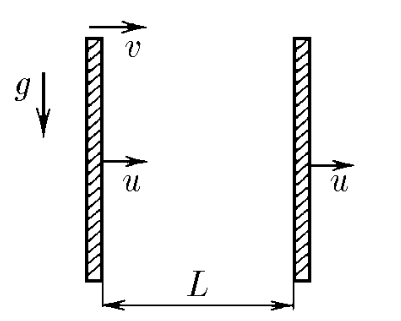
        $1.4.12.$ A body flies horizontally at speed $v$ into the space between two vertical walls that move at speed $u$. Determine the speed of the body after the $n$-th impact on the front wall. Distance between walls $L$. The blows are absolutely elastic.
    <h3>Solution</h3>
    <p>
        <center>
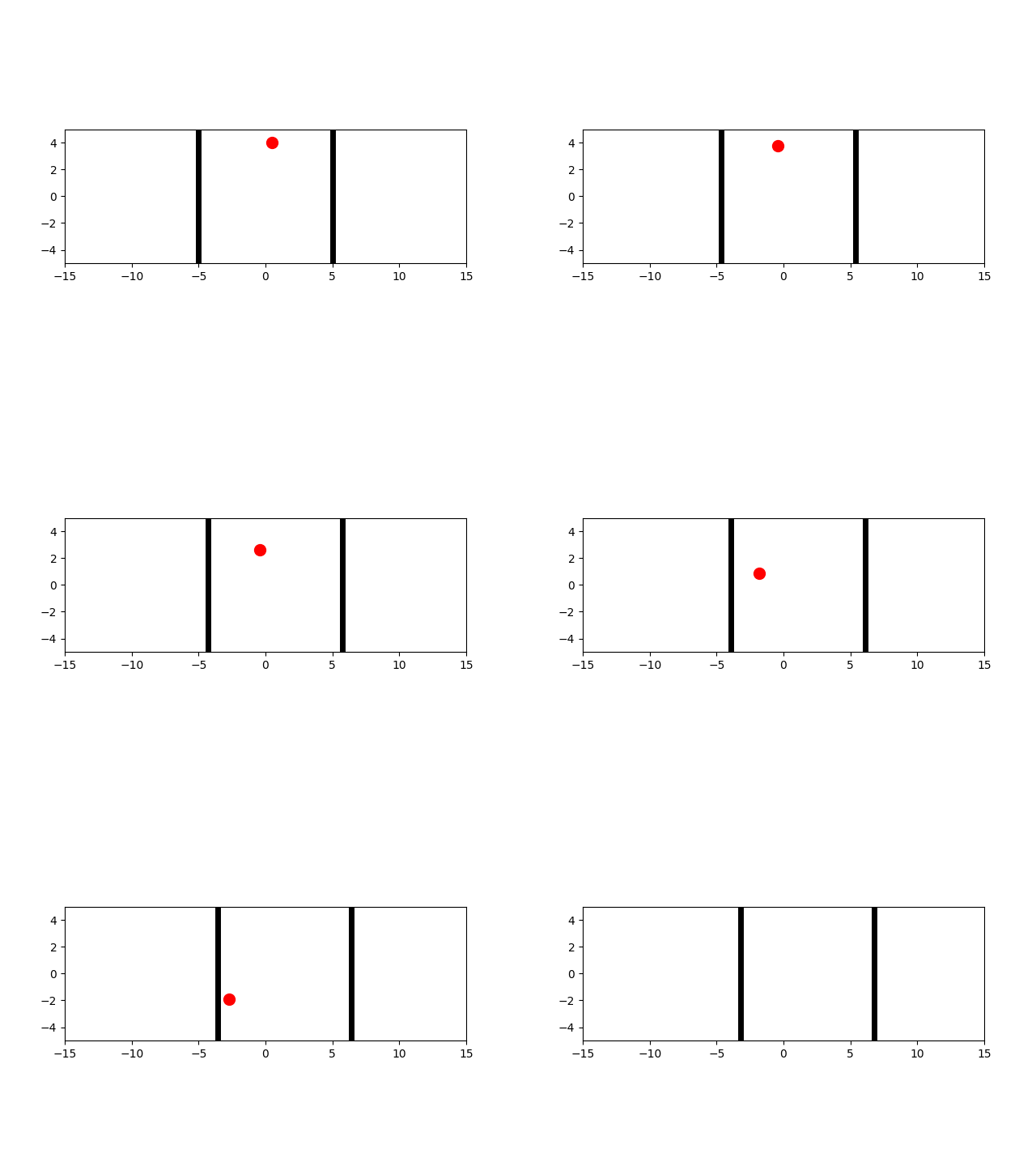
Let's consider how the velocity
When the body flies to the right wall,
Similarly, after hitting the left wall,
Thus, always after hitting the right wall, the speed of
And the time between
Since there are no collisions in the vertical plane, the velocity
And in the general case:
    <h4>Answer</h4>
    <p>
        The projection of the velocity on the horizontal direction $v_x = v −2u$; the projection of the velocity on the vertical direction $$v_y = (2n − 1)g L \frac{2(v-u)}{v(v-2u)}$$
    </p>


<footer class="row container">
  <br>
    <p>
        <small> © <strong>Savchenko Solutions</strong>, 2023-2024 <br></small>
    </p>
    <p>
        <small>All rights belong to the authors. <br> Commercial use of materials - with the written permission of the authors. <br> aliaksandr@savchenkosolutions.com <br></small>
    </p>
</footer>