
 Savchenko Solutions
    <h3 id="back-link"><a href="/#1.3">$\leftarrow$Back</a></h3>

    <h3> Statement </h3>
    <p>
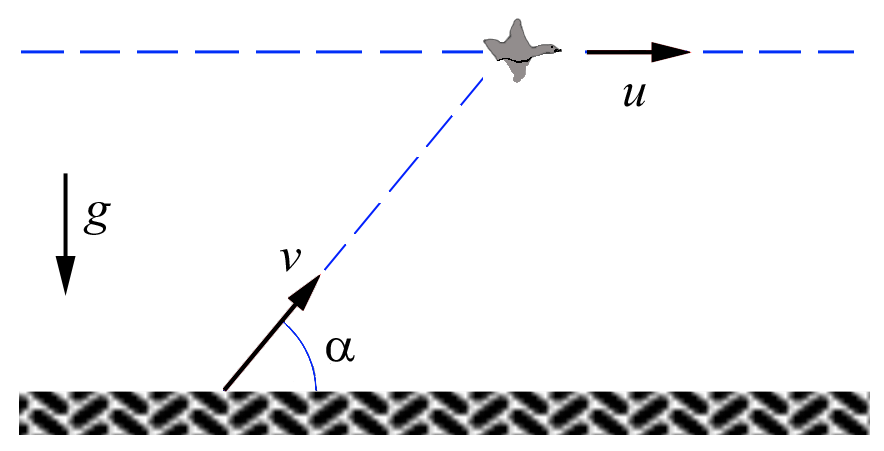
        $1.3.10.$ The duck was flying in a horizontal straight line with a constant speed $u$. An inexperienced "hunter" threw a stone at it, and the throw was made without pre-emption, i.e. at the time of the throw, the speed of the stone $v$ was directed just at the duck at an angle $\alpha$ to the horizon. At what height did the duck fly, if the rock still hit it?
    <h3>Solution</h3>
    <p>
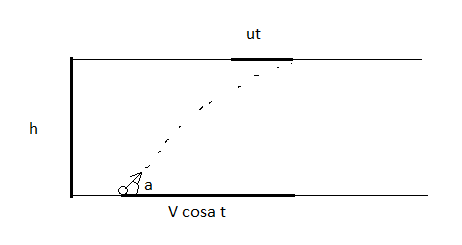
Let's consider this equation of motion:
    <h4>Answer</h4>
    <p>
        $$h=\frac{2utg^{2}\alpha}{g}(\nu cos\alpha -u)$$
    </p>

    <p style="text-align: right; font-style: italic; font-size: 14;">
      <a href="https://www.instagram.com/_den.di__/" target="_blank">Dzikan Danila</a>
    </p>
    </p>


<footer class="row container">
  <br>
    <p>
        <small> © <strong>Savchenko Solutions</strong>, 2023-2024 <br></small>
    </p>
    <p>
        <small>All rights belong to the authors. <br> Commercial use of materials - with the written permission of the authors. <br> alex@savchenkosolutions.com <br></small>
    </p>
</footer>