 Savchenko Solutions
    <h3 id="back-link"><a href="/#2.1">$\leftarrow$Back</a></h3>

    <h3> Statement </h3>
    <p>
        $2.1.28.$ On an icy section of the highway, the coefficient of friction between the wheels and the road is ten times less than on an un-icy one. How many times do you need to reduce the speed of the car so that the braking distance on an icy section of the highway remains the same?
    </p>

    <h3>Solution</h3>
    <p>
        <center>
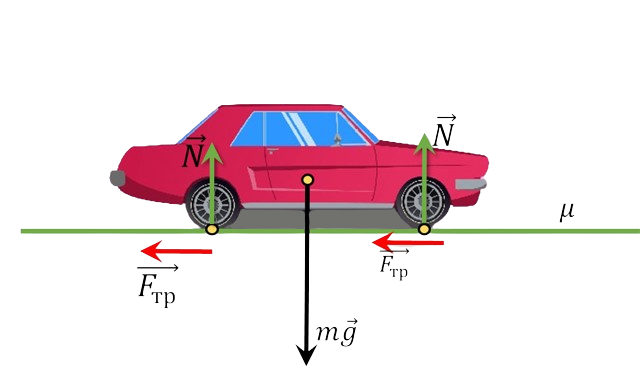
1. The external force when the car is moving is the friction force
2. The kinematic equations of motion in this case are represented as follows:
3. When substituting the values of acceleration and time into the second equation, we obtain the equation for the braking distance of a car
Hence the speed needs to be
reduced by
    <h4>Answer: $\sqrt{10}$ times</h4>


<footer class="row container">
  <br>
    <p>
        <small> © <strong>Savchenko Solutions</strong>, 2023-2024 <br></small>
    </p>
    <p>
        <small>All rights belong to the authors. <br> Commercial use of materials - with the written permission of the authors. <br> alex@savchenkosolutions.com <br></small>
    </p>
</footer>