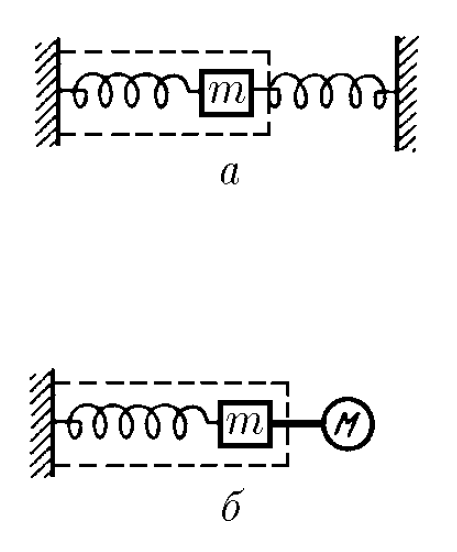
In the systems shown in the figure, free oscillations without friction occur. Show that the force acting on the oscillator highlighted by the dashed line is harmonic in nature.
Solution
For problem
The purpose of this exercise is to show that results obtained by considering mass and the left spring as a single oscillator are consistent with those obtained by considering mass alone in the top figure or masses and together in the bottom figure.
In the top figure, the forces acting on the oscillator are from the left wall and the right spring. If the displacement of mass from equilibrium is , then the force from the left wall is (as the left spring exerts the force on the left wall). Similarly, the force from the right spring is , and the total force on the oscillator is . As , the motion is harmonic in nature and consistent with what we would have obtained had we considered mass alone.
In the bottom figure, the forces acting on the oscillator are from the left wall and the rod connecting to mass . If the displacement of mass from equilibrium is , then the force from the left wall is . On the other hand, mass moves with acceleration and experiences the force from the rod. Consequently, the rod exerts the force on the oscillator, and the total force on the oscillator is . As
the motion is harmonic in nature and consistent with what we would have obtained had we considered masses and together.
Discussion
Log in to join the discussion