Statement
3.8.9∗. The tensile strength of ceramics and glasses is significantly lower than their compressive strength. As a result of a blow to the left end of a glass rod, a compression wave began to travel—a "half-wave" of a sinusoid with stress amplitude

Solution
In the statement, the tensile strength
Diagrams
We begin by looking at the stress diagrams (changes in pressure) after the forward traveling wave (see the figure for the problem) touches the free boundary of the rod, toward which the positive half-wave of stress was initially moving. In the diagrams, this free boundary coincides with the vertical axis, on which we plot the values of the stress
Suppose the forward traveling wave has entered the boundary by a distance less than
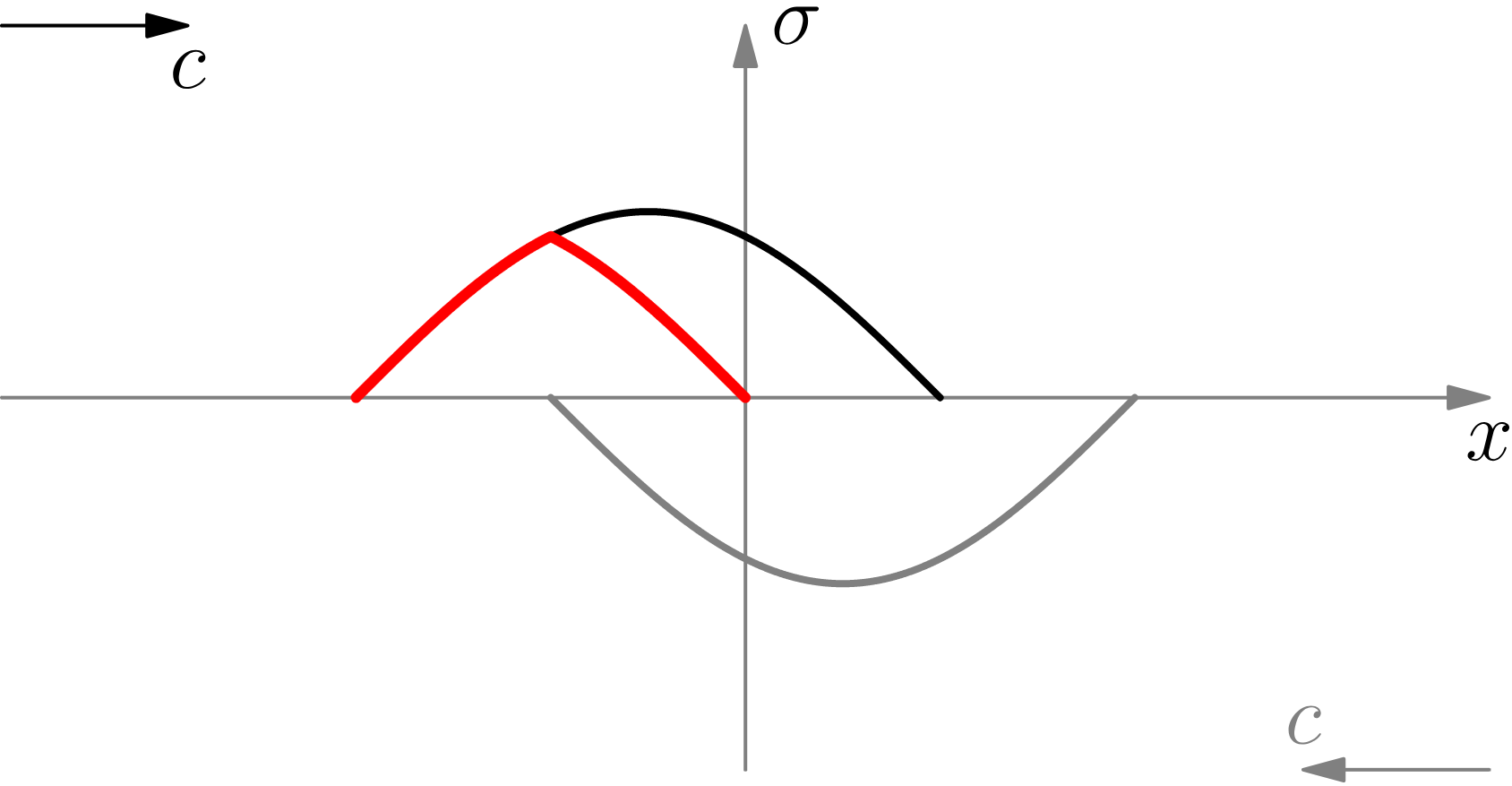
Analysis of Fig. D1 shows that when the forward wave has entered the boundary by a distance less than
Clearly, if the forward traveling wave has entered the boundary by a distance
Now suppose the forward traveling wave has entered the boundary by a distance greater(!) than
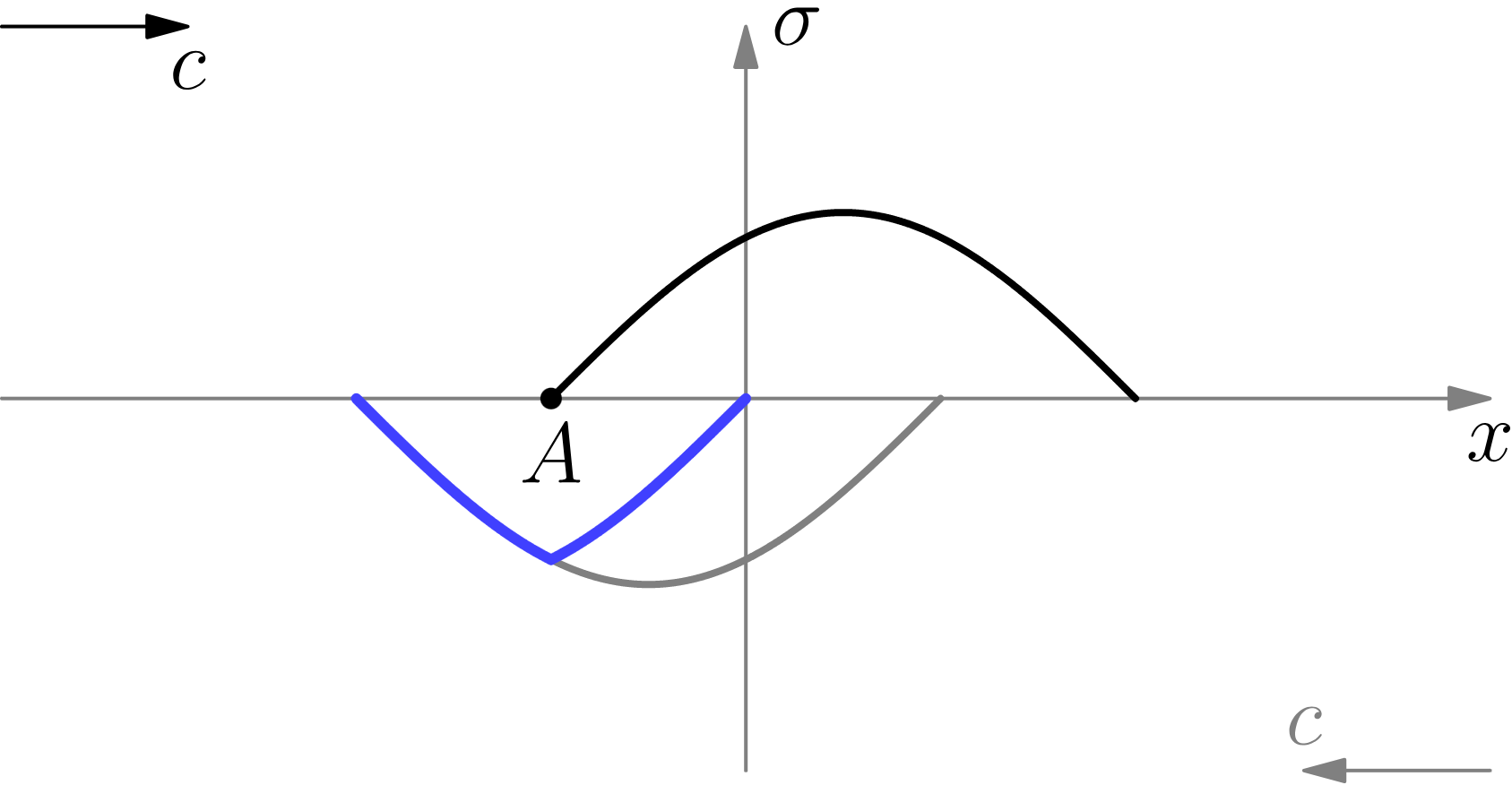
Analysis of Fig. D2 shows that when the forward wave has entered the boundary by a distance greater than
Spalling point
The cases corresponding to diagram D2 make it clear that the maximum tensile stress is always below the leftmost point of the forward traveling wave, below point
Someone will figure out that after the moment when the forward wave has entered the boundary by
If the rest of the solution is tied to point
Thus, the law of variation of the tensile stress after tension appears
Hence, taking into account
The distance from the boundary at which the maximum tension will be reached (see D2)
and
For
For
References
[1] V. I. Feodosyev. Strength of Materials. 1999.
[2] Physics of Explosion. L. P. Orlenko. Vol. 2. 2004.
[3] I. E. Irodov. Wave Processes. 2015.
[4] D. V. Sivukhin. Mechanics. 1979. (Mechanics of Elastic Bodies.)
Answer
For
For
Discussion
Log in to join the discussion