Statement
$6.5.27^*$. A conducting plate of thickness $c$ with dimensions $a \times a$ is placed into a parallel‑plate capacitor with plate dimensions $a \times a$ and separation $d$, as shown in the figure. Determine the force that must be applied to the plate to hold it in place if:
$a)$ the charge on the plates is $\pm Q$;
$b)$ a constant potential difference $V$ is maintained between the plates.
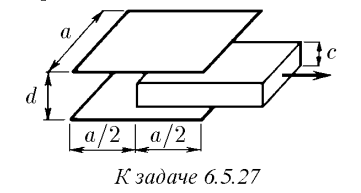
Solution
Let the plate be inserted into the capacitor to a depth $x$. Then the capacitance of the remaining part of the capacitor is
$$
C_1 = \frac{\varepsilon_0 a (a - x)}{d},
$$
and the plate effectively creates two more capacitors connected in series, each of capacitance
$$
C_2 = \frac{2\varepsilon_0 a x}{d - c}.
$$
Together,
$$
C_3 = \frac{1}{1/C_2 + 1/C_2} = \frac{\varepsilon_0 a x}{d - c}.
$$
The voltage across $C_1$ and $C_3$ is the same, so they can be considered as connected in parallel; the total capacitance of the system is then
$$
C = \frac{\varepsilon_0 a (a - x)}{d} + \frac{\varepsilon_0 a x}{d - c}.
$$
$$
C(a/2) = \frac{\varepsilon_0 a^2}{2d} + \frac{\varepsilon_0 a^2}{2(d - c)} = \frac{\varepsilon_0 a^2 (2d - c)}{2d(d - c)}.
$$
We shall need the quantity
$$
\zeta = \frac{dC}{dx} = \frac{\varepsilon_0 a c}{d(d - c)}.
$$
It is interesting that it does not depend on the position of the plate.
If we apply a force to the plate, we begin to do work by changing the capacitance, and hence the energy of the capacitor. Then the force is
$$
F = \pm \frac{dW_c}{dx} = \pm \frac{dW_c}{dC} \zeta.
$$
Care must be taken when choosing the formula for the energy, because in part $b)$ the work of the source is also allowed, and this may affect the answer. The choice of sign is also related to this, but if we only need the magnitude of the force, it is not so important. Therefore,
$$
F_a = -\frac{d}{dC}\left[\frac{Q^2}{2C}\right]_{C(a/2)} \cdot \zeta = \frac{Q^2}{2C(a/2)^2} \zeta,
$$
$$
F_b = \frac{d}{dC}\left[\frac{CV^2}{2}\right]_{C(a/2)} \cdot \zeta = \frac{V^2}{2} \zeta.
$$
$$
F_a = \frac{2Q^2 d c (d - c)}{\varepsilon_0 a^3 (2d - c)^2},
$$
$$
F_b = \frac{\varepsilon_0 a c V^2}{2d (d - c)}.
$$
Answer
$$
a. \ F = \frac{2Q^2 d c (d - c)}{\varepsilon_0 a^3 (2d - c)^2}
$$
$$
b. \ F = \frac{\varepsilon_0 a c V^2}{2d (d - c)}
$$
Discussion
Log in to join the discussion