Statement
$8.3.8.$ Switching the voltmeter to measure twice the voltage range (from $100$ to $200 \ V$), we expected the arrow to deviate by half the number of divisions. However, this did not happen, although nothing was changed in the rest of the chain. Will the voltmeter show a higher or lower voltage after switching?
Solution
Let $\mathcal{E}$ be the effective EMF of the part of the circuit connected to the voltmeter, and $R$ be its resistance.
Every real voltmeter has its own internal resistance $R_v$. To extend the measurement limit, an additional series resistor is connected inside the voltmeter. Why? This is related to the design of the instrument:
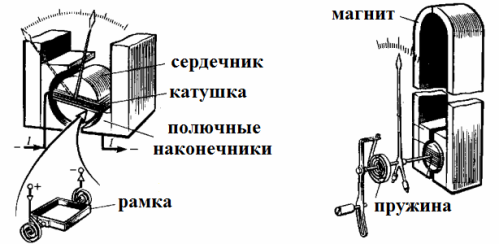
A permanent magnet is fixed in place. A stationary steel core is located between its poles so that a constant magnetic field is formed in the annular gap between the core and the pole pieces of the magnet.
A movable aluminum frame, on which a coil is wound with thin wire, is placed in the gap. The frame can rotate together with the coil. The pointer of the instrument is attached to the frame by means of spiral springs. Current is supplied to the coil through these springs.
When a current $I$ flows through the coil wire, since the coil is placed in a magnetic field and the current in its conductors flows perpendicular to the magnetic field lines in the gap, a rotating Ampere force will act on it. The coil, together with the frame and pointer, will rotate through a certain angle until this force is balanced by the torsion (restoring torque) of the spring.
The external field and the spring stiffness are constant, so a strictly defined current $I_0$ corresponds to the deflection up to the maximum scale division. Therefore, to measure a higher voltage, we must change the resistance of the instrument so that $U_{max}=R_vI_0$ holds.
When we increased the resistance of the voltmeter, it began to draw less current from the circuit. Consequently, the voltage drop across the internal (output) resistance of the circuit decreased, and the voltage directly at the terminals of the voltmeter increased.
Mathematically, the change in the measured voltage when the internal resistance is increased by a factor of $N$ can be described as follows:
$$
\frac{U_2}{U_1}=\frac{\mathcal{E}\frac{NR_v}{NR_v+R}}{\mathcal{E}\frac{R_v}{R_v+R}}=\frac{N(R_v+R)}{NR_v+R}
$$
$$
\frac{U_2}{U_1}>1 \quad for \ N>1
$$
Answer
$$
\boxed{Higher}
$$
Discussion
Log in to join the discussion