Edit to “Solution”

en/13.2.11.md
+1 −1
| ### Statement | |||
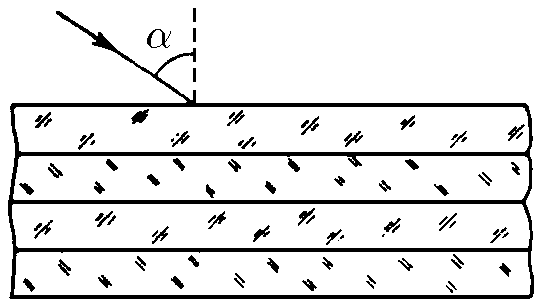
| $13.2.11$ What minimum angle of incidence should have a light ray that incides over a group of plane transparent plates (each one with refraction index decreasing $k$ times respect to the upper to it) such that the ray doesn't pass the group? The refraction index of the upper plate is $n$ and the amount of plates is $N$. | |||
|  | |||
| ### Solution | |||
| @@ -8,6 +8,6 @@Solution | |||
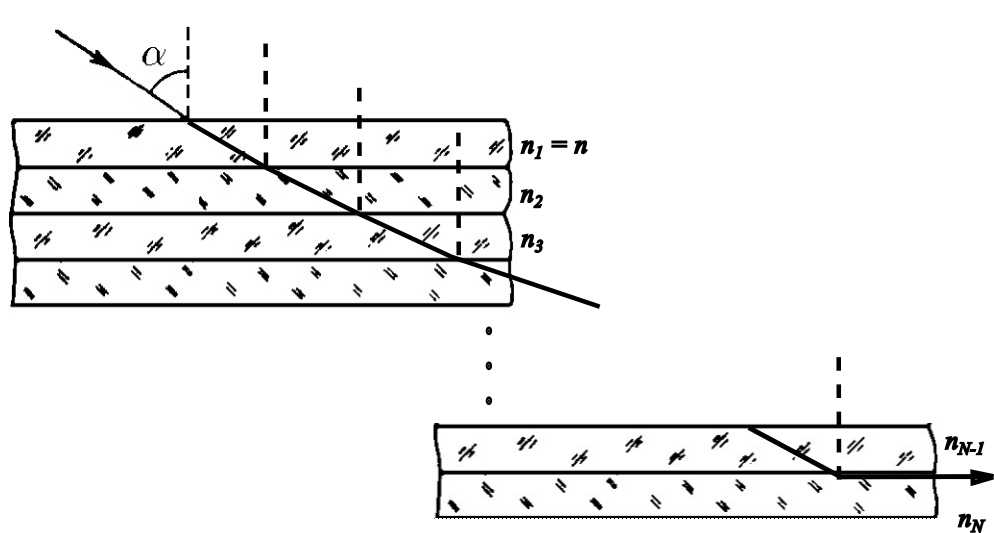
| Let's consider the following figure | |||
| − |  | ||
| + |  | ||
| Applying Snell's law for each interphase between media $$n_0 \sin{\alpha} = n_1 \sin{\alpha_1} = n \sin{\alpha_1}$$ $$n \sin{\alpha_1} = n_2 \sin{\alpha_2}$$ $$n_2 \sin{\alpha_2} = n_3 \sin{\alpha_3}$$ $$\vdots$$ $$n_{N-1} \sin{\alpha_{N-1}} = n_N \sin{\frac{\pi}{2}} = n_N$$ It's known that $n_2 = \frac{n}{k}$, $n_3 = \frac{n_2}{k}=\frac{n}{k^2}$, and so on. Then, $n_N=\frac{n}{k^{N-1}}$. The $N$-th refraction angle is $\frac{\pi}{2}$ beacause the ray doesn't pass this latest plate, i.e., there is a total reflection. $$n_m \sin{\alpha} = \frac{n}{k^{N-1}}$$ If exterior medium is air, $n_m = 1$, $$\boxed{\sin{\alpha}=\frac{n}{k^{N-1}}}$$ This angle $\alpha$ is the critical angle of the internal total reflection for this group of plates. | |||
| ### Statement | ### Statement | ||
| $13.2.11$ What minimum angle of incidence should have a light ray that incides over a group of plane transparent plates (each one with refraction index decreasing $k$ times respect to the upper to it) such that the ray doesn't pass the group? The refraction index of the upper plate is $n$ and the amount of plates is $N$. | $13.2.11$ What minimum angle of incidence should have a light ray that incides over a group of plane transparent plates (each one with refraction index decreasing $k$ times respect to the upper to it) such that the ray doesn't pass the group? The refraction index of the upper plate is $n$ and the amount of plates is $N$. | ||
|  |  | ||
| ### Solution | ### Solution | ||
| @@ -8,6 +8,6 @@Solution | |||
| Let's consider the following figure | Let's consider the following figure | ||
|  |
 | ||
| Applying Snell's law for each interphase between media $$n_0 \sin{\alpha} = n_1 \sin{\alpha_1} = n \sin{\alpha_1}$$ $$n \sin{\alpha_1} = n_2 \sin{\alpha_2}$$ $$n_2 \sin{\alpha_2} = n_3 \sin{\alpha_3}$$ $$\vdots$$ $$n_{N-1} \sin{\alpha_{N-1}} = n_N \sin{\frac{\pi}{2}} = n_N$$ It's known that $n_2 = \frac{n}{k}$, $n_3 = \frac{n_2}{k}=\frac{n}{k^2}$, and so on. Then, $n_N=\frac{n}{k^{N-1}}$. The $N$-th refraction angle is $\frac{\pi}{2}$ beacause the ray doesn't pass this latest plate, i.e., there is a total reflection. $$n_m \sin{\alpha} = \frac{n}{k^{N-1}}$$ If exterior medium is air, $n_m = 1$, $$\boxed{\sin{\alpha}=\frac{n}{k^{N-1}}}$$ This angle $\alpha$ is the critical angle of the internal total reflection for this group of plates. | Applying Snell's law for each interphase between media $$n_0 \sin{\alpha} = n_1 \sin{\alpha_1} = n \sin{\alpha_1}$$ $$n \sin{\alpha_1} = n_2 \sin{\alpha_2}$$ $$n_2 \sin{\alpha_2} = n_3 \sin{\alpha_3}$$ $$\vdots$$ $$n_{N-1} \sin{\alpha_{N-1}} = n_N \sin{\frac{\pi}{2}} = n_N$$ It's known that $n_2 = \frac{n}{k}$, $n_3 = \frac{n_2}{k}=\frac{n}{k^2}$, and so on. Then, $n_N=\frac{n}{k^{N-1}}$. The $N$-th refraction angle is $\frac{\pi}{2}$ beacause the ray doesn't pass this latest plate, i.e., there is a total reflection. $$n_m \sin{\alpha} = \frac{n}{k^{N-1}}$$ If exterior medium is air, $n_m = 1$, $$\boxed{\sin{\alpha}=\frac{n}{k^{N-1}}}$$ This angle $\alpha$ is the critical angle of the internal total reflection for this group of plates. | ||