Edit to “Solution”
en/2.6.14.md
+0 −4
| ### Statement | |||
| $2.6.14^*.$ Two stars of mass $m_1$ and $m_2$ form a binary system with a constant distance between the stars $R$. What is the period of rotation of the stars around the common center of mass? | |||
| ### Solution | |||
| @@ -6,9 +6,6 @@Solution | |||
|  | |||
| − | The position of the center of mass (point $O$) could be found as | ||
| − | |||
| − | $$ | ||
| R_1=R\frac{m_2}{m_1+m_2} | |||
| $$ | |||
| $$ | |||
| R_2=R-R_1=R\frac{m_1}{m_1+m_2} | |||
| $$ | |||
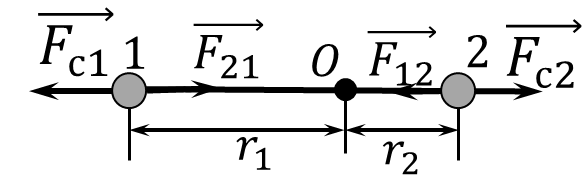
| Since the bodies are stationary, their accelerations are equal, and therefore, according to Newton's first law, the sum of external forces is zero | |||
| $$ | |||
| F_{c1}=F_{21} \quad F_{c2}=F_{12}\tag{1} | |||
| $$ | |||
| By definition of centripetal acceleration | |||
| $$ | |||
| F_{c1}=m_1\omega_1^2R_1\tag{2.1} | |||
| $$ | |||
| $$ | |||
| F_{c2}=m_2\omega_2^2R_2\tag{2.2} | |||
| $$ | |||
| Since the body $m_1$ and $m_2$ rotate along the same straight line | |||
| $$ | |||
| \omega_1=\omega_2=\omega | |||
| $$ | |||
| On the other hand, the force of their gravitational attraction is equal to | |||
| $$ | |||
| F_{12}=F_{21}=G\frac{m_1m_2}{R^2}\tag{4} | |||
| $$ | |||
| Given $(2)$, we equate $(1)$ and $(3)$ | |||
| $$ | |||
| G\frac{m_1m_2}{R^2}=m_1\omega^2R\frac{m_2}{m_1+m_2} | |||
| $$ | |||
| From where | |||
| $$ | |||
| \omega =\sqrt{\frac{G(m_1+m_2)}{R^3}} | |||
| $$ | |||
| @@ -59,7 +56,6 @@Solution | |||
| Whence the circulation period is equal to | |||
| $$ | |||
| − | \boxed{T=\frac{2\pi}{\omega}=2\pi\sqrt{\frac{R^3}{G(m_1+m_2)}}} | ||
| $$ | |||
| #### Answer | |||
| $$ | |||
| T=2\pi\sqrt{R^3/\gamma (m_1+m_2)} | |||
| $$ | |||
| unchanged lines 4 | |||
| ### Statement | ### Statement | ||
| $2.6.14^*.$ Two stars of mass $m_1$ and $m_2$ form a binary system with a constant distance between the stars $R$. What is the period of rotation of the stars around the common center of mass? | $2.6.14^*.$ Two stars of mass $m_1$ and $m_2$ form a binary system with a constant distance between the stars $R$. What is the period of rotation of the stars around the common center of mass? | ||
| ### Solution | ### Solution | ||
| @@ -6,9 +6,6 @@Solution | |||
|  |  | ||
| The position of the center of mass (point $O$) could be found as | |||
| $$ | |||
| R_1=R\frac{m_2}{m_1+m_2} | R_1=R\frac{m_2}{m_1+m_2} | ||
| $$ | $$ | ||
| $$ | $$ | ||
| R_2=R-R_1=R\frac{m_1}{m_1+m_2} | R_2=R-R_1=R\frac{m_1}{m_1+m_2} | ||
| $$ | $$ | ||
| Since the bodies are stationary, their accelerations are equal, and therefore, according to Newton's first law, the sum of external forces is zero | Since the bodies are stationary, their accelerations are equal, and therefore, according to Newton's first law, the sum of external forces is zero | ||
| $$ | $$ | ||
| F_{c1}=F_{21} \quad F_{c2}=F_{12}\tag{1} | F_{c1}=F_{21} \quad F_{c2}=F_{12}\tag{1} | ||
| $$ | $$ | ||
| By definition of centripetal acceleration | By definition of centripetal acceleration | ||
| $$ | $$ | ||
| F_{c1}=m_1\omega_1^2R_1\tag{2.1} | F_{c1}=m_1\omega_1^2R_1\tag{2.1} | ||
| $$ | $$ | ||
| $$ | $$ | ||
| F_{c2}=m_2\omega_2^2R_2\tag{2.2} | F_{c2}=m_2\omega_2^2R_2\tag{2.2} | ||
| $$ | $$ | ||
| Since the body $m_1$ and $m_2$ rotate along the same straight line | Since the body $m_1$ and $m_2$ rotate along the same straight line | ||
| $$ | $$ | ||
| \omega_1=\omega_2=\omega | \omega_1=\omega_2=\omega | ||
| $$ | $$ | ||
| On the other hand, the force of their gravitational attraction is equal to | On the other hand, the force of their gravitational attraction is equal to | ||
| $$ | $$ | ||
| F_{12}=F_{21}=G\frac{m_1m_2}{R^2}\tag{4} | F_{12}=F_{21}=G\frac{m_1m_2}{R^2}\tag{4} | ||
| $$ | $$ | ||
| Given $(2)$, we equate $(1)$ and $(3)$ | Given $(2)$, we equate $(1)$ and $(3)$ | ||
| $$ | $$ | ||
| G\frac{m_1m_2}{R^2}=m_1\omega^2R\frac{m_2}{m_1+m_2} | G\frac{m_1m_2}{R^2}=m_1\omega^2R\frac{m_2}{m_1+m_2} | ||
| $$ | $$ | ||
| From where | From where | ||
| $$ | $$ | ||
| \omega =\sqrt{\frac{G(m_1+m_2)}{R^3}} | \omega =\sqrt{\frac{G(m_1+m_2)}{R^3}} | ||
| $$ | $$ | ||
| @@ -59,7 +56,6 @@Solution | |||
| Whence the circulation period is equal to | Whence the circulation period is equal to | ||
| $$ | $$ | ||
| \boxed{T=\frac{2\pi}{\omega}=2\pi\sqrt{\frac{R^3}{G(m_1+m_2)}}} | |||
| $$ | $$ | ||
| #### Answer | #### Answer | ||
| $$ | $$ | ||
| T=2\pi\sqrt{R^3/\gamma (m_1+m_2)} | T=2\pi\sqrt{R^3/\gamma (m_1+m_2)} | ||
| $$ | $$ | ||
| unchanged lines 4 | |||