| @@ -1,44 +1,13 @@ |
| | | ### Statement |
| | | |
| | − | $3.3.11.$ [Insert problem description here] |
| | + | $3.3.11.$ Not completed period |
| | | |
| | − | __Example Statement__: |
| | − | $1.1.1.$ Determine the coordinate $x(t)$ of a body as a function of time $t$, given that its acceleration is defined as $a(t) = bt$, where $b$ is a constant. |
| | + | __Statement__: |
| | + | $3.3.11.$ |
| | + | 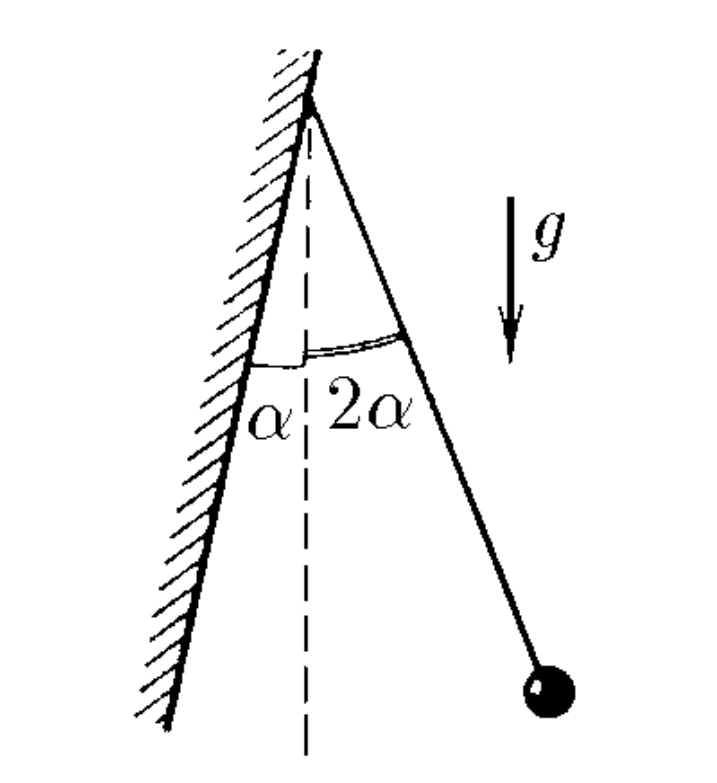 |
| | + | $$Pic.1.$$ |
| | + | A pendulum of length $L$ is suspended from an inclined wall. The pendulum is tilted from the vertical by a small angle, twice the angle of inclination of the wall to the vertical, and released. Find the period of oscillation of the pendulum if the impacts with the wall are perfectly elastic. (Look Pic1) |
| | | |
| | − | |
| | − | ### Solution |
| | − | |
| | − | [Your solution should be placed here] |
| | − | |
| | − | __Example Solution__: |
| | − | The acceleration of the body defined by |
| | − | |
| | − | $$a(t) = bt$$ |
| | − | |
| | − | We know that acceleration is the time derivative of velocity: |
| | − | |
| | − | $$a(t) = \frac{d v(t)}{d t}$$ |
| | − | |
| | − | To find the velocity $v(t)$, we integrate $a(t)$ with respect to time: |
| | − | |
| | − | $$v(t) = \int a(t) \, dt = \int b t \, dt$$ |
| | − | |
| | − | If the initial velocity is $v(0) = 0$, then the velocity becomes: |
| | − | |
| | − | $$v(t) = \frac{b t^2}{2}$$ |
| | − | |
| | − | Likewise, integrate $v(t)$ with respect to time: |
| | − | |
| | − | $$x(t)= \int v(t) \, dt = \frac{b}{2} \int t^2 \, dt$$ |
| | − | |
| | − | From where the coordinate from time, considering the initial conditions: |
| | − | |
| | − | $$\boxed{x(t)=\frac{bt^3}{6}}$$ |
| | − | |
| | − | #### Answer |
| | − | |
| | − | [Insert a concise answer or boxed result, like this:] |
| | − | |
| | − | |
| | − | __Example Answer__: |
| | − | $$ x(t)=\frac{bt^3}{6} $$ |
| | + | ### Solution and Answer |
| | + | 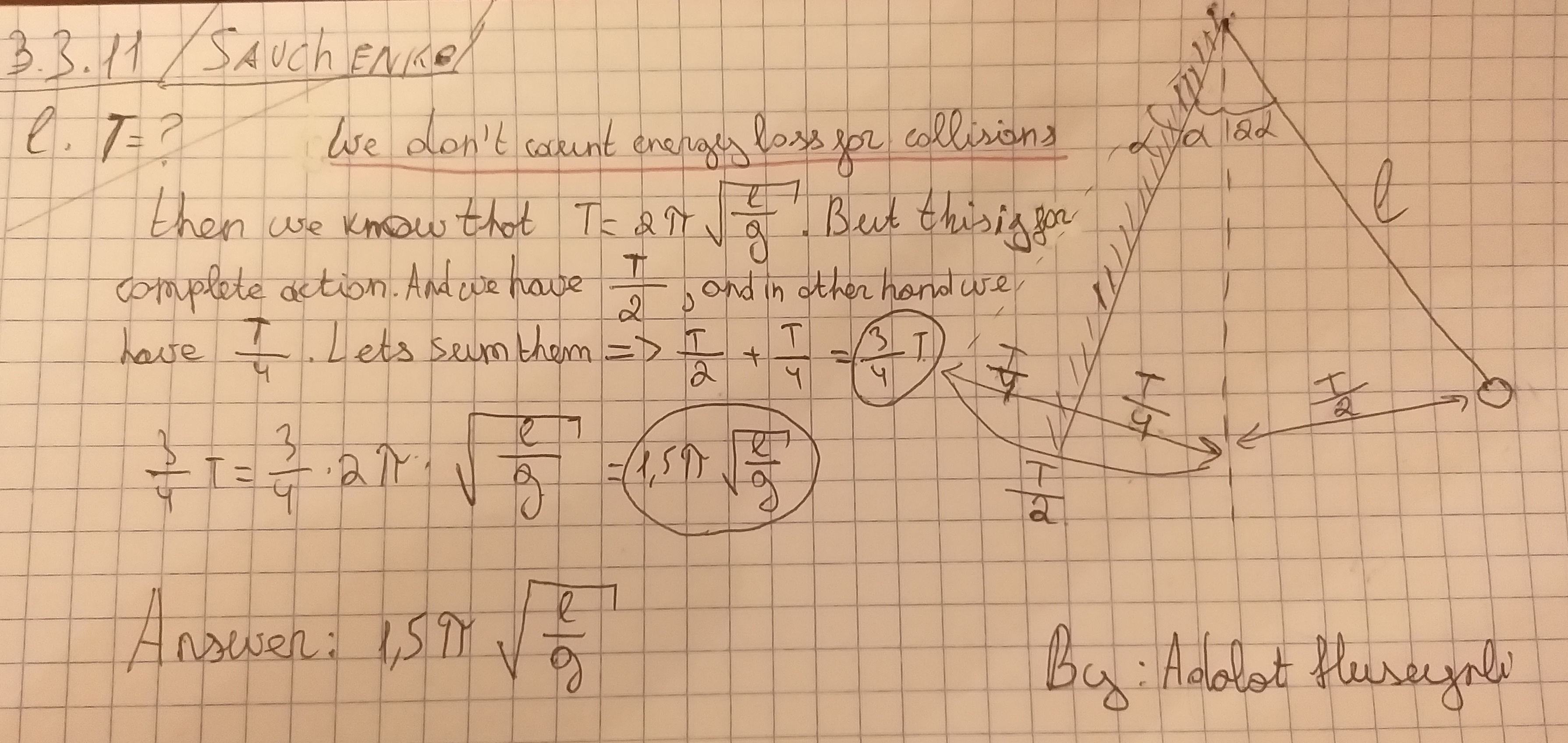 |
| | + | By Adalat Huseynli |