| @@ -1,44 +1,20 @@ |
| | | ### Statement |
| | | |
| | − | $10.2.1.$ [Insert problem description here] |
| | | |
| | − | __Example Statement__: |
| | − | $1.1.1.$ Determine the coordinate $x(t)$ of a body as a function of time $t$, given that its acceleration is defined as $a(t) = bt$, where $b$ is a constant. |
| | + | $10.2.1.$ Space is divided into two regions by a plane. In one region, a magnetic field |
| | + | of induction B_{1} is created, in the other — of induction $B_{2}$, and the fields are |
| | + | homogeneous and parallel to each other. An electron starts from the interface plane perpendicular to it with velocity v towards the region with field |
| | + | induction $B_{1}$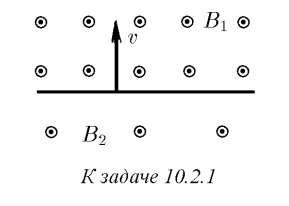. Describe the further movement of the electron. Determine the |
| | + | average (drift) velocity of an electron moving along the magnetic field interface that is permeable to it. |
| | | |
| | | |
| | | ### Solution |
| | | |
| | − | [Your solution should be placed here] |
| | + | $$v = \frac{\Delta R}{\Delta t}= \frac{2(R_{2}-R_{1})}{\frac{T_{1}+T_{2}}{2}}$$ , Radii of curvature for the circular paths in the two regions are : |
| | + | $R_{1} = \frac{mv}{eB_{1}} , R_{2} = \frac{mv}{eB_{2}}$ . Periods of revolution are $T_{1} = \frac{2\pi R_{1}}{v} ,T_{2} = \frac{2\pi R_{2}}{v} $ : $$v = \frac{2}{\pi}\frac{{B_{1}-B_{2}}}{{B_{1}+B_{2}}}$$ , the drift velocity in the field. |
| | | |
| | − | __Example Solution__: |
| | − | The acceleration of the body defined by |
| | | |
| | − | $$a(t) = bt$$ |
| | − | |
| | − | We know that acceleration is the time derivative of velocity: |
| | − | |
| | − | $$a(t) = \frac{d v(t)}{d t}$$ |
| | − | |
| | − | To find the velocity $v(t)$, we integrate $a(t)$ with respect to time: |
| | − | |
| | − | $$v(t) = \int a(t) \, dt = \int b t \, dt$$ |
| | − | |
| | − | If the initial velocity is $v(0) = 0$, then the velocity becomes: |
| | − | |
| | − | $$v(t) = \frac{b t^2}{2}$$ |
| | − | |
| | − | Likewise, integrate $v(t)$ with respect to time: |
| | − | |
| | − | $$x(t)= \int v(t) \, dt = \frac{b}{2} \int t^2 \, dt$$ |
| | − | |
| | − | From where the coordinate from time, considering the initial conditions: |
| | − | |
| | − | $$\boxed{x(t)=\frac{bt^3}{6}}$$ |
| | − | |
| | | #### Answer |
| | | |
| | − | [Insert a concise answer or boxed result, like this:] |
| | | |
| | − | |
| | − | __Example Answer__: |
| | − | $$ x(t)=\frac{bt^3}{6} $$ |
| | + | $$v = \frac{2}{\pi}\frac{{B_{1}-B_{2}}}{{B_{1}+B_{2}}}$$ |