Edit to “Statement”
en/10.2.1.md
+1 −1
| @@ -1,8 +1,8 @@ | |||
| ### Statement | |||
| $10.2.1.$ Space is divided into two regions by a plane. In one region, a magnetic field | |||
| − | of induction B_{1} is created, in the other — of induction $B_{2}$, and the fields are | ||
| + | of induction $B_{1}$ is created, in the other — of induction $B_{2}$, and the fields are | ||
| homogeneous and parallel to each other. An electron starts from the interface plane perpendicular to it with velocity v towards the region with field | |||
| induction $B_{1}$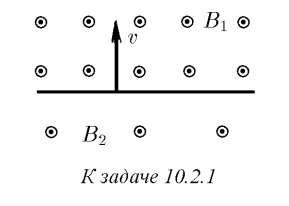. Describe the further movement of the electron. Determine the | |||
| average (drift) velocity of an electron moving along the magnetic field interface that is permeable to it. | |||
| ### Solution | |||
| $$v = \frac{\Delta R}{\Delta t}= \frac{2(R_{2}-R_{1})}{\frac{T_{1}+T_{2}}{2}}$$ , Radii of curvature for the circular paths in the two regions are : | |||
| $R_{1} = \frac{mv}{eB_{1}} , R_{2} = \frac{mv}{eB_{2}}$ . Periods of revolution are $T_{1} = \frac{2\pi R_{1}}{v} ,T_{2} = \frac{2\pi R_{2}}{v} $ : $$v = \frac{2}{\pi}\frac{{B_{1}-B_{2}}}{{B_{1}+B_{2}}}$$ , the drift velocity in the field. | |||
| #### Answer | |||
| $$v = \frac{2}{\pi}\frac{{B_{1}-B_{2}}}{{B_{1}+B_{2}}}$$ | |||
| unchanged lines 12 | |||
| @@ -1,8 +1,8 @@ | |||
| ### Statement | ### Statement | ||
| $10.2.1.$ Space is divided into two regions by a plane. In one region, a magnetic field | $10.2.1.$ Space is divided into two regions by a plane. In one region, a magnetic field | ||
| of induction B_{1} is created, in the other — of induction $B_{2}$, and the fields are | of induction $B_{1}$ is created, in the other — of induction $B_{2}$, and the fields are | ||
| homogeneous and parallel to each other. An electron starts from the interface plane perpendicular to it with velocity v towards the region with field | homogeneous and parallel to each other. An electron starts from the interface plane perpendicular to it with velocity v towards the region with field | ||
| induction $B_{1}$. Describe the further movement of the electron. Determine the | induction $B_{1}$. Describe the further movement of the electron. Determine the | ||
| average (drift) velocity of an electron moving along the magnetic field interface that is permeable to it. | average (drift) velocity of an electron moving along the magnetic field interface that is permeable to it. | ||
| ### Solution | ### Solution | ||
| $$v = \frac{\Delta R}{\Delta t}= \frac{2(R_{2}-R_{1})}{\frac{T_{1}+T_{2}}{2}}$$ , Radii of curvature for the circular paths in the two regions are : | $$v = \frac{\Delta R}{\Delta t}= \frac{2(R_{2}-R_{1})}{\frac{T_{1}+T_{2}}{2}}$$ , Radii of curvature for the circular paths in the two regions are : | ||
| $R_{1} = \frac{mv}{eB_{1}} , R_{2} = \frac{mv}{eB_{2}}$ . Periods of revolution are $T_{1} = \frac{2\pi R_{1}}{v} ,T_{2} = \frac{2\pi R_{2}}{v} $ : $$v = \frac{2}{\pi}\frac{{B_{1}-B_{2}}}{{B_{1}+B_{2}}}$$ , the drift velocity in the field. | $R_{1} = \frac{mv}{eB_{1}} , R_{2} = \frac{mv}{eB_{2}}$ . Periods of revolution are $T_{1} = \frac{2\pi R_{1}}{v} ,T_{2} = \frac{2\pi R_{2}}{v} $ : $$v = \frac{2}{\pi}\frac{{B_{1}-B_{2}}}{{B_{1}+B_{2}}}$$ , the drift velocity in the field. | ||
| #### Answer | #### Answer | ||
| $$v = \frac{2}{\pi}\frac{{B_{1}-B_{2}}}{{B_{1}+B_{2}}}$$ | $$v = \frac{2}{\pi}\frac{{B_{1}-B_{2}}}{{B_{1}+B_{2}}}$$ | ||
| unchanged lines 12 | |||