Edit to “Solution”
en/7.1.12.md
+1 −1
| ### Statement | |||
| $7.1.12^*.$ Determine what the accelerating potential difference $V$ should be in order for the electrons to follow the path shown in the figure. Radii of cylindrical capacitor plates $R_1$ and $R_2$. Potential difference between the plates $V_0$. | |||
| 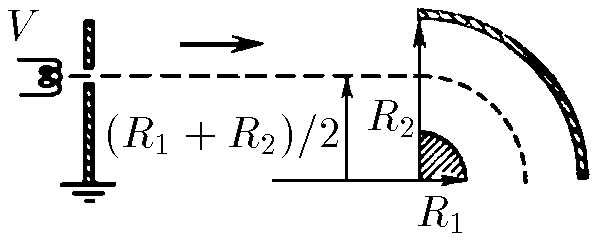 | |||
| @@ -6,7 +6,7 @@Statement | |||
| ### Solution | |||
| − | Gauss theorem | ||
| + | Gauss theoremwulawula | ||
| $$ | |||
| \oint_{2\pi r}E\,dl=\frac{q}{\varepsilon_0}\Rightarrow E=\frac{q}{2\pi\varepsilon_0 r} | |||
| $$ | |||
| Let's write down the small change of the electrostatic field and then integrate it | |||
| $$ | |||
| dU=E \,dr\Rightarrow \int dU=\int E \,dr | |||
| $$ | |||
| Integrate from $R_1$ to $R_2$ | |||
| $$ | |||
| U_0=\frac{q}{2\pi\varepsilon_0 r}\int_{R_1}^{R_2}\frac{dr}{r}=\frac{q}{2\pi\varepsilon_0 r}\ln\frac{R_2}{R_1} | |||
| $$ | |||
| Law of conservation of energy | |||
| $$ | |||
| \frac{mv^2}{2}=eU | |||
| $$ | |||
| $$ | |||
| e\frac{q}{2\pi\varepsilon_0 \frac{R_1+R_2}{2}}=\frac{mv^2}{(\frac{R_1+R_2}{2})} | |||
| $$ | |||
| From where we get | |||
| $$ | |||
| \frac{q}{2\pi\varepsilon_0}=\frac{mv^2}{e} | |||
| $$ | |||
| Substituting the previously obtained values | |||
| $$ | |||
| \frac{U_0}{\ln\frac{R_2}{R_1}}=\frac{2eU}{e} | |||
| $$ | |||
| From where | |||
| $$ | |||
| U=\frac{U_0}{2\ln\frac{R_2}{R_1}} | |||
| $$ | |||
| #### Answer | |||
| $$ | |||
| V=(V_0/2)/\ln(R_2/R_1) | |||
| $$ | |||
| unchanged lines 47 | |||
| ### Statement | ### Statement | ||
| $7.1.12^*.$ Determine what the accelerating potential difference $V$ should be in order for the electrons to follow the path shown in the figure. Radii of cylindrical capacitor plates $R_1$ and $R_2$. Potential difference between the plates $V_0$. | $7.1.12^*.$ Determine what the accelerating potential difference $V$ should be in order for the electrons to follow the path shown in the figure. Radii of cylindrical capacitor plates $R_1$ and $R_2$. Potential difference between the plates $V_0$. | ||
|  |  | ||
| @@ -6,7 +6,7 @@Statement | |||
| ### Solution | ### Solution | ||
| Gauss theorem | Gauss theoremwulawula | ||
| $$ | $$ | ||
| \oint_{2\pi r}E\,dl=\frac{q}{\varepsilon_0}\Rightarrow E=\frac{q}{2\pi\varepsilon_0 r} | \oint_{2\pi r}E\,dl=\frac{q}{\varepsilon_0}\Rightarrow E=\frac{q}{2\pi\varepsilon_0 r} | ||
| $$ | $$ | ||
| Let's write down the small change of the electrostatic field and then integrate it | Let's write down the small change of the electrostatic field and then integrate it | ||
| $$ | $$ | ||
| dU=E \,dr\Rightarrow \int dU=\int E \,dr | dU=E \,dr\Rightarrow \int dU=\int E \,dr | ||
| $$ | $$ | ||
| Integrate from $R_1$ to $R_2$ | Integrate from $R_1$ to $R_2$ | ||
| $$ | $$ | ||
| U_0=\frac{q}{2\pi\varepsilon_0 r}\int_{R_1}^{R_2}\frac{dr}{r}=\frac{q}{2\pi\varepsilon_0 r}\ln\frac{R_2}{R_1} | U_0=\frac{q}{2\pi\varepsilon_0 r}\int_{R_1}^{R_2}\frac{dr}{r}=\frac{q}{2\pi\varepsilon_0 r}\ln\frac{R_2}{R_1} | ||
| $$ | $$ | ||
| Law of conservation of energy | Law of conservation of energy | ||
| $$ | $$ | ||
| \frac{mv^2}{2}=eU | \frac{mv^2}{2}=eU | ||
| $$ | $$ | ||
| $$ | $$ | ||
| e\frac{q}{2\pi\varepsilon_0 \frac{R_1+R_2}{2}}=\frac{mv^2}{(\frac{R_1+R_2}{2})} | e\frac{q}{2\pi\varepsilon_0 \frac{R_1+R_2}{2}}=\frac{mv^2}{(\frac{R_1+R_2}{2})} | ||
| $$ | $$ | ||
| From where we get | From where we get | ||
| $$ | $$ | ||
| \frac{q}{2\pi\varepsilon_0}=\frac{mv^2}{e} | \frac{q}{2\pi\varepsilon_0}=\frac{mv^2}{e} | ||
| $$ | $$ | ||
| Substituting the previously obtained values | Substituting the previously obtained values | ||
| $$ | $$ | ||
| \frac{U_0}{\ln\frac{R_2}{R_1}}=\frac{2eU}{e} | \frac{U_0}{\ln\frac{R_2}{R_1}}=\frac{2eU}{e} | ||
| $$ | $$ | ||
| From where | From where | ||
| $$ | $$ | ||
| U=\frac{U_0}{2\ln\frac{R_2}{R_1}} | U=\frac{U_0}{2\ln\frac{R_2}{R_1}} | ||
| $$ | $$ | ||
| #### Answer | #### Answer | ||
| $$ | $$ | ||
| V=(V_0/2)/\ln(R_2/R_1) | V=(V_0/2)/\ln(R_2/R_1) | ||
| $$ | $$ | ||
| unchanged lines 47 | |||