New solution

en/2.1.51.md
+98 −0
| @@ -0,0 +1,98 @@ | |||
| + | ### Statement | ||
| + | |||
| + | $2.1.51.$ [Insert the problem statement] | ||
| + | |||
| + | ### Solution | ||
| + | |||
| + | ### Problem Statement: | ||
| + | |||
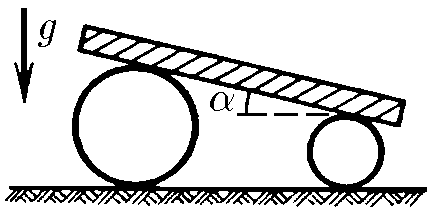
| + | **2.1.51.** A heavy plate is placed on two rollers of different radii. The plate forms an angle $\alpha$ with the horizontal. Find the acceleration of this plate. There is no slipping. The masses of the rollers are negligible. | ||
| + | |||
| + |  | ||
| + | |||
| + | --- | ||
| + | |||
| + | ### Solution: | ||
| + | |||
| + |  | ||
| + | |||
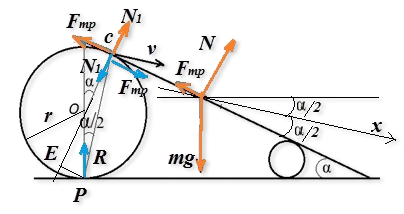
| + | The motion of the plate is complex: it consists of horizontal motion (due to the rolling of the rollers) and motion at an angle to the horizontal, but overall it is translational. Let us mark the forces. | ||
| + | |||
| + | * Blue vectors represent forces acting on the roller ($N_1$ — the force from the plate on the roller, equal and opposite to the force from the roller on the plate; $F_{fr}$ — the friction force acting on the roller, which causes its rotation; and the reaction force $R$ at point $P$). | ||
| + | * Similar forces act on the smaller-radius roller. | ||
| + | * Red vectors represent forces acting on the plate ($N$ — the total normal force, $mg$ — the gravitational force, and $F_{fr}$ — the friction force from the rollers on the plate). | ||
| + | |||
| + | We choose the $Ox$ axis along the velocity of the plate. The velocity itself is the instantaneous velocity of the point of contact between the plate and the roller, while point $P$ is the instantaneous center of velocity. The velocity $v$ is perpendicular to $PC$ (the instantaneous radius of rotation). | ||
| + | |||
| + | Writing the equation of motion for the plate in projections on the $Ox$ axis: | ||
| + | |||
| + | $$ | ||
| + | ma = mg \sin \frac{\alpha}{2} + N \sin\frac{\alpha}{2} - F_{fr} \cos\frac{\alpha}{2} \tag{1} | ||
| + | $$ | ||
| + | |||
| + | This equation contains three unknowns. We need more equations. | ||
| + | |||
| + | Now let’s write the rotational equation of motion for the roller: | ||
| + | |||
| + | $$ | ||
| + | I \varepsilon = \Sigma M | ||
| + | $$ | ||
| + | |||
| + | That is, the product of the moment of inertia and the angular acceleration equals the sum of the torques acting on the roller. | ||
| + | |||
| + | The lever arms of the forces acting on the roller (relative to $PC$) are: | ||
| + | |||
| + | * For force $F_{fr}$: | ||
| + | $$ | ||
| + | 2r \cos^2 \frac{\alpha}{2} | ||
| + | $$ | ||
| + | |||
| + | * For force $N$: | ||
| + | $$ | ||
| + | 2r \cos\frac{\alpha}{2} \cdot \sin\frac{\alpha}{2} | ||
| + | $$ | ||
| + | |||
| + | * For force $R$: | ||
| + | zero. | ||
| + | |||
| + | Thus, the rotational equation for the roller is (since the roller mass is negligible, $I=0$): | ||
| + | |||
| + | $$ | ||
| + | 0 = - F_{fr} \cdot 2r \cos^2 \frac{\alpha}{2} + N r \sin\alpha \tag{2} | ||
| + | $$ | ||
| + | |||
| + | From here: | ||
| + | |||
| + | $$ | ||
| + | F_{fr} = N \tan\frac{\alpha}{2} | ||
| + | $$ | ||
| + | |||
| + | Substituting this into equation (1), we get: | ||
| + | |||
| + | $$ | ||
| + | ma = mg \sin\frac{\alpha}{2} | ||
| + | $$ | ||
| + | |||
| + | Thus, the required acceleration is: | ||
| + | |||
| + | $$ | ||
| + | \boxed{a = g \sin\frac{\alpha}{2}} | ||
| + | $$ | ||
| + | |||
| + | --- | ||
| + | |||
| + | #### Answer: | ||
| + | |||
| + | $$ | ||
| + | a = g \sin\frac{\alpha}{2} | ||
| + | $$ | ||
| + | |||
| + | --- | ||
| + | |||
| + | ### Alternative Solution: | ||
| + | |||
| + |  | ||
| + | |||
| + | #### Answer | ||
| + | |||
| + | [Insert a concise answer or boxed result] | ||
| @@ -0,0 +1,98 @@ | |||
| ### Statement | |||
| $2.1.51.$ [Insert the problem statement] | |||
| ### Solution | |||
| ### Problem Statement: | |||
| **2.1.51.** A heavy plate is placed on two rollers of different radii. The plate forms an angle $\alpha$ with the horizontal. Find the acceleration of this plate. There is no slipping. The masses of the rollers are negligible. | |||
|  | |||
| --- | |||
| ### Solution: | |||
|  | |||
| The motion of the plate is complex: it consists of horizontal motion (due to the rolling of the rollers) and motion at an angle to the horizontal, but overall it is translational. Let us mark the forces. | |||
| * Blue vectors represent forces acting on the roller ($N_1$ — the force from the plate on the roller, equal and opposite to the force from the roller on the plate; $F_{fr}$ — the friction force acting on the roller, which causes its rotation; and the reaction force $R$ at point $P$). | |||
| * Similar forces act on the smaller-radius roller. | |||
| * Red vectors represent forces acting on the plate ($N$ — the total normal force, $mg$ — the gravitational force, and $F_{fr}$ — the friction force from the rollers on the plate). | |||
| We choose the $Ox$ axis along the velocity of the plate. The velocity itself is the instantaneous velocity of the point of contact between the plate and the roller, while point $P$ is the instantaneous center of velocity. The velocity $v$ is perpendicular to $PC$ (the instantaneous radius of rotation). | |||
| Writing the equation of motion for the plate in projections on the $Ox$ axis: | |||
| $$ | |||
| ma = mg \sin \frac{\alpha}{2} + N \sin\frac{\alpha}{2} - F_{fr} \cos\frac{\alpha}{2} \tag{1} | |||
| $$ | |||
| This equation contains three unknowns. We need more equations. | |||
| Now let’s write the rotational equation of motion for the roller: | |||
| $$ | |||
| I \varepsilon = \Sigma M | |||
| $$ | |||
| That is, the product of the moment of inertia and the angular acceleration equals the sum of the torques acting on the roller. | |||
| The lever arms of the forces acting on the roller (relative to $PC$) are: | |||
| * For force $F_{fr}$: | |||
| $$ | |||
| 2r \cos^2 \frac{\alpha}{2} | |||
| $$ | |||
| * For force $N$: | |||
| $$ | |||
| 2r \cos\frac{\alpha}{2} \cdot \sin\frac{\alpha}{2} | |||
| $$ | |||
| * For force $R$: | |||
| zero. | |||
| Thus, the rotational equation for the roller is (since the roller mass is negligible, $I=0$): | |||
| $$ | |||
| 0 = - F_{fr} \cdot 2r \cos^2 \frac{\alpha}{2} + N r \sin\alpha \tag{2} | |||
| $$ | |||
| From here: | |||
| $$ | |||
| F_{fr} = N \tan\frac{\alpha}{2} | |||
| $$ | |||
| Substituting this into equation (1), we get: | |||
| $$ | |||
| ma = mg \sin\frac{\alpha}{2} | |||
| $$ | |||
| Thus, the required acceleration is: | |||
| $$ | |||
| \boxed{a = g \sin\frac{\alpha}{2}} | |||
| $$ | |||
| --- | |||
| #### Answer: | |||
| $$ | |||
| a = g \sin\frac{\alpha}{2} | |||
| $$ | |||
| --- | |||
| ### Alternative Solution: | |||
|  | |||
| #### Answer | |||
| [Insert a concise answer or boxed result] | |||