New solution

en/13.2.23.md
+13 −0
| @@ -0,0 +1,13 @@ | |||
| + | ### Statement | ||
| + | |||
| + | $13.2.23.$ [Insert the problem statement] | ||
| + | |||
| + | ### Solution | ||
| + | |||
| + |  | ||
| + | |||
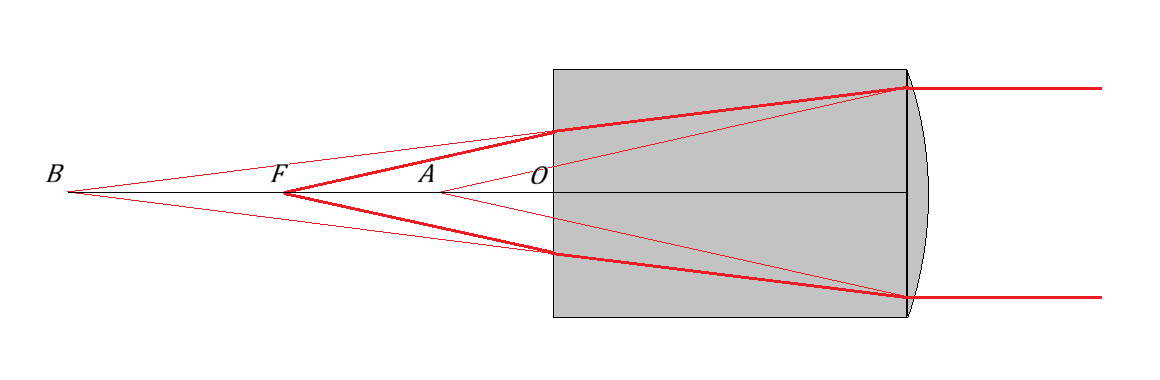
| + | When light rays parallel to the principal axis are incident on the flat surface of the hemisphere, its thickness is irrelevant, and we may treat it as a thin lens with one flat surface and one convex surface of radius $R$ and with focal length $x$. By the lens maker formula, $1/x=(n-1)/R$, so $R=(n-1)x$. Consequently, when light rays parallel to the principal axis are incident on the convex surface of the thin lens, they converge to Point $A$ which is at the distance $x$ from the convex surface. If a sufficiently long piece of glass is placed next to the flat surface of the thin lens, these light rays will be refracted to Point $B$ which is at the distance $nx$ from the convex surface of the thin lens. Clearly, $nx>R$. Thus, if a piece of glass of length $R$ is placed next to the flat surface of the thin lens instead, light rays leaving the glass will be refracted to Point $F$ which is at the distance $OB/n=(nx-R)/n=x/n$ from the left surface of the glass. | ||
| + | |||
| + | #### Answer | ||
| + | |||
| + | [Insert a concise answer or boxed result] | ||
| @@ -0,0 +1,13 @@ | |||
| ### Statement | |||
| $13.2.23.$ [Insert the problem statement] | |||
| ### Solution | |||
|  | |||
| When light rays parallel to the principal axis are incident on the flat surface of the hemisphere, its thickness is irrelevant, and we may treat it as a thin lens with one flat surface and one convex surface of radius $R$ and with focal length $x$. By the lens maker formula, $1/x=(n-1)/R$, so $R=(n-1)x$. Consequently, when light rays parallel to the principal axis are incident on the convex surface of the thin lens, they converge to Point $A$ which is at the distance $x$ from the convex surface. If a sufficiently long piece of glass is placed next to the flat surface of the thin lens, these light rays will be refracted to Point $B$ which is at the distance $nx$ from the convex surface of the thin lens. Clearly, $nx>R$. Thus, if a piece of glass of length $R$ is placed next to the flat surface of the thin lens instead, light rays leaving the glass will be refracted to Point $F$ which is at the distance $OB/n=(nx-R)/n=x/n$ from the left surface of the glass. | |||
| #### Answer | |||
| [Insert a concise answer or boxed result] | |||