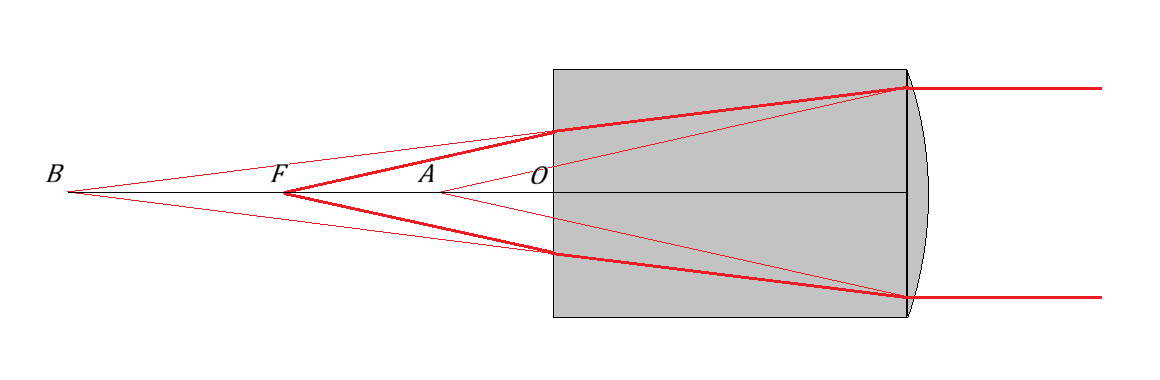
When light rays parallel to the principal axis are incident on the flat surface of the hemisphere, its thickness is irrelevant, and we may treat it as a thin lens with one flat surface and one convex surface of radius and with focal length . By the lens maker formula, , so . Consequently, when light rays parallel to the principal axis are incident on the convex surface of the thin lens, they converge to Point which is at the distance from the convex surface. If a sufficiently long piece of glass is placed next to the flat surface of the thin lens, these light rays will be refracted to Point which is at the distance from the convex surface of the thin lens. Clearly, . Thus, if a piece of glass of length is placed next to the flat surface of the thin lens instead, light rays leaving the glass will be refracted to Point which is at the distance from the left surface of the glass.
Discussion
Log in to join the discussion