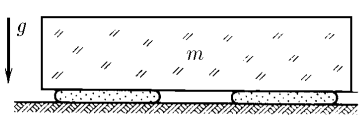
5.5.4∗. A slab of mass $m$ is placed on two long cylindrical bags of radius $r$ and length $L \gg r$, made of an inextensible material and filled with gas. As a result, they are flattened to a thickness of $h \ll r$. The external pressure is $P_0$. Determine the initial pressure in the bags if the temperature of the gas in them did not change.
For problem $5.5.4$
Solution
Since the material of the bags is inextensible, the perimeter of their cross-section does not change during deformation. Initially, the perimeter of one bag is $C = 2\pi r$.
After the slab is placed on them, the bags are flattened to a thickness of $h \ll r$. In this flattened state, the cross-section of the bag can be approximated as a rectangle with width $w$ and height $h$. The perimeter of this cross-section is $2w + 2h$. Using the condition $h \ll r$, we can neglect $2h$, so the perimeter is approximately $2w$. Equating the initial and final perimeters: $$2w \approx 2\pi r \implies w = \pi r$$
Now we can write down the initial and final volumes for one bag: Initial volume: $V_1 = \pi r^2 L$ Final volume: $V_2 = w \cdot h \cdot L = \pi r h L$
The slab of mass $m$ rests on two bags. The total horizontal contact area of the slab with both bags is: $$S = 2 \cdot w \cdot L = 2\pi r L$$
In a state of mechanical equilibrium, the force of gravity acting on the slab is balanced by the difference between the force from the gas pressure inside the bags ($P_2$) and the external atmospheric pressure ($P_0$) acting on this contact area: $$mg = (P_2 - P_0)S$$ From this, we express the final pressure in the bags: $$P_2 = P_0 + \frac{mg}{2\pi r L}$$
According to the problem statement, the gas temperature does not change ($T = \text{const}$). Applying Boyle's Law for the initial and final states of the gas inside one bag: $$P_1 V_1 = P_2 V_2$$
Substituting the expressions for the volumes: $$P_1 (\pi r^2 L) = P_2 (\pi r h L)$$ $$P_1 \cdot r = P_2 \cdot h \implies P_1 = P_2 \frac{h}{r}$$
Substituting the expression for $P_2$ into this equation and expanding the brackets: $$P_1 = \left( P_0 + \frac{mg}{2\pi r L} \right) \frac{h}{r} = P_0 \frac{h}{r} + \frac{mgh}{2\pi r^2 L}$$