Statement
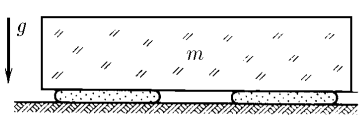
5.5.4∗. A slab of mass
Solution
Since the material of the bags is inextensible, the perimeter of their cross-section does not change during deformation. Initially, the perimeter of one bag is
After the slab is placed on them, the bags are flattened to a thickness of
Equating the initial and final perimeters:
Now we can write down the initial and final volumes for one bag:
Initial volume:
Final volume:
The slab of mass
In a state of mechanical equilibrium, the force of gravity acting on the slab is balanced by the difference between the force from the gas pressure inside the bags (
From this, we express the final pressure in the bags:
According to the problem statement, the gas temperature does not change (
Crucial Note
When applying the ideal gas law (and its consequence, Boyle's Law), we must use absolute pressure, not gauge (excess) pressure. Gas compressibility inherently depends on the total pressure acting on the molecules. Attempting to use only the gauge pressure (
Applying Boyle's Law for the initial and final states of the gas inside one bag:
Substituting the expressions for the volumes:
Substituting the expression for