Edits to “Statement”, “Solution”, “Answer”

en/13.3.23.md
+3 −3
| @@ -1,10 +1,10 @@ | |||
| ### Statement | |||
| − | $13.3.23.$ [Insert the problem statement] | ||
| + | $13.3.23.$ The optical system consists of a collecting lens with a focal length $f$ and a mirror ball of radius $R$, the center of which is located on the optical axis of the lens at a distance $d$ from it. Determine the distance from the lens to the point source located on the optical axis of the system, at which the source image coincides with the source itself. | ||
| ### Solution | |||
| − | 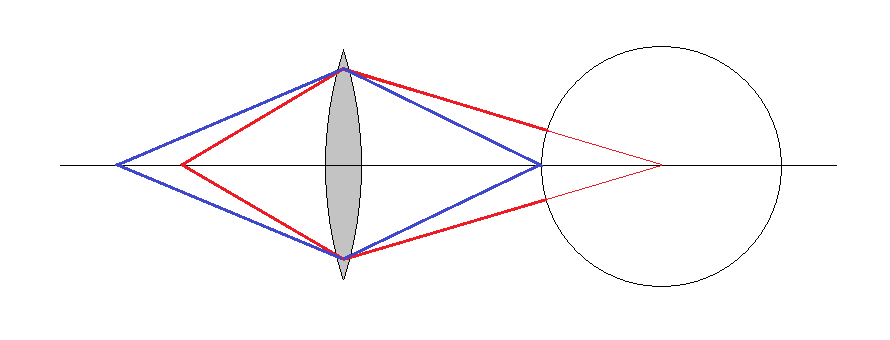 | ||
| There are two scenarios in which the image of the source coincides with the source. | |||
| 1. Light rays (Red) emerging from the lens converge to the center of the sphere, in which case they are reflected and return on the same path. In this case, the position of the object in front of the lens is | |||
| \[u=\frac{df}{d-f},\] | |||
| which is possible if $d>f$. | |||
| 2. Light rays (Blue) emerging from the lens converge to the front of the sphere, in which case they are reflected and return on the path symmetric to the original path with respect to the principal axis. In this case, the position of the object in front of the lens is | |||
| \[u=\frac{(d-R)f}{(d-R)-f},\] | |||
| which is possible if $d-R>f$. | |||
| @@ -22,4 +22,4 @@Solution | |||
| #### Answer | |||
| − | [Insert a concise answer or boxed result] | ||
| + | $\frac{df}{d-f}$ if $d>f$ and/or $\frac{(d-R)f}{(d-R)-f}$ if $d-R>f$ | ||
| @@ -1,10 +1,10 @@ | |||
| ### Statement | ### Statement | ||
| $13.3.23.$ [Insert the problem statement] | $13.3.23.$ The optical system consists of a collecting lens with a focal length $f$ and a mirror ball of radius $R$, the center of which is located on the optical axis of the lens at a distance $d$ from it. Determine the distance from the lens to the point source located on the optical axis of the system, at which the source image coincides with the source itself. | ||
| ### Solution | ### Solution | ||
|  | ||
| There are two scenarios in which the image of the source coincides with the source. | There are two scenarios in which the image of the source coincides with the source. | ||
| 1. Light rays (Red) emerging from the lens converge to the center of the sphere, in which case they are reflected and return on the same path. In this case, the position of the object in front of the lens is | 1. Light rays (Red) emerging from the lens converge to the center of the sphere, in which case they are reflected and return on the same path. In this case, the position of the object in front of the lens is | ||
| \[u=\frac{df}{d-f},\] | \[u=\frac{df}{d-f},\] | ||
| which is possible if $d>f$. | which is possible if $d>f$. | ||
| 2. Light rays (Blue) emerging from the lens converge to the front of the sphere, in which case they are reflected and return on the path symmetric to the original path with respect to the principal axis. In this case, the position of the object in front of the lens is | 2. Light rays (Blue) emerging from the lens converge to the front of the sphere, in which case they are reflected and return on the path symmetric to the original path with respect to the principal axis. In this case, the position of the object in front of the lens is | ||
| \[u=\frac{(d-R)f}{(d-R)-f},\] | \[u=\frac{(d-R)f}{(d-R)-f},\] | ||
| which is possible if $d-R>f$. | which is possible if $d-R>f$. | ||
| @@ -22,4 +22,4 @@Solution | |||
| #### Answer | #### Answer | ||
| [Insert a concise answer or boxed result] | $\frac{df}{d-f}$ if $d>f$ and/or $\frac{(d-R)f}{(d-R)-f}$ if $d-R>f$ | ||