Statement
5.6.1. The average energy of a single gas molecule over a wide temperature range is determined quite accurately by the formula
Theoretical Background: Degrees of Freedom & Molecular Models
In thermodynamics, a "degree of freedom (
At normal temperatures, we consider translational motion (the center of mass moving along coordinate axes) and rotational motion (tumbling around axes). Let's visualize all three fundamental models:
1. Monatomic Gas (e.g.,
A single atom is treated as a point mass. It can move in 3D space, but its moment of inertia is practically zero, so rotation does not store thermodynamic energy.
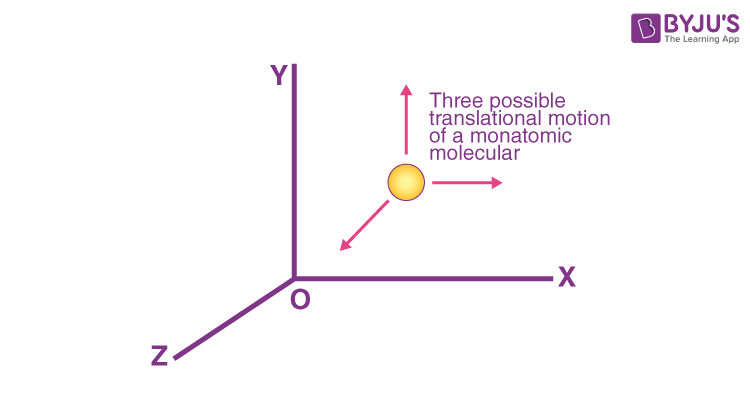
- Translational (
): 3 (motion along the , , and axes, as shown by the pink arrows). - Rotational (
): 0 - Total
2. Diatomic Gas (e.g.,
Two atoms connected by a rigid bond (a "dumbbell" model). Its motion is divided into two parts.
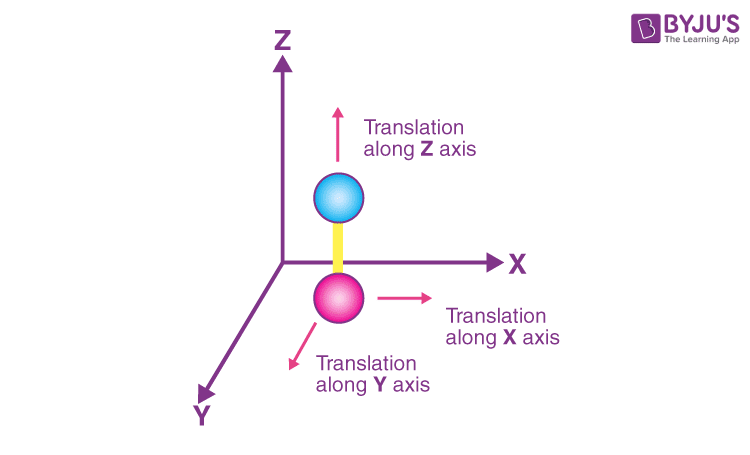
First, the entire center of mass can move in 3D space.
- Translational (
): 3 (motion along the , , and axes).
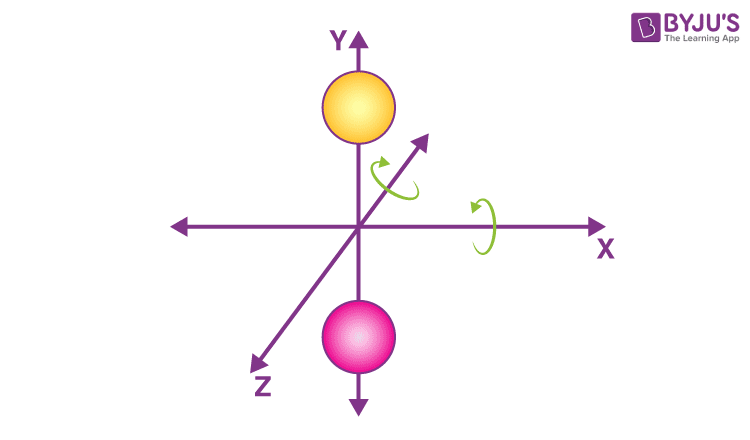
Second, it can rotate end-over-end. As shown in the diagram above, if the molecule lies along the
- Rotational (
): 2 - Total
3. Polyatomic Non-linear Gas (e.g.,
These molecules possess a complex 3D structure with substantial mass distribution around all three spatial axes.

- Translational (
): 3 (motion along , , and axes, always present). - Rotational (
): 3 (as shown by the green arrows, the molecule can tumble around the , , and axes independently). - Total
Solution
To find the average energy of a single gas molecule using the formula:
we determine the number of degrees of freedom
For the diatomic gases
For the non-linear polyatomic molecules