Edit to “Theoretical Background: Degrees of Freed”

en/5.6.1.md
+1 −1
| ### Statement | |||
| $5.6.1.$ The average energy of a single gas molecule over a wide temperature range is determined quite accurately by the formula $\bar{\varepsilon} = \frac{i}{2}kT$, where $i$ is the number of degrees of freedom of the molecule, which is equal to the number of coordinates determining its position. Using this formula, find the average energy of $H_2$, $N_2$, $H_2O$, and $CH_4$ molecules at a temperature $T$. | |||
| @@ -4,7 +4,7 @@Statement | |||
| ### Theoretical Background: Degrees of Freedom & Molecular Models | |||
| − | In thermodynamics, a "degree of freedom ($i$)" | ||
| + | In thermodynamics, a "degree of freedom ($i$)" is an independent coordinate required to completely specify the position and orientation of a molecule in space. It represents the number of independent ways a molecule can move and store kinetic energy. | ||
| At normal temperatures, we consider translational motion (the center of mass moving along coordinate axes) and rotational motion (tumbling around axes). Let's visualize all three fundamental models: | |||
| #### 1. Monatomic Gas (e.g., $He$, $Ne$, $Ar$) | |||
| A single atom is treated as a point mass. It can move in 3D space, but its moment of inertia is practically zero, so rotation does not store thermodynamic energy. | |||
| 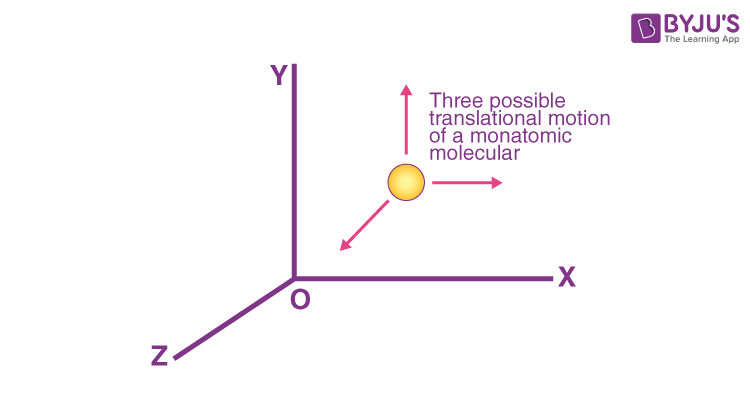 | |||
| 1. Translational ($i_{\text{trans}}$): 3 (motion along the $X$, $Y$, and $Z$ axes, as shown by the pink arrows). | |||
| 2. Rotational ($i_{\text{rot}}$): 0 | |||
| 3. Total $i = 3$ | |||
| #### 2. Diatomic Gas (e.g., $H_2$, $N_2$) | |||
| Two atoms connected by a rigid bond (a "dumbbell" model). Its motion is divided into two parts. | |||
| 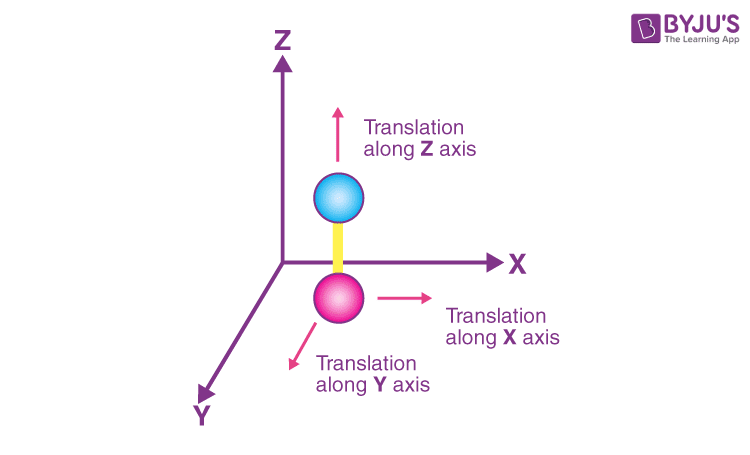 | |||
| First, the entire center of mass can move in 3D space. | |||
| 1. Translational ($i_{\text{trans}}$): 3 (motion along the $X$, $Y$, and $Z$ axes). | |||
| 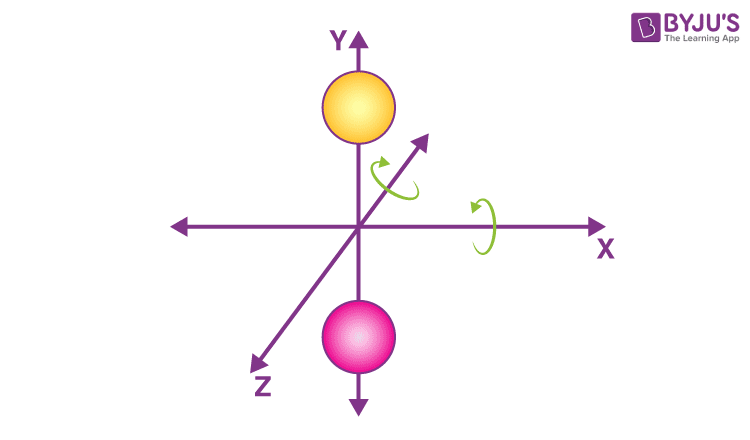 | |||
| Second, it can rotate end-over-end. As shown in the diagram above, if the molecule lies along the $Y$-axis, it can rotate independently around the $X$ and $Z$ axes (indicated by the green arrows). Rotation strictly around its own bond axis ($Y$-axis in this specific orientation) has a negligible moment of inertia and is therefore ignored. | |||
| 2. Rotational ($i_{\text{rot}}$): 2 | |||
| 3. Total $i = 5$ | |||
| #### 3. Polyatomic Non-linear Gas (e.g., $H_2O$, $CH_4$) | |||
| These molecules possess a complex 3D structure with substantial mass distribution around all three spatial axes. | |||
| 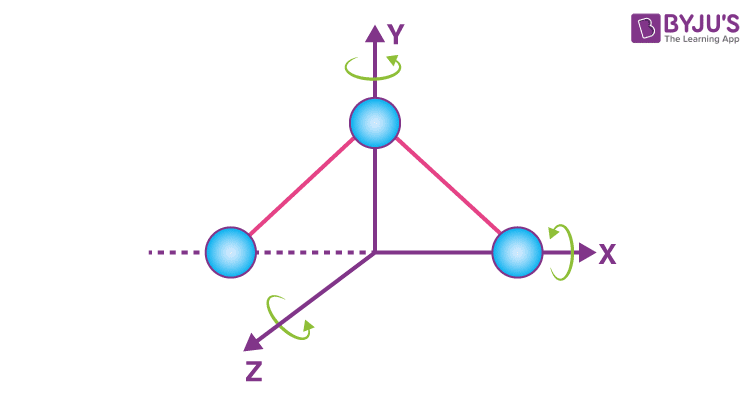 | |||
| 1. Translational ($i_{\text{trans}}$): 3 (motion along $X$, $Y$, and $Z$ axes, always present). | |||
| 2. Rotational ($i_{\text{rot}}$): 3 (as shown by the green arrows, the molecule can tumble around the $X$, $Y$, and $Z$ axes independently). | |||
| 3. Total $i = 6$ | |||
| ### Solution | |||
| To find the average energy of a single gas molecule using the formula: | |||
| $$\bar{\varepsilon} = \frac{i}{2}kT$$ | |||
| we determine the number of degrees of freedom $i$ based on the geometric structures analyzed above. | |||
| For the diatomic gases $H_2$ and $N_2$, the number of degrees of freedom is $i = 5$. Therefore, the average energy of a single molecule of these gases is: | |||
| $$\bar{\varepsilon}_{H_2} = \bar{\varepsilon}_{N_2} = \frac{5}{2}kT$$ | |||
| For the non-linear polyatomic molecules $H_2O$ and $CH_4$, the number of degrees of freedom is $i = 6$. Therefore, the average energy of a single molecule is: | |||
| $$\bar{\varepsilon}_{H_2O} = \bar{\varepsilon}_{CH_4} = \frac{6}{2}kT = 3kT$$ | |||
| #### Answer | |||
| $$\bar{\varepsilon}_{H_2} = \bar{\varepsilon}_{N_2} = \frac{5}{2}kT$$ | |||
| $$\bar{\varepsilon}_{H_2O} = \bar{\varepsilon}_{CH_4} = 3kT$$ | |||
| unchanged lines 48 | |||
| ### Statement | ### Statement | ||
| $5.6.1.$ The average energy of a single gas molecule over a wide temperature range is determined quite accurately by the formula $\bar{\varepsilon} = \frac{i}{2}kT$, where $i$ is the number of degrees of freedom of the molecule, which is equal to the number of coordinates determining its position. Using this formula, find the average energy of $H_2$, $N_2$, $H_2O$, and $CH_4$ molecules at a temperature $T$. | $5.6.1.$ The average energy of a single gas molecule over a wide temperature range is determined quite accurately by the formula $\bar{\varepsilon} = \frac{i}{2}kT$, where $i$ is the number of degrees of freedom of the molecule, which is equal to the number of coordinates determining its position. Using this formula, find the average energy of $H_2$, $N_2$, $H_2O$, and $CH_4$ molecules at a temperature $T$. | ||
| @@ -4,7 +4,7 @@Statement | |||
| ### Theoretical Background: Degrees of Freedom & Molecular Models | ### Theoretical Background: Degrees of Freedom & Molecular Models | ||
| In thermodynamics, a "degree of freedom ($i$)" |
In thermodynamics, a "degree of freedom ($i$)" is an independent coordinate required to completely specify the position and orientation of a molecule in space. It represents the number of independent ways a molecule can move and store kinetic energy. | ||
| At normal temperatures, we consider translational motion (the center of mass moving along coordinate axes) and rotational motion (tumbling around axes). Let's visualize all three fundamental models: | At normal temperatures, we consider translational motion (the center of mass moving along coordinate axes) and rotational motion (tumbling around axes). Let's visualize all three fundamental models: | ||
| #### 1. Monatomic Gas (e.g., $He$, $Ne$, $Ar$) | #### 1. Monatomic Gas (e.g., $He$, $Ne$, $Ar$) | ||
| A single atom is treated as a point mass. It can move in 3D space, but its moment of inertia is practically zero, so rotation does not store thermodynamic energy. | A single atom is treated as a point mass. It can move in 3D space, but its moment of inertia is practically zero, so rotation does not store thermodynamic energy. | ||
|  |  | ||
| 1. Translational ($i_{\text{trans}}$): 3 (motion along the $X$, $Y$, and $Z$ axes, as shown by the pink arrows). | 1. Translational ($i_{\text{trans}}$): 3 (motion along the $X$, $Y$, and $Z$ axes, as shown by the pink arrows). | ||
| 2. Rotational ($i_{\text{rot}}$): 0 | 2. Rotational ($i_{\text{rot}}$): 0 | ||
| 3. Total $i = 3$ | 3. Total $i = 3$ | ||
| #### 2. Diatomic Gas (e.g., $H_2$, $N_2$) | #### 2. Diatomic Gas (e.g., $H_2$, $N_2$) | ||
| Two atoms connected by a rigid bond (a "dumbbell" model). Its motion is divided into two parts. | Two atoms connected by a rigid bond (a "dumbbell" model). Its motion is divided into two parts. | ||
|  |  | ||
| First, the entire center of mass can move in 3D space. | First, the entire center of mass can move in 3D space. | ||
| 1. Translational ($i_{\text{trans}}$): 3 (motion along the $X$, $Y$, and $Z$ axes). | 1. Translational ($i_{\text{trans}}$): 3 (motion along the $X$, $Y$, and $Z$ axes). | ||
|  |  | ||
| Second, it can rotate end-over-end. As shown in the diagram above, if the molecule lies along the $Y$-axis, it can rotate independently around the $X$ and $Z$ axes (indicated by the green arrows). Rotation strictly around its own bond axis ($Y$-axis in this specific orientation) has a negligible moment of inertia and is therefore ignored. | Second, it can rotate end-over-end. As shown in the diagram above, if the molecule lies along the $Y$-axis, it can rotate independently around the $X$ and $Z$ axes (indicated by the green arrows). Rotation strictly around its own bond axis ($Y$-axis in this specific orientation) has a negligible moment of inertia and is therefore ignored. | ||
| 2. Rotational ($i_{\text{rot}}$): 2 | 2. Rotational ($i_{\text{rot}}$): 2 | ||
| 3. Total $i = 5$ | 3. Total $i = 5$ | ||
| #### 3. Polyatomic Non-linear Gas (e.g., $H_2O$, $CH_4$) | #### 3. Polyatomic Non-linear Gas (e.g., $H_2O$, $CH_4$) | ||
| These molecules possess a complex 3D structure with substantial mass distribution around all three spatial axes. | These molecules possess a complex 3D structure with substantial mass distribution around all three spatial axes. | ||
|  |  | ||
| 1. Translational ($i_{\text{trans}}$): 3 (motion along $X$, $Y$, and $Z$ axes, always present). | 1. Translational ($i_{\text{trans}}$): 3 (motion along $X$, $Y$, and $Z$ axes, always present). | ||
| 2. Rotational ($i_{\text{rot}}$): 3 (as shown by the green arrows, the molecule can tumble around the $X$, $Y$, and $Z$ axes independently). | 2. Rotational ($i_{\text{rot}}$): 3 (as shown by the green arrows, the molecule can tumble around the $X$, $Y$, and $Z$ axes independently). | ||
| 3. Total $i = 6$ | 3. Total $i = 6$ | ||
| ### Solution | ### Solution | ||
| To find the average energy of a single gas molecule using the formula: | To find the average energy of a single gas molecule using the formula: | ||
| $$\bar{\varepsilon} = \frac{i}{2}kT$$ | $$\bar{\varepsilon} = \frac{i}{2}kT$$ | ||
| we determine the number of degrees of freedom $i$ based on the geometric structures analyzed above. | we determine the number of degrees of freedom $i$ based on the geometric structures analyzed above. | ||
| For the diatomic gases $H_2$ and $N_2$, the number of degrees of freedom is $i = 5$. Therefore, the average energy of a single molecule of these gases is: | For the diatomic gases $H_2$ and $N_2$, the number of degrees of freedom is $i = 5$. Therefore, the average energy of a single molecule of these gases is: | ||
| $$\bar{\varepsilon}_{H_2} = \bar{\varepsilon}_{N_2} = \frac{5}{2}kT$$ | $$\bar{\varepsilon}_{H_2} = \bar{\varepsilon}_{N_2} = \frac{5}{2}kT$$ | ||
| For the non-linear polyatomic molecules $H_2O$ and $CH_4$, the number of degrees of freedom is $i = 6$. Therefore, the average energy of a single molecule is: | For the non-linear polyatomic molecules $H_2O$ and $CH_4$, the number of degrees of freedom is $i = 6$. Therefore, the average energy of a single molecule is: | ||
| $$\bar{\varepsilon}_{H_2O} = \bar{\varepsilon}_{CH_4} = \frac{6}{2}kT = 3kT$$ | $$\bar{\varepsilon}_{H_2O} = \bar{\varepsilon}_{CH_4} = \frac{6}{2}kT = 3kT$$ | ||
| #### Answer | #### Answer | ||
| $$\bar{\varepsilon}_{H_2} = \bar{\varepsilon}_{N_2} = \frac{5}{2}kT$$ | $$\bar{\varepsilon}_{H_2} = \bar{\varepsilon}_{N_2} = \frac{5}{2}kT$$ | ||
| $$\bar{\varepsilon}_{H_2O} = \bar{\varepsilon}_{CH_4} = 3kT$$ | $$\bar{\varepsilon}_{H_2O} = \bar{\varepsilon}_{CH_4} = 3kT$$ | ||
| unchanged lines 48 | |||