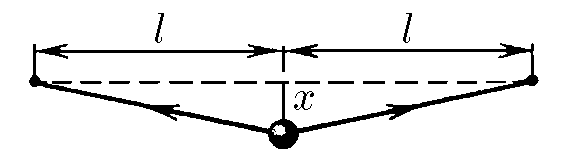
$3.1.1.$ A ball is fixed in the middle of a string of length $2$l. What is the total force acting on the ball from the side of the string if its transverse displacement from the equilibrium position is $x \ll$, and the string tension force $F$ does not depend on the displacement? Why, for small displacements, can we consider the dependence of the force acting on the ball on $x$ to be linear? What is the direction of this force with respect to the displacement? Find how the potential energy of the ball depends on the small displacement $x$. What is the velocity of the ball when it passes its equilibrium position if its maximum displacement is $x_0$? The mass of the ball is $m$.
### Solution
In addition to the force of gravity $mg$, the ball is subject to the force of tension of the string $F$, which has a vertical component $F'$:
$3.1.1.$ A ball is fixed in the middle of a string of length $2$l. What is the total force acting on the ball from the side of the string if its transverse displacement from the equilibrium position is $x \ll$, and the string tension force $F$ does not depend on the displacement? Why, for small displacements, can we consider the dependence of the force acting on the ball on $x$ to be linear? What is the direction of this force with respect to the displacement? Find how the potential energy of the ball depends on the small displacement $x$. What is the velocity of the ball when it passes its equilibrium position if its maximum displacement is $x_0$? The mass of the ball is $m$.
$3.1.1.$ A ball is fixed in the middle of a string of length $2$l. What is the total force acting on the ball from the side of the string if its transverse displacement from the equilibrium position is $x \ll$, and the string tension force $F$ does not depend on the displacement? Why, for small displacements, can we consider the dependence of the force acting on the ball on $x$ to be linear? What is the direction of this force with respect to the displacement? Find how the potential energy of the ball depends on the small displacement $x$. What is the velocity of the ball when it passes its equilibrium position if its maximum displacement is $x_0$? The mass of the ball is $m$.


### Solution
### Solution
In addition to the force of gravity $mg$, the ball is subject to the force of tension of the string $F$, which has a vertical component $F'$:
In addition to the force of gravity $mg$, the ball is subject to the force of tension of the string $F$, which has a vertical component $F'$:
