Edits to “Statement”, “Answer”

en/2.3.13.md
+0 −10
| @@ -1,11 +1,5 @@ | |||
| ### Statement | |||
| − | $2.3.13.$ [Insert the problem statement] | ||
| − | |||
| − | ### Solution | ||
| − | |||
| − | ### Statement | ||
| − | |||
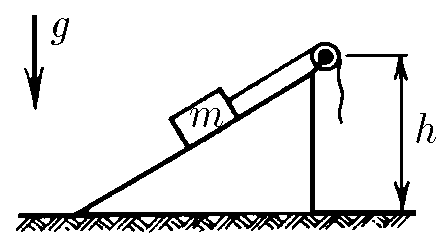
| $2.3.13.$ A load of mass $m$ is slowly pulled up to a height $h$ along an inclined plane using a block and a cable. The work done during this process is $A$. Then the cable is released, and the load slides down. What velocity will it gain by the time it reaches the starting point? | |||
|  | |||
| ### Solution | |||
| The difference between the work of the pulling force and the work of friction is equal to the change in potential energy: | |||
| $$ | |||
| A - A_{\\text{f}} = mgh | |||
| $$ | |||
| During the slide down from the top, friction performs the same amount of work. Let us write the law of conservation of energy: | |||
| $$ | |||
| A_{\\text{f}} + \\frac{mv^2}{2} = mgh | |||
| $$ | |||
| Substitute the work of friction to express the kinetic energy: | |||
| $$ | |||
| \\frac{mv^2}{2} = 2mgh - A | |||
| $$ | |||
| From this, we find the velocity the load will gain upon reaching the starting point: | |||
| $$ | |||
| v = \\sqrt{4gh - 2A/m} | |||
| $$ | |||
| @@ -31,7 +25,3 @@Solution | |||
| #### Answer | |||
| $v = \\sqrt{4gh - 2A/m}$ | |||
| − | |||
| − | #### Answer | ||
| − | |||
| − | [Insert a concise answer or boxed result] | ||
| @@ -1,11 +1,5 @@ | |||
| ### Statement | ### Statement | ||
| $2.3.13.$ [Insert the problem statement] | |||
| ### Solution | |||
| ### Statement | |||
| $2.3.13.$ A load of mass $m$ is slowly pulled up to a height $h$ along an inclined plane using a block and a cable. The work done during this process is $A$. Then the cable is released, and the load slides down. What velocity will it gain by the time it reaches the starting point? | $2.3.13.$ A load of mass $m$ is slowly pulled up to a height $h$ along an inclined plane using a block and a cable. The work done during this process is $A$. Then the cable is released, and the load slides down. What velocity will it gain by the time it reaches the starting point? | ||
|  |  | ||
| ### Solution | ### Solution | ||
| The difference between the work of the pulling force and the work of friction is equal to the change in potential energy: | The difference between the work of the pulling force and the work of friction is equal to the change in potential energy: | ||
| $$ | $$ | ||
| A - A_{\\text{f}} = mgh | A - A_{\\text{f}} = mgh | ||
| $$ | $$ | ||
| During the slide down from the top, friction performs the same amount of work. Let us write the law of conservation of energy: | During the slide down from the top, friction performs the same amount of work. Let us write the law of conservation of energy: | ||
| $$ | $$ | ||
| A_{\\text{f}} + \\frac{mv^2}{2} = mgh | A_{\\text{f}} + \\frac{mv^2}{2} = mgh | ||
| $$ | $$ | ||
| Substitute the work of friction to express the kinetic energy: | Substitute the work of friction to express the kinetic energy: | ||
| $$ | $$ | ||
| \\frac{mv^2}{2} = 2mgh - A | \\frac{mv^2}{2} = 2mgh - A | ||
| $$ | $$ | ||
| From this, we find the velocity the load will gain upon reaching the starting point: | From this, we find the velocity the load will gain upon reaching the starting point: | ||
| $$ | $$ | ||
| v = \\sqrt{4gh - 2A/m} | v = \\sqrt{4gh - 2A/m} | ||
| $$ | $$ | ||
| @@ -31,7 +25,3 @@Solution | |||
| #### Answer | #### Answer | ||
| $v = \\sqrt{4gh - 2A/m}$ | $v = \\sqrt{4gh - 2A/m}$ | ||
| #### Answer | |||
| [Insert a concise answer or boxed result] | |||