New solution

en/2.3.32.md
+25 −0
| @@ -0,0 +1,25 @@ | |||
| + | ### Statement | ||
| + | |||
| + | $2.3.32.$ [Insert the problem statement] | ||
| + | |||
| + | ### Solution | ||
| + | |||
| + |  | ||
| + | |||
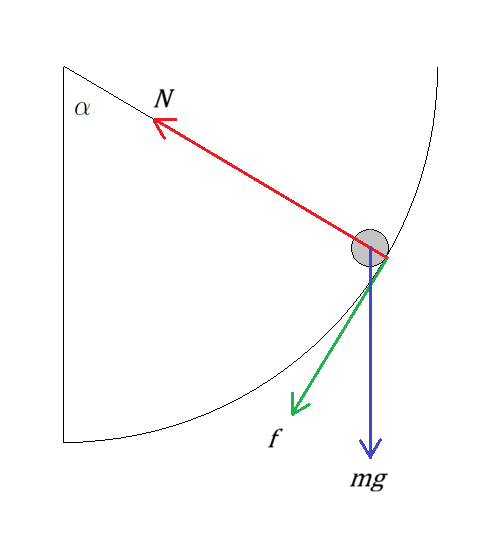
| + | Let $\alpha$ be the angle from the downward radius of the circle to the radius pointing to the sled measured counterclockwise. The centripetal force on the sled is | ||
| + | |||
| + | \[N-mg\cos\alpha=\frac{mv^2}{r}.\] | ||
| + | |||
| + | Consequently, the friction is | ||
| + | |||
| + | \[f=\mu N=\mu m\left(g\cos\alpha+\frac{v^2}{r}\right).\] | ||
| + | |||
| + | Thus, the work done by friction is | ||
| + | |||
| + | \[\int_0^{2\pi}fr\,d\alpha=\int_0^{2\pi}\mu m\left(g\cos\alpha+\frac{v^2}{r}\right)r\,d\alpha.\] | ||
| + | |||
| + | Since the average of $\cos\alpha$ for $0\le\alpha\le2\pi$ is zero, the integral simplies to $2\pi\mu mv^2$. (Technically, the work done by friction is negative.) | ||
| + | |||
| + | #### Answer | ||
| + | |||
| + | [Insert a concise answer or boxed result] | ||
| @@ -0,0 +1,25 @@ | |||
| ### Statement | |||
| $2.3.32.$ [Insert the problem statement] | |||
| ### Solution | |||
|  | |||
| Let $\alpha$ be the angle from the downward radius of the circle to the radius pointing to the sled measured counterclockwise. The centripetal force on the sled is | |||
| \[N-mg\cos\alpha=\frac{mv^2}{r}.\] | |||
| Consequently, the friction is | |||
| \[f=\mu N=\mu m\left(g\cos\alpha+\frac{v^2}{r}\right).\] | |||
| Thus, the work done by friction is | |||
| \[\int_0^{2\pi}fr\,d\alpha=\int_0^{2\pi}\mu m\left(g\cos\alpha+\frac{v^2}{r}\right)r\,d\alpha.\] | |||
| Since the average of $\cos\alpha$ for $0\le\alpha\le2\pi$ is zero, the integral simplies to $2\pi\mu mv^2$. (Technically, the work done by friction is negative.) | |||
| #### Answer | |||
| [Insert a concise answer or boxed result] | |||