New solution

en/3.7.9.md
+17 −0
| @@ -0,0 +1,17 @@ | |||
| + | ### Statement | ||
| + | |||
| + | $3.7.9.$ [Insert the problem statement] | ||
| + | |||
| + | ### Solution | ||
| + | |||
| + |  | ||
| + | |||
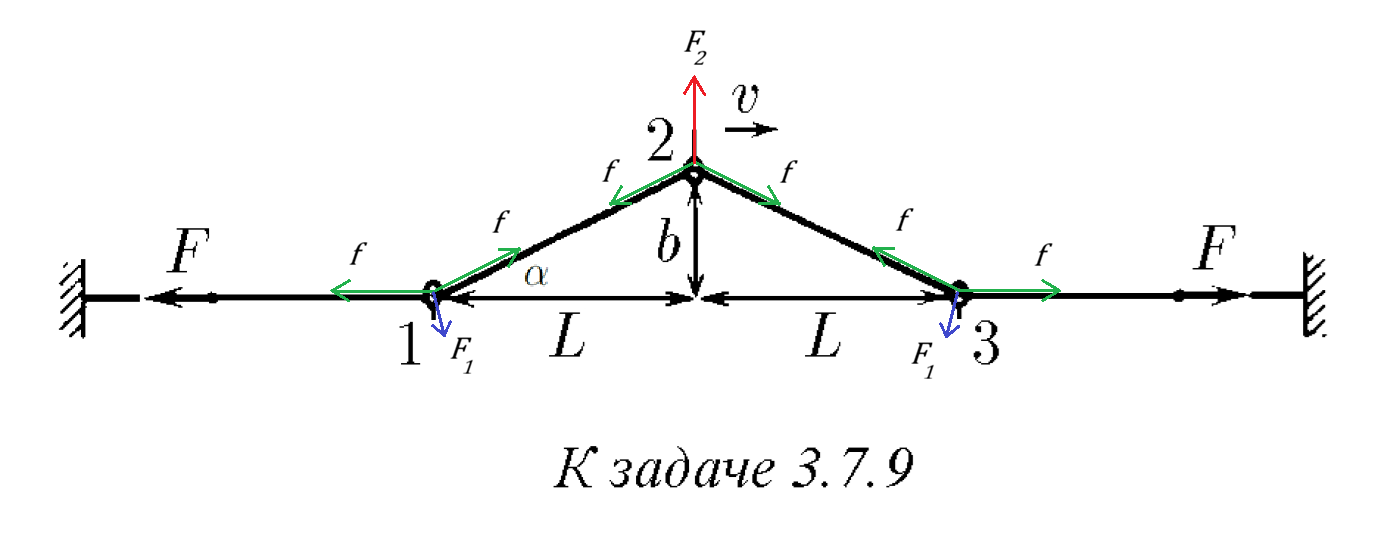
| + | If $v=\sqrt{F/\rho}$ (or $F=\rho v^2$), then the wave moves at the natural speed of propagation in the string, and there will be no force exerted by the rings on the string. If $v\ne\sqrt{F/\rho}$, then additional tension $f=\rho v^2-F$ must be created in the string in order to allow wave propagation at the speed $v$. These additional tension (shown in green) are reactions to the forces that the rings exert on the string. At Point 1 and 3, we have $F_1=2f\sin(\alpha/2)$, while at Point 2 we have $F_2=2f\sin\alpha$. For a small $\alpha$, we have | ||
| + | |||
| + | \[F_1\approx(\rho v^2-F)\cdot\frac{b}{L}\qquad\mbox{and}\qquad F_2\approx2(\rho v^2-F)\cdot\frac{b}{L},\] | ||
| + | |||
| + | where $\vec F_1$ points almost downward and $\vec F_2$ points upward when $\rho v^2>F$ and vice versa. | ||
| + | |||
| + | #### Answer | ||
| + | |||
| + | [Insert a concise answer or boxed result] | ||
| @@ -0,0 +1,17 @@ | |||
| ### Statement | |||
| $3.7.9.$ [Insert the problem statement] | |||
| ### Solution | |||
|  | |||
| If $v=\sqrt{F/\rho}$ (or $F=\rho v^2$), then the wave moves at the natural speed of propagation in the string, and there will be no force exerted by the rings on the string. If $v\ne\sqrt{F/\rho}$, then additional tension $f=\rho v^2-F$ must be created in the string in order to allow wave propagation at the speed $v$. These additional tension (shown in green) are reactions to the forces that the rings exert on the string. At Point 1 and 3, we have $F_1=2f\sin(\alpha/2)$, while at Point 2 we have $F_2=2f\sin\alpha$. For a small $\alpha$, we have | |||
| \[F_1\approx(\rho v^2-F)\cdot\frac{b}{L}\qquad\mbox{and}\qquad F_2\approx2(\rho v^2-F)\cdot\frac{b}{L},\] | |||
| where $\vec F_1$ points almost downward and $\vec F_2$ points upward when $\rho v^2>F$ and vice versa. | |||
| #### Answer | |||
| [Insert a concise answer or boxed result] | |||