Edit to “Solution”

en/3.7.9.md
+2 −4
| ### Statement | |||
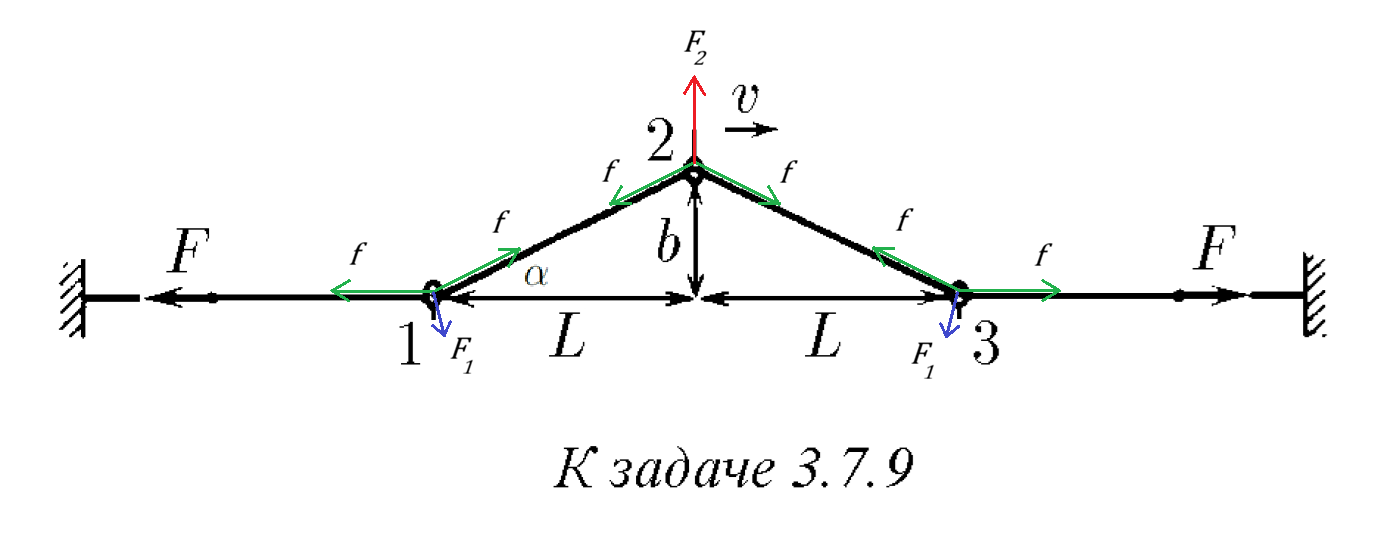
| $3.7.9.$ Three smooth rings are placed on a string stretched with force $F$, linear density of which is equal to $\rho$. The rings move along the string with speed $v$, deforming it. The bending area created by the rings moves along the string at the same speed without changing its shape. What forces act on the string from the side of the rings? What happens as $v$ approaches | |||
| $\sqrt{F/ρ}$? | |||
| ### Solution | |||
| @@ -7,12 +7,10 @@Solution | |||
|  | |||
| − | If $v=\sqrt{F/\rho}$ (or $F=\rho v^2$), then the wave moves at the natural speed of propagation in the string, and there will be no force exerted by the rings on the string. If $v | ||
| + | If $v=\sqrt{F/\rho}$ (or $F=\rho v^2$), then the wave moves at the natural speed of propagation in the string, and there will be no force exerted by the rings on the string. If $v>\sqrt{F/\rho}$, then additional tension $f=\rho v^2-F$ must be created in the string in order to allow wave propagation at the speed $v$. These additional tensions (shown in green) are reactions to the forces that the rings exert on the string. At Points 1 and 3, we have $F_1=2f\sin(\alpha/2)$, while at Point 2 we have $F_2=2f\sin\alpha$. For a small $\alpha$, we have | ||
| − | \[F_1\approx(\rho v^2-F)\cdot\frac{b}{L}\qquad\mbox{and}\qquad F_2\approx2(\rho v^2-F)\cdot\frac{b}{L} | ||
| − | |||
| − | where $\vec F_1$ points almost downward and $\vec F_2$ points upward when $\rho v^2>F$ and vice versa. | ||
| + | \[F_1\approx(\rho v^2-F)\cdot\frac{b}{L}\qquad\mbox{and}\qquad F_2\approx2(\rho v^2-F)\cdot\frac{b}{L}.\] | ||
| #### Answer | |||
| $F_1\approx(\rho v^2-F)\cdot\frac{b}{L}$ and $F_2\approx2(\rho v^2-F)\cdot\frac{b}{L}$ | |||
| ### Statement | ### Statement | ||
| $3.7.9.$ Three smooth rings are placed on a string stretched with force $F$, linear density of which is equal to $\rho$. The rings move along the string with speed $v$, deforming it. The bending area created by the rings moves along the string at the same speed without changing its shape. What forces act on the string from the side of the rings? What happens as $v$ approaches | $3.7.9.$ Three smooth rings are placed on a string stretched with force $F$, linear density of which is equal to $\rho$. The rings move along the string with speed $v$, deforming it. The bending area created by the rings moves along the string at the same speed without changing its shape. What forces act on the string from the side of the rings? What happens as $v$ approaches | ||
| $\sqrt{F/ρ}$? | $\sqrt{F/ρ}$? | ||
| ### Solution | ### Solution | ||
| @@ -7,12 +7,10 @@Solution | |||
|  |  | ||
| If $v=\sqrt{F/\rho}$ (or $F=\rho v^2$), then the wave moves at the natural speed of propagation in the string, and there will be no force exerted by the rings on the string. If $v |
If $v=\sqrt{F/\rho}$ (or $F=\rho v^2$), then the wave moves at the natural speed of propagation in the string, and there will be no force exerted by the rings on the string. If $v>\sqrt{F/\rho}$, then additional tension $f=\rho v^2-F$ must be created in the string in order to allow wave propagation at the speed $v$. These additional tensions (shown in green) are reactions to the forces that the rings exert on the string. At Points 1 and 3, we have $F_1=2f\sin(\alpha/2)$, while at Point 2 we have $F_2=2f\sin\alpha$. For a small $\alpha$, we have | ||
| \[F_1\approx(\rho v^2-F)\cdot\frac{b}{L}\qquad\mbox{and}\qquad F_2\approx2(\rho v^2-F)\cdot\frac{b}{L} |
\[F_1\approx(\rho v^2-F)\cdot\frac{b}{L}\qquad\mbox{and}\qquad F_2\approx2(\rho v^2-F)\cdot\frac{b}{L}.\] | ||
| where $\vec F_1$ points almost downward and $\vec F_2$ points upward when $\rho v^2>F$ and vice versa. | |||
| #### Answer | #### Answer | ||
| $F_1\approx(\rho v^2-F)\cdot\frac{b}{L}$ and $F_2\approx2(\rho v^2-F)\cdot\frac{b}{L}$ | $F_1\approx(\rho v^2-F)\cdot\frac{b}{L}$ and $F_2\approx2(\rho v^2-F)\cdot\frac{b}{L}$ | ||