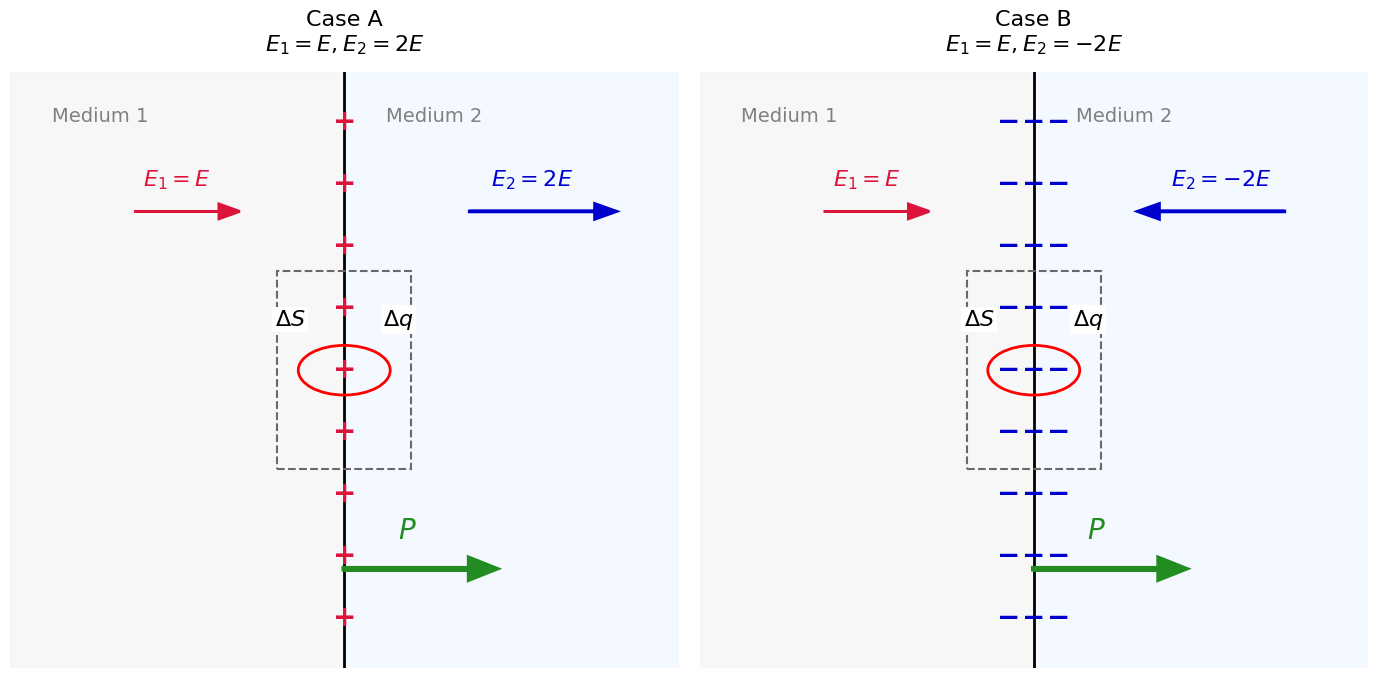
6.5.3. What are the surface charge density and the electrostatic pressure at the boundary between two fields with magnitudes $E$ and $2E$? What about $E$ and $-2E$? In the second case, the surface charge density is three times larger. Why then is the electrostatic pressure the same in both cases?
Solution
Let us write the boundary condition for the normal components of the electric displacement field: $$D_{2n} - D_{1n} = \sigma$$ where $\sigma$ is the free surface charge density at the boundary. Since $D = \varepsilon_0 E$, for the first case ($E_1 = E$,$E_2 = 2E$) we have: $$\sigma = \varepsilon_0 E_2 - \varepsilon_0 E_1 = \varepsilon_0 (2E) - \varepsilon_0 E = \varepsilon_0 E$$
To find the pressure, consider a thin cylindrical shell at the boundary of the two media. Let us isolate a small portion of the surface with charge $\Delta q = \sigma \Delta S$. Let the field generated by this specific portion be $E_0$, and the field generated by all other charges in the system (the external field) be $E_0'$. From the superposition principle, the total fields on either side of the boundary are: $$E_2 = E_0' + E_0 = 2E$$ $$E_1 = E_0' - E_0 = E$$ By adding these two equations, we can find the external field $E_0'$: $$2E_0' = 3E \implies E_0' = \frac{3}{2}E$$ The total force acting on this portion is: $$\Delta F = \sigma \Delta S E_0'$$ Thus, the electrostatic pressure at the interface is: $$P = \frac{\Delta F}{\Delta S} = \sigma E_0' = (\varepsilon_0 E)\left(\frac{3}{2}E\right) = \frac{3\varepsilon_0 E^2}{2}$$
Similarly, for the second case ($E_1 = E$,$E_2 = -2E$), we have: $$\sigma = \varepsilon_0 E_2 - \varepsilon_0 E_1 = \varepsilon_0 (-2E) - \varepsilon_0 E = -3\varepsilon_0 E$$ The external field in this case is: $$E_0' = \frac{E_1 + E_2}{2} = \frac{E - 2E}{2} = -\frac{1}{2}E$$ And the pressure is: $$P = \sigma E_0' = (-3\varepsilon_0 E)\left(-\frac{1}{2}E\right) = \frac{3\varepsilon_0 E^2}{2}$$
Why is the pressure the same? We can obtain a general formula for the pressure $P$ using analogous reasoning. By substituting $E_0' = \frac{E_1 + E_2}{2}$ and $\sigma = \varepsilon_0(E_2 - E_1)$: $$P = \sigma E_0' = \varepsilon_0(E_2 - E_1)\frac{E_1 + E_2}{2} = \frac{\varepsilon_0(E_2^2 - E_1^2)}{2}$$ From this final equation, we see that the electrostatic pressure depends on the squares of the electric fields. Therefore, changing the sign of $E_2$ leaves the pressure unchanged.
Answer
a) $\sigma = \varepsilon_0 E$;$P = \frac{3\varepsilon_0 E^2}{2}$
b) $\sigma = -3\varepsilon_0 E$;$P = \frac{3\varepsilon_0 E^2}{2}$