Edits to “Statement”, “Solution”, “Answer”

en/13.1.5.md
+4 −4
| @@ -1,15 +1,15 @@ | |||
| ### Statement | |||
| − | $13.1.5.$ [Insert the problem statement] | ||
| + | $13.1.5.$ Create an image of the object in a flat mirror. The image is inverted from right to left in relation to the subject. Why doesn't the mirror "flip" the image from top to bottom? | ||
| ### Solution | |||
| − | 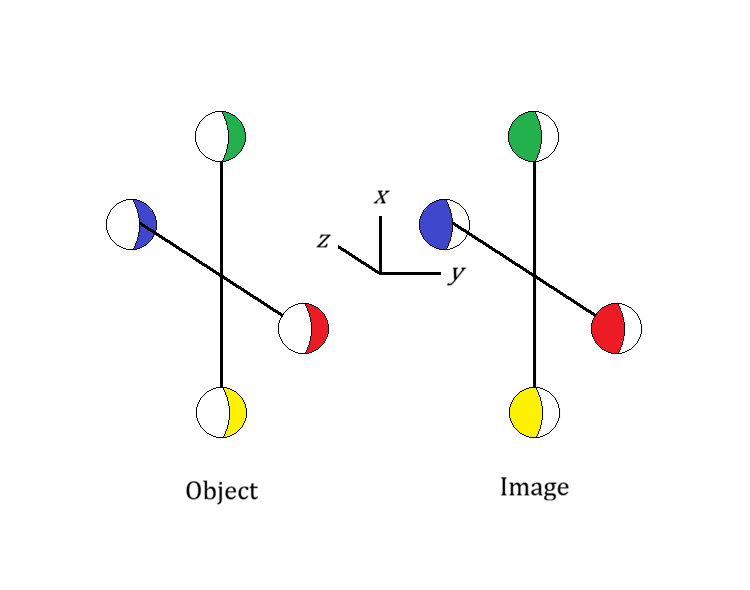 | ||
| Mirror image is front-back inverted, but we often say that it is left-right inverted because we fix the up-down direction and use it together with the front-back direction to define the left-right direction. More precisely, if we consider $\hat\imath$ as up and $\hat\jmath$ as front, then left is defined as $\hat\imath\times\hat\jmath=\hat k$. When mirror image is front-back inverted, left becomes $\hat\imath\times(-\hat\jmath)=-\hat k$, and we say that the image is left-right inverted. | |||
| − | Imagine what happens when we fix the left-right direction and use it together with the front-back direction to define the up-down direction. If we consider $\hat | ||
| + | Imagine what happens when we fix the left-right direction and use it together with the front-back direction to define the up-down direction. If we consider $\hat k$ as left and $\hat\jmath$ as front, then up is defined as $\hat\jmath\times\hat k=\hat\imath$. When mirror image is front-back inverted, up becomes $-\hat\jmath\times\hat k=-\hat\imath$, and we might as well say that the image is up-down inverted. | ||
| #### Answer | |||
| − | [Insert a concise answer or boxed result] | ||
| + | See the solution. | ||
| @@ -1,15 +1,15 @@ | |||
| ### Statement | ### Statement | ||
| $13.1.5.$ [Insert the problem statement] | $13.1.5.$ Create an image of the object in a flat mirror. The image is inverted from right to left in relation to the subject. Why doesn't the mirror "flip" the image from top to bottom? | ||
| ### Solution | ### Solution | ||
|  | ||
| Mirror image is front-back inverted, but we often say that it is left-right inverted because we fix the up-down direction and use it together with the front-back direction to define the left-right direction. More precisely, if we consider $\hat\imath$ as up and $\hat\jmath$ as front, then left is defined as $\hat\imath\times\hat\jmath=\hat k$. When mirror image is front-back inverted, left becomes $\hat\imath\times(-\hat\jmath)=-\hat k$, and we say that the image is left-right inverted. | Mirror image is front-back inverted, but we often say that it is left-right inverted because we fix the up-down direction and use it together with the front-back direction to define the left-right direction. More precisely, if we consider $\hat\imath$ as up and $\hat\jmath$ as front, then left is defined as $\hat\imath\times\hat\jmath=\hat k$. When mirror image is front-back inverted, left becomes $\hat\imath\times(-\hat\jmath)=-\hat k$, and we say that the image is left-right inverted. | ||
| Imagine what happens when we fix the left-right direction and use it together with the front-back direction to define the up-down direction. If we consider $\hat |
Imagine what happens when we fix the left-right direction and use it together with the front-back direction to define the up-down direction. If we consider $\hat k$ as left and $\hat\jmath$ as front, then up is defined as $\hat\jmath\times\hat k=\hat\imath$. When mirror image is front-back inverted, up becomes $-\hat\jmath\times\hat k=-\hat\imath$, and we might as well say that the image is up-down inverted. | ||
| #### Answer | #### Answer | ||
| [Insert a concise answer or boxed result] | See the solution. | ||